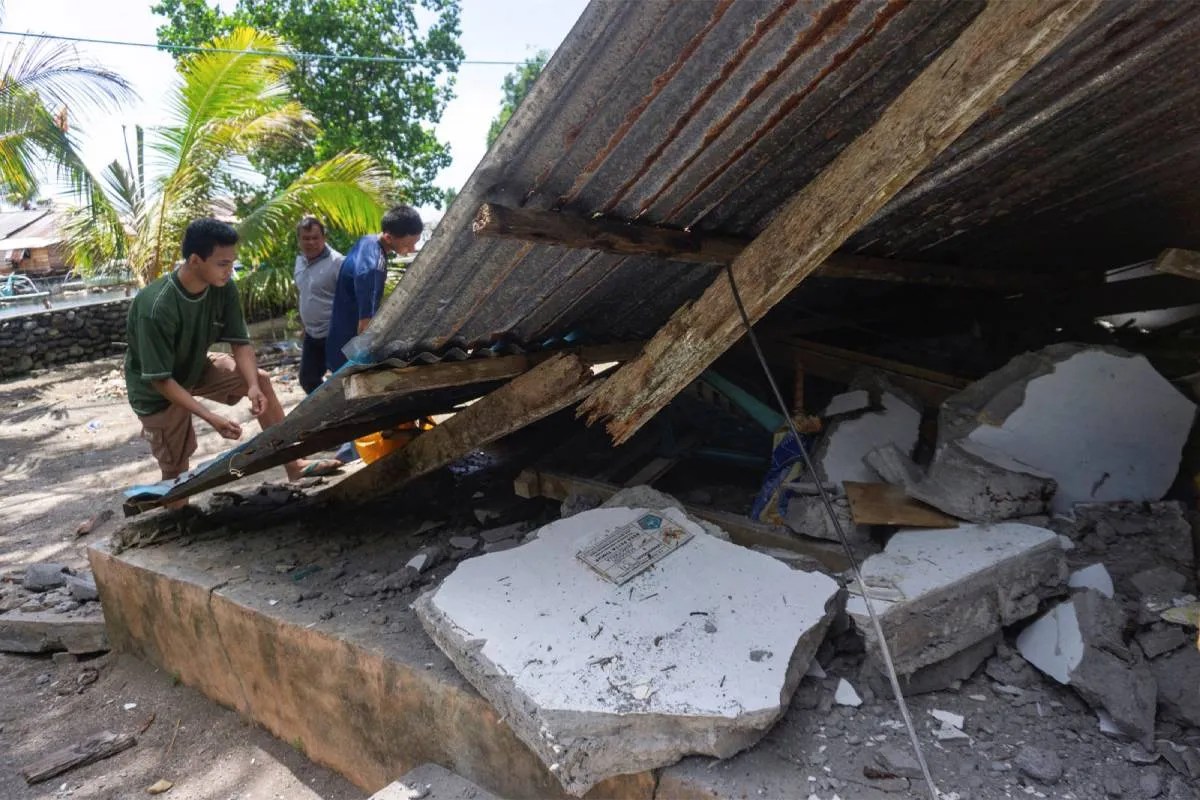
The Illusion of the Heroic Dash
Every time an earthquake strikes, the media rolls out the same dramatic footage. Schoolchildren sprinting out of a building as a roof cracks. Teachers guiding panicking crowds into the open air. The narrative is always framed around miraculous escapes and heroic survival instincts.
It is a lie.
Running during active ground shaking is not a survival strategy. It is a statistically proven gamble that increases your chances of injury or death. Yet, mainstream reporting continues to romanticize the mad dash, reinforcing a dangerous behavioral pattern that structural engineers and disaster scientists have spent decades trying to eradicate.
When the ground moves, our primal instinct screams at us to flee. Media coverage validates that instinct by celebrating the lucky few who made it out. They rarely focus on the ones who tripped, got crushed by falling facades, or were struck by flying debris the moment they stepped outside.
We need to stop praising the run. We need to start enforcing the reality of structural mechanics.
The Physics of a Collapse
To understand why running is a mistake, look at how modern buildings actually fail. Having spent years analyzing structural integrity post-disaster, I can tell you that engineering failures are rarely instantaneous, total collapses unless you are dealing with unreinforced masonry or severe code violations.
What actually kills people during the first thirty seconds of an earthquake? Non-structural components.
- Ceiling Tiles and Light Fixtures: These detach at low-frequency vibrations and strike occupants.
- Glass Curtains: Window panes flex, shatter, and rain down on the perimeter of the building.
- Parapets and Facades: The exterior skin of a building is often the first thing to slough off, turning the immediate outside perimeter into a kill zone.
When you run during a quake, you are attempting to navigate a shifting, unpredictable obstacle course while gravity itself is fluctuating horizontally.
$$\text{Lateral Force} = \text{Mass} \times \text{Acceleration}$$
As the ground accelerates, that lateral force acts on your body and everything around you. Your balance is compromised. The moment you stand up and run, you increase your surface area exposure to flying objects and guarantee a hard fall onto a moving floor.
The Perimeter Trap
The biggest misconception is that "outside" equals "safe."
If you are inside a modern engineered building, the interior core is often the stiffest, most secure part of the structure. The perimeter—the exact place you have to run through to escape—is the most volatile.
"More injuries occur during the attempt to leave the building than inside the structure itself."
This is a foundational axiom of seismology. When you run out the door, you are walking directly into a guillotine of falling glass, concrete trim, and severed utility lines.
Why Drop, Cover, and Hold On Is Boring, Unpopular, and Correct
The gold standard of earthquake survival is dull. It does not make for viral video content. It does not look heroic.
Drop, Cover, and Hold On.
- Drop to your hands and knees. This lowers your center of gravity, preventing you from being thrown to the ground violently, and keeps you small.
- Cover your head and neck under a sturdy piece of furniture. If no shelter is nearby, crawl next to an interior wall.
- Hold On to your shelter until the shaking stops.
[Earthquake Shaking Begins]
       │
       ├─► Instinct: Run Outside ──► Exposed to falling facade/glass (High Risk)
       │
       └─► Protocol: Drop & Cover ─► Shielded by furniture/interior core (Low Risk)
The data backs this up consistently. Studies of casualties in major seismic events show a clear correlation between movement during shaking and increased injury severity. You are safer under a desk in a building with a damaged roof than you are running through a collapsing doorway.
The counter-argument usually goes like this: "What if the whole building collapses? A desk won't save you from a pancaked concrete slab."
This is where we have to look at the math of probability. In regions with modern building codes—and even in developing nations with basic reinforced concrete standards—total structural collapse represents a tiny fraction of total earthquake damage. The vast majority of damage is cosmetic, non-structural, or partial.
If you base your survival strategy entirely on the 1% scenario (total collapse) by running, you guarantee you will be injured in the 99% scenario (falling debris). You are hedging against the wrong risk.
The Broken System of Disaster Education
Why does this lazy consensus persist? Because governments and media outlets prefer optics over actionable engineering realities.
It is easy to broadcast a drill where everyone walks out to a football field on a sunny day. It is much harder to retroactively fix weak first-story structures (soft-story buildings) or hold contractors accountable for using substandard rebar.
We have built a culture of reactive theater. We watch a video of schoolkids running from a collapsing roof, we sigh in relief that they made it, and we change nothing about how we teach disaster response.
The Cost of the Wrong Narrative
I have looked at the aftermath of urban seismic events where hundreds of millions of dollars were spent on emergency response, yet simple code enforcement was ignored. The financial and human cost of ignoring structural reality is staggering.
| Building Component | Risk Level During Shaking | Proper Action |
|---|---|---|
| Interior Core / Desks | Low | Stay put, shield head |
| Hallways / Stairwells | High | Avoid (stairwells can shear) |
| Exterior Exit Doors | Extreme | Do not approach until shaking stops |
Stairwells are particularly lethal. They are designed as independent structural elements to allow for movement, meaning they can drift at different rates than the main floors. Running into a stairwell during active shaking is diving into a structural bottleneck that is actively shearing.
Dismantling the Triangle of Life Myth
You cannot discuss earthquake survival without addressing the "Triangle of Life" theory. This viral piece of misinformation claims you should lay down next to large objects rather than under them, under the assumption that a collapsing ceiling will create a void space next to the object.
It is a pseudo-scientific theory based on observations of unreinforced masonry structures in countries with zero building codes, and it has been thoroughly debunked by global rescue organizations.
Objects shift. Safes, refrigerators, and heavy desks slide horizontally during a quake. If you are lying next to one, you run the risk of being crushed by the very object you thought would protect you. The space underneath a sturdy desk remains your highest statistical probability of survival because it acts as a shield against the most common threat: low-mass, high-velocity falling objects.
Stop Waiting For the Miracle
We have to strip the emotion out of disaster reporting. The survival of those children in the Philippines was a triumph of luck, not a validation of strategy.
If we keep teaching children and citizens that survival means winning a footrace against gravity, we will continue to count bodies that should have walked away with minor bruises.
Stop looking for the exit sign the moment the ground trembles. Look for the nearest heavy table. Get under it. Hold on. Let the building do the flexing it was engineered to do. Your legs cannot outrun a seismic wave moving at miles per second, and your skull cannot break a falling concrete tile. Drop.