The air in the Jordan Valley usually tastes of salt and ancient dust. On a Tuesday night in early October, that familiar scent was replaced by the sharp, metallic tang of ozone and the low, rhythmic thrum of something heavy tearing through the atmosphere. It is a sound that doesn't belong to nature. It is the sound of physics being weaponized.
Jericho is the oldest city in the world. Its stone foundations have survived empires, earthquakes, and sieges. But it was never designed for the ballistic trajectory of a medium-range missile launched from fifteen hundred miles away. When the sirens began their mechanical wail, the sound didn't just warn of danger; it vibrated through the floorboards of modest homes, rattling teacups and waking children who have grown far too accustomed to the music of war.
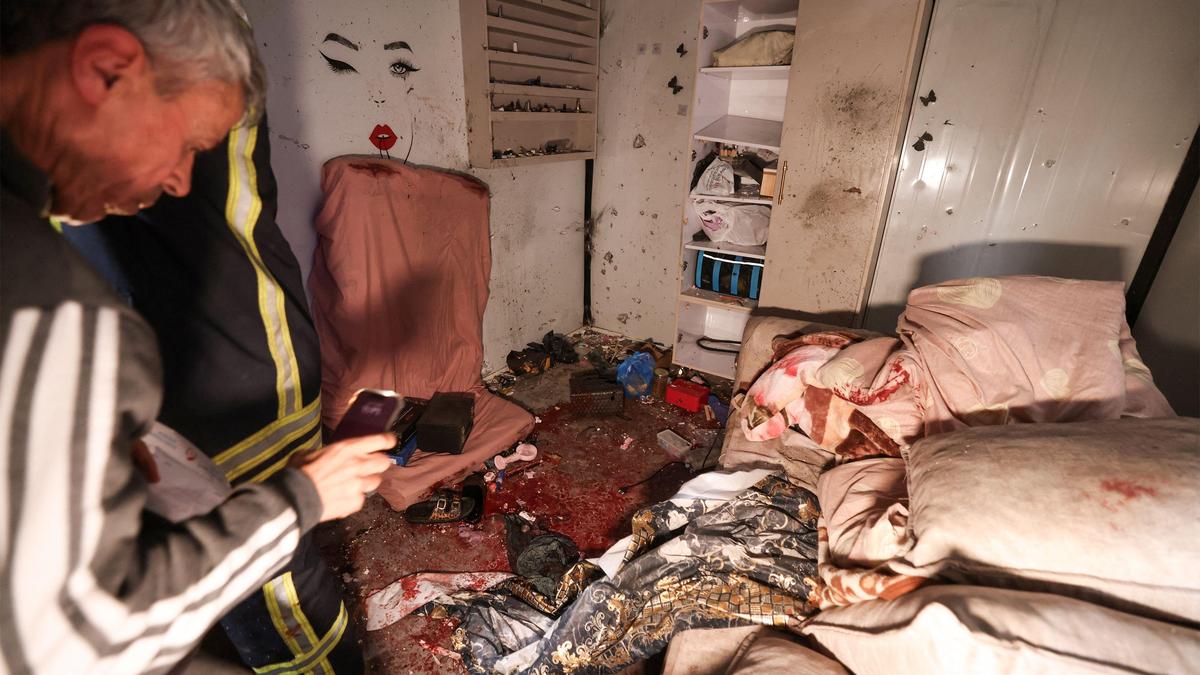
History is often written in the broad strokes of geopolitics—treaties signed in gold ink, maps redrawn by generals, and the fiery rhetoric of distant capitals. Yet, the true weight of a missile isn't measured in kilotons or range. It is measured in the sudden, permanent silence of a living room. It is measured in the three lives extinguished in an instant when the iron debris of a global power struggle fell from the clouds and landed on a home in the West Bank.
The Red Crescent workers didn't find soldiers in the rubble. They found three women.
The Mathematics of Collateral Damage
To the engineers in Tehran, the flight path was a success. To the defense analysts in Tel Aviv, the interception rate was a statistic to be touted. But for the families in the West Bank, the technical prowess of military hardware is a cruel abstraction.
When an interceptor meets a ballistic missile at three times the speed of sound, the result isn't a clean disappearance. It is a violent disintegration. The sky becomes a lottery of jagged steel. In this instance, the "success" of a missile defense system meant that the warhead did not reach its primary target, but the kinetic energy had to go somewhere. It went into the roof of a house. It went into the lives of three people who were simply trying to survive the night.
Imagine the domesticity of that final moment. Perhaps they were drinking tea. Perhaps they were discussing the rising cost of flour or the wedding of a neighbor. These are the invisible stakes. We focus so intently on the "why" of the launch—the retaliation, the posturing, the regional dominance—that we ignore the "where" of the impact. The West Bank exists in a strange, purgatorial geography where the residents are often spectators to a conflict that kills them anyway.
The Geography of the Unprotected
There is a terrifying vulnerability in being caught between two warring giants. While residents in central Israel have access to sophisticated reinforced rooms and a multilayered defense umbrella, the infrastructure in Palestinian towns is a patchwork of hope and old concrete.
The Red Crescent ambulances arrived at the scene through narrow streets, their blue lights reflecting off the faces of neighbors who stood in stunned silence. There is a specific kind of shock that comes when the sky, usually a source of rain or starlight, becomes a source of sudden, indiscriminate execution. These women weren't participants in the "Great Game." They were the unintended variables in a lethal equation.
Consider the logistics of grief in a conflict zone. You cannot simply mourn. You must first navigate the wreckage, wait for the clearance of unexploded ordnance, and then try to explain to a grieving father or son why a missile intended for a military base ended up in his kitchen. The explanation always rings hollow. "Technical malfunction." "Debris scatter." "Collateral damage."
Words are weak shields against shrapnel.
The Sound of an Empty Room
War is loud, but its aftermath is a deafening quiet. After the sirens stop and the dust settles, there is a moment where the world feels brittle. In the house in the West Bank, the silence is now permanent.
We are told that these events are the price of security, or the inevitable outcome of resistance, depending on which side of the border holds the microphone. But if you stand in the ruins of a home in Jericho, those arguments lose their luster. The sophisticated sensors, the satellite tracking, and the billions of dollars spent on "smart" weaponry seem remarkably stupid when they result in the death of three civilians who were miles away from any frontline.
The tragedy of the three Palestinian women killed by the Iranian barrage isn't just a news cycle blip. It is a testament to the fact that in modern warfare, there is no such thing as a "targeted" strike that doesn't bleed into the lives of the innocent. The fragments of that missile didn't care about the political affiliations of the people they hit. They didn't care about the history of the land or the complexities of the peace process. They were simply heavy objects obeying the laws of gravity and the whims of a distant commander.
The world watched the glowing streaks across the night sky like they were fireworks. We saw the videos on social media, the bright arcs of light and the thud of explosions in the distance. It looked like a movie. It looked like a video game.
Until the cameras moved closer. Until the Red Crescent began pulling bodies from the dust.
The salt in the air in Jericho remains, but today it is joined by the scent of fresh turned earth and the heavy, lingering presence of what was lost. The oldest city in the world has one more layer of tragedy buried in its soil. It is a layer made of twisted metal and broken dreams, a reminder that when the giants of the earth clash, it is the earth itself—and the people who walk upon it—that bears the scars.
Somewhere in the West Bank, a door is swinging on a broken hinge, clicking against the frame in the wind. The house is empty. The tea has gone cold. The sky is clear again, indifferent and vast, hiding the next storm behind a mask of stars.