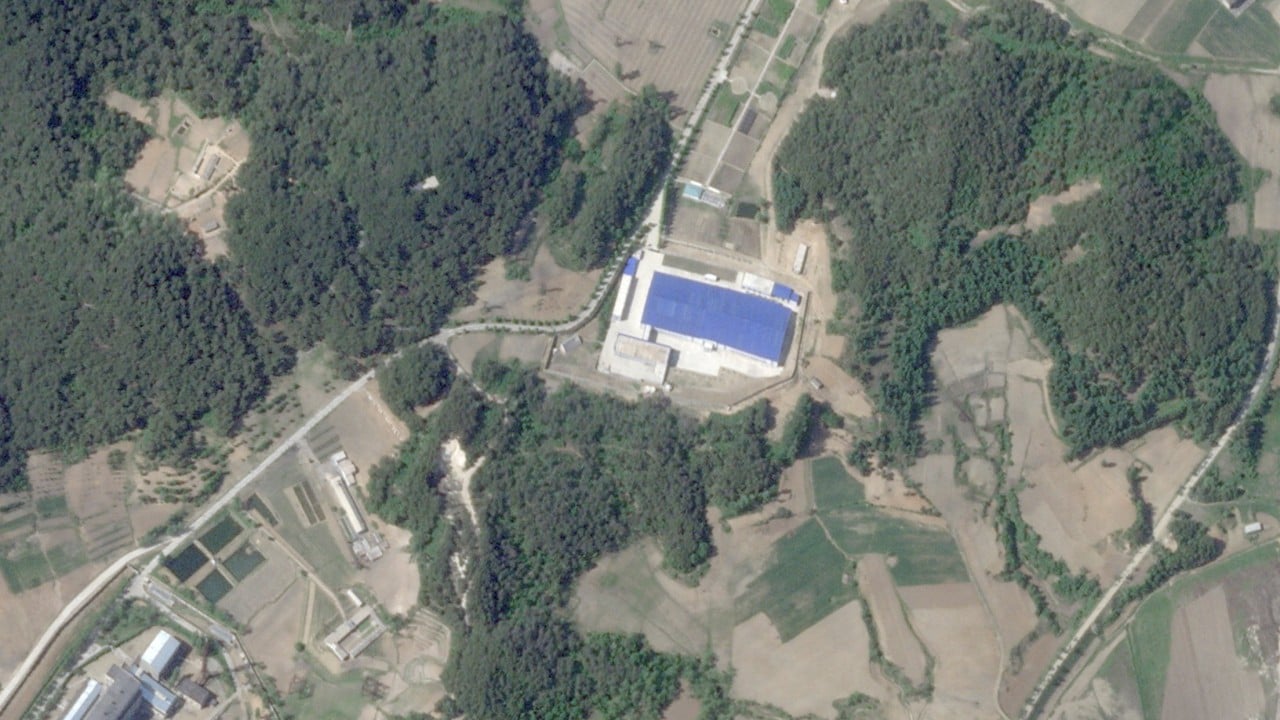
The roof is on. According to assessments from the International Atomic Energy Agency (IAEA), the major extension to North Korea’s primary uranium enrichment facility at Yongbyon is now externally complete. For non-proliferation analysts and intelligence officers tracking the Korean Peninsula, that single phrase carries an unmistakable weight. When the concrete cures and the roof panels lock into place, satellite cameras go blind to what happens next. Pyongyang has effectively closed the curtain on its physical construction phase, signaling that the internal installation of gas centrifuges—the precision machines required to spin raw uranium into weapons-grade fissile material—is either underway or imminent.
Most mainstream coverage treats these IAEA updates as routine diplomatic weather reports. Another building goes up, another statement gets issued in Vienna, and the news cycle moves on. That is a dangerous misreading of the situation. Completing the outer shell of an enrichment annex is not a symbolic gesture meant to rattle sabers before a diplomatic summit. It is an industrial milestone. It represents a permanent, structural expansion of North Korea’s capacity to mass-produce nuclear warheads, shifting the strategic balance in Northeast Asia in ways that sanctions and diplomatic isolation have failed to stop.
The Blind Spot Behind the Concrete
Satellite imagery is an extraordinary intelligence tool, right up until the moment a roof is finished. Over the past several years, commercial satellite providers and national intelligence agencies watched the Yongbyon Nuclear Scientific Research Center expand methodically. Analysts tracked the grading of soil, the pouring of foundations, the erection of structural walls, and the arrival of heavy cranes. Every phase of external construction offered a rough timeline of Pyongyang’s ambitions.
That visibility is now gone. Once a facility is externally complete, thermal imaging and optical satellites can only tell observers so much. Analysts can look for heat signatures from cooling towers, exhaust plumes, or the movement of trucks entering and exiting secure perimeters. What they cannot see is the floor layout inside. They cannot count the cascades—the interconnected rows of spinning cylinders that separate uranium-235 from the much more abundant uranium-238.
This distinction matters enormously. A building is just concrete and steel; centrifuges are the engine of a nuclear arsenal. Because the IAEA has had no inspectors on the ground in North Korea since they were expelled in 2009, the agency relies entirely on open-source intelligence, national technical means provided by member states, and historical baseline data. Saying a building is externally complete is intelligence-speak for admitting that our best window into the facility's true output has just slammed shut.
Why Uranium Is the Real Story
For decades, Western intelligence focused heavily on North Korea’s plutonium production. Plutonium comes from spent nuclear fuel reprocessed from a reactor, specifically the aging 5-megawatt reactor at Yongbyon. That process is messy, loud, and easy to spot from space. You can see steam rising from the cooling system. You can detect chemical plumes during reprocessing. Plutonium production has a hard ceiling dictated by the size and operating hours of the reactor.
Highly enriched uranium (HEU) changes the rules entirely.
Unlike plutonium reactors, gas centrifuge facilities require relatively little electricity and generate a minimal thermal footprint. They can be housed in nondescript industrial buildings, tucked into valleys, or buried deep underground. More importantly, uranium enrichment is modular. If North Korea wants more plutonium, it has to build a whole new reactor—a massive, multi-year engineering project visible from orbit. If it wants more enriched uranium, it simply manufactures more centrifuges and hooks them up inside an existing building.
Consider a hypothetical example to understand the scale. Imagine a traditional bakery with one massive brick oven; everyone on the block knows when the fire is lit, and the baker can only produce a set number of loaves per day. Now imagine that same baker quietly sets up rows of compact, electric bread machines inside a windowless warehouse next door. You cannot smell the smoke, you cannot see the heat, and every month the baker adds ten more machines to the floor. That warehouse is the Yongbyon extension.
By expanding its physical footprint at Yongbyon, Pyongyang is signaling a commitment to industrial-scale HEU production. Tactical nuclear weapons—smaller warheads designed for short-range artillery, cruise missiles, and battlefield delivery—require substantial amounts of fissile material. Kim Jong Un has explicitly ordered an "exponential increase" in the country's nuclear arsenal. You do not achieve exponential growth with a single 1980s-era plutonium reactor. You achieve it with thousands of centrifuges spinning around the clock.
The Supply Chain Paradox
A critical question rarely asked in brief news dispatches is how an impoverished, heavily sanctioned state manages to build and equip sophisticated nuclear facilities. The answer exposes the limits of modern economic containment.
Gas centrifuges are marvels of precision engineering. They spin at supersonic speeds—often exceeding 50,000 to 70,000 revolutions per minute—to exploit the tiny mass difference between uranium isotopes. If a rotor is off by a fraction of a millimeter, the machine tears itself apart in seconds. Building them requires high-strength maraging steel or carbon fiber, specialized bearings, precision flow meters, and frequency converters.
In theory, international export controls ban the sale of every single one of those components to North Korea. In practice, North Korea has spent forty years perfecting illicit procurement networks. Over the past decade, however, something fundamental shifted. Pyongyang stopped relying solely on smuggled foreign parts and mastered domestic manufacturing.
North Korean engineers have reverse-engineered foreign designs, utilizing computer numerical control (CNC) machine tools acquired years ago through front companies in China and Southeast Asia. They produce their own rotors, casings, and vacuum pumps. While they still rely on smuggling networks for certain high-end electronics and specialty alloys, the core bottleneck of foreign dependency has largely been broken. The external completion of the Yongbyon annex proves that Pyongyang is confident it has the domestic hardware ready to fill the space. If they did not have the centrifuges in hand or on the assembly line, they would not have rushed to seal the roof.
Beyond Yongbyon The Shadow Network
Focusing exclusively on Yongbyon carries a major analytical trap. It encourages the illusion that Yongbyon is the entirety of North Korea’s nuclear program. It is not.
Intelligence assessments from the United States, South Korea, and independent think tanks have long pointed to the existence of covert, undeclared enrichment sites scattered across the country. The most widely suspected facility is Kangson, located near Pyongyang. Discovered through commercial satellite analysis and intelligence leaks several years ago, Kangson exhibits the exact security perimeters, electrical infrastructure, and industrial layout associated with a centrifuge plant—yet North Korea has never acknowledged its existence.
Why build openly at Yongbyon if you already have secret underground facilities?
The answer lies in both logistics and signaling. Yongbyon is the heart of the North Korean nuclear complex. It has the established rail links, the dedicated power grids, the waste management infrastructure, and the concentration of veteran scientists and technicians. Consolidating expansion at Yongbyon maximizes efficiency. At the same time, building in plain sight under the gaze of commercial satellites serves a strategic purpose. Pyongyang wants Washington and Seoul to see the expansion. It is a visual message that North Korea’s nuclear status is irreversible, raising the baseline price for any future diplomatic engagement.
Meanwhile, the undeclared sites serve as an insurance policy. Even if a future diplomatic deal—however unlikely that looks right now—included the dismantlement of Yongbyon, North Korea would retain a hidden, functioning enrichment capability at Kangson and potentially other unknown locations. The externally complete building at Yongbyon is the visible tip of an iceberg whose submerged mass remains largely unmapped.
The Geopolitical Tailwinds
North Korea’s rapid progress at Yongbyon does not happen in a vacuum. It is unfolding against the backdrop of the most favorable geopolitical environment Pyongyang has enjoyed since the end of the Cold War.
For years, the United Nations Security Council functioned as a flawed but functional brake on North Korean proliferation. Following nuclear tests in 2016 and 2017, both China and Russia voted in favor of crippling economic sanctions designed to starve the regime of hard currency and industrial imports. That consensus is dead.
Russia’s invasion of Ukraine and its subsequent desperation for artillery shells and ballistic missiles forced Moscow into a transactional alliance with Pyongyang. In exchange for millions of rounds of ammunition and tactical missiles, Russia has effectively dismantled the UN monitoring regime. In March 2024, Moscow vetoed the annual renewal of the UN Panel of Experts, the independent body responsible for tracking sanctions violations and investigating North Korea’s illicit procurement networks. Beijing abstained, tacitly endorsing the dismantling of oversight.
This diplomatic cover has profound practical consequences for facilities like the Yongbyon extension. With the UN watchdog blinded and Moscow actively cultivating ties with Kim Jong Un, the enforcement of export controls has eroded. Financial networks that once faced relentless scrutiny now operate with wider margins for error. Furthermore, intelligence agencies remain deeply concerned about what technical knowledge Russia might be sharing with North Korean engineers in return for battlefield munitions. Even minor Russian assistance with metallurgy, vacuum technology, or cascade stabilization could dramatically accelerate the efficiency of the new Yongbyon centrifuges.
The Limits of Deterrence and Diplomacy
The physical completion of this annex exposes a stark reality for policymakers in Washington, Seoul, and Tokyo. The strategy of "strategic patience" combined with maximum economic pressure has failed to cap North Korea's fissile material production.
Sanctions did not stop the concrete from being poured. Cyber operations and sabotage efforts—which reportedly plagued Pyongyang's missile tests in the mid-2010s—have not halted the steady expansion of its nuclear infrastructure. Military options remain non-starters; any preemptive strike on Yongbyon would trigger a catastrophic artillery and missile retaliation against Seoul, a metropolitan area of 25 million people sitting just thirty-five miles from the Demilitarized Zone.
This leaves Western allies trapped in a narrowing corridor of bad choices. Continuing the current approach of isolation and periodic military drills simply allows North Korea to run out the clock, adding dozens of warheads to its inventory every year. Yet returning to the negotiating table requires confronting a painful truth: North Korea is no longer negotiating over whether it will give up its nuclear weapons. At best, future talks would revolve around arms control—freezing production at Yongbyon in exchange for sanctions relief, a framework that implicitly accepts North Korea as a de facto nuclear-armed state.
Even an arms control deal faces massive verification hurdles. Because uranium enrichment facilities are so easy to hide and replicate, verifying a freeze requires intrusive, anytime-anywhere inspections across the entire country. Given that Kim Jong Un walked away from the 2019 Hanoi summit rather than dismantle the entirety of the Yongbyon complex, the odds of him opening up covert sites like Kangson to international inspectors are virtually zero.
What Happens When the Machines Spin Up
The transition from external construction to internal commissioning takes months, not years. Technicians must install the heavy concrete mounting pads to dampen vibrations, lay down miles of specialized piping to feed uranium hexafluoride gas through the cascades, wire the complex electrical control systems, and run exhaustive vacuum tests before a single gram of uranium enters the system.
Once those cascades begin spinning, the math on the Korean Peninsula changes permanently. Every kilogram of weapons-grade uranium produced inside that newly roofed building translates into smaller, lighter, and more numerous warheads capable of riding atop solid-fuel intercontinental ballistic missiles aimed at the U.S. mainland, or short-range tactical systems aimed at allied bases in South Korea and Japan.
The IAEA’s dry, technical observation that a roof has been finished at Yongbyon is not just another data point in a decades-old standoff. It is the closing of a chapter in which the world could at least watch North Korea build its nuclear capacity from the outside, and the beginning of an era where the true size of Pyongyang’s arsenal becomes an educated guess.