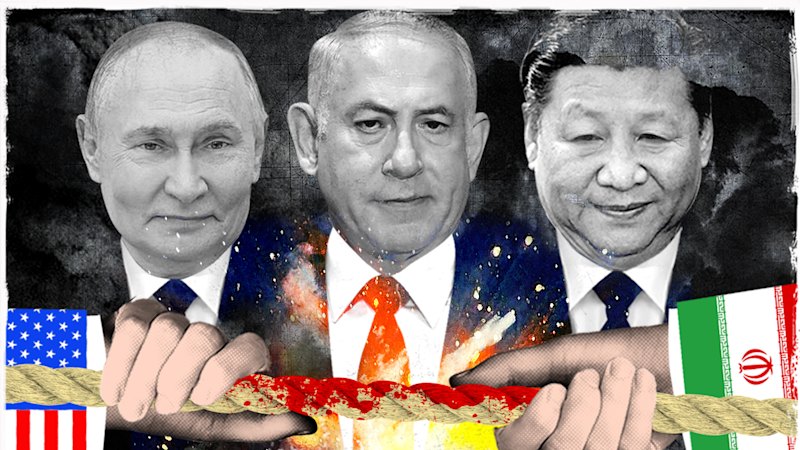
The current trajectory of American foreign and economic policy under the "America First" doctrine operates on a fundamental miscalculation of global interdependence, treating a complex, multi-nodal system as a zero-sum binary. While the stated objective is the restoration of domestic industrial primacy and the containment of adversarial growth, the actual mechanics of this strategy are precipitating a shift in the global equilibrium that favors decentralized power blocs over Washington’s historical hegemony. Winning, in a geopolitical context, is defined by the ability to set global standards, control the flow of strategic capital, and maintain a favorable security-to-cost ratio. By these metrics, the United States is currently absorbing the externalities of a transition it cannot fully govern.
The Triad of Hegemonic Erosion
To understand why the current posture is failing to produce a "win," one must analyze the three structural pillars that previously supported American dominance and how they are currently being liquidated:
- The Institutional Premium: The loss of influence within multilateral organizations.
- The Supply Chain Bottleneck: The inflationary cost of reshoring versus the agility of "China Plus One" strategies.
- The Reserve Currency Trap: The gradual weaponization of the dollar leading to accelerated de-dollarization among non-aligned powers.
1. The Institutional Premium and the Vacuum of Governance
For seventy years, the U.S. maintained dominance not just through military spend, but through the "Institutional Premium"—the ability to write the rules of global trade, intellectual property, and maritime law. By withdrawing from or paralyzing these institutions (such as the WTO’s appellate body or specific climate and trade accords), the U.S. creates a governance vacuum.
Nature and geopolitics both abhor a vacuum. When the U.S. retreats from a standard-setting role, it does not stop standards from being set; it merely hands the "pen" to regional competitors. The RCEP (Regional Comprehensive Economic Partnership) and the expansion of the BRICS+ framework are direct responses to this retreat. These entities are not just "talking shops"; they are developing alternative clearing systems and trade protocols that bypass American oversight. The result is a fragmented global market where U.S. companies must navigate multiple, often conflicting, regulatory environments, increasing the "Cost of Doing Business" (CoDB) and eroding profit margins that previously funded American R&D.
2. The Cost Function of Reshoring
The rhetoric of "bringing jobs back" ignores the reality of modern manufacturing's capital-to-labor ratios. Success in the 21st-century industrial sector is driven by automation, not high-density human labor. Therefore, reshoring does not restore the 1950s middle class; it necessitates massive state subsidies to offset the lack of local ecosystem density.
Consider the Industrial Ecosystem Density (IED). In regions like the Pearl River Delta, a manufacturer is surrounded by thousands of specialized suppliers within a 50-mile radius. Moving a factory to Ohio or Arizona requires the U.S. to build that entire ecosystem from scratch.
- Capital Expenditure (CapEx) Inefficiency: The U.S. government must provide billions in grants (e.g., the CHIPS Act) to make domestic production competitive with offshore alternatives.
- Operational Friction: The lack of a skilled vocational workforce and the presence of more stringent environmental and zoning regulations create a "Time-to-Market" lag.
- Input Inflation: Higher labor and energy costs in the domestic market act as a hidden tax on the American consumer, reducing disposable income and slowing the velocity of money.
The competitor's assertion that the U.S. is "losing" ignores the fact that the U.S. is actually paying to lose its competitive edge in exchange for a perceived, but fragile, security of supply.
3. The Weaponization of Finance and the Rise of "Neutral" Infrastructure
The most potent tool in the American arsenal is the U.S. Dollar. However, the aggressive use of sanctions and the freezing of sovereign assets have changed the risk assessment for central banks worldwide. This is the Trust-Security Paradox: The more the U.S. uses the dollar as a weapon of war, the less attractive it becomes as a store of value for any nation that might one day find itself at odds with Washington.
We are seeing a shift toward "Neutral Infrastructure." This includes:
- mBridge: A multi-CBDC (Central Bank Digital Currency) platform that allows for cross-border payments without touching the SWIFT system or the dollar.
- Bilateral Currency Swaps: Increasing use of the Yuan, Dirham, and Euro for energy settlements.
- Gold Accumulation: Central banks, particularly in the Global South, have increased gold reserves to a multi-decade high, seeking an asset with zero counterparty risk.
The Real Winner: The Rise of the Arbitrageurs
If the U.S. is incurring the costs of decoupling and China is facing the headwinds of restricted market access, the "winners" are not found in the headlines. They are the Geopolitical Arbitrageurs—middle-power nations that are positioning themselves as the indispensable "middlemen" of the new era.
The Vietnam-Mexico-India Corridor
These nations are executing a "dual-track" strategy. They maintain security ties with the U.S. while deepening economic integration with China.
- Vietnam: Acts as a "finishing school" for Chinese components. Goods are manufactured in China, sent to Vietnam for final assembly, and exported to the U.S. under "Made in Vietnam" labels to bypass tariffs.
- Mexico: Since the implementation of the USMCA, Mexico has become a backdoor for Chinese automotive and electronics firms to enter the North American market, leveraging the proximity to the U.S. consumer without the geopolitical baggage.
- India: Positioning itself as the "Democratic Alternative," India leverages its massive scale to extract concessions from both sides, securing energy from Russia, technology from the U.S., and infrastructure investment from global capital markets.
These nations win by remaining non-aligned. They avoid the costs of the conflict while reaping the benefits of the redirection of capital.
The Silicon Iron Curtain: A Misunderstood Front
The tech war—specifically regarding sub-7nm semiconductors and AI—is often cited as the primary theater where the U.S. is "winning." However, this analysis fails to account for Innovation Diversification.
Strict export controls on NVIDIA chips or lithography machines (EUV/DUV) have created a massive incentive for China to achieve self-sufficiency. History shows that while export controls work in the short term, they function as a subsidy for domestic innovation in the long term. By cutting off the "easy" supply of American tech, the U.S. has forced its primary competitor to accelerate its own R&D cycle.
The risk is the creation of a "Silicon Iron Curtain," where two incompatible tech ecosystems emerge. If the Chinese ecosystem becomes the standard for the Global South (due to lower price points and "no-strings-attached" financing), the U.S. will find itself locked out of the fastest-growing markets of the next thirty years. The "win" in high-end chips becomes a "loss" in global market share.
Quantifying the Strategic Deficit
To evaluate the success of the current administration’s policies, we must look at the Net Strategic Position (NSP).
$$NSP = (Economic Output + Alliance Cohesion) - (Geopolitical Overstretch + Debt Service)$$
- Economic Output: While GDP growth remains steady, the quality of that growth is increasingly reliant on deficit spending and "bubble" sectors like high-finance and tech-monopolies, rather than a broad-based industrial revival.
- Alliance Cohesion: Friction with European and Asian allies over protectionist measures (like the Inflation Reduction Act) is straining the "Force Multiplier" effect of the American alliance system.
- Geopolitical Overstretch: Simultaneous commitments in Eastern Europe, the Middle East, and the Indo-Pacific are stretching the U.S. military-industrial base to its breaking point.
- Debt Service: With the national debt exceeding $34 trillion, the cost of servicing that debt is now rivaling the defense budget. This limits the "Fiscal Space" available for future strategic pivots.
The U.S. is currently operating in a strategic deficit. The expenditures (political, economic, and military) required to maintain the status quo are exceeding the returns generated by the international order.
The Logical Fallacy of "Winning" via Isolation
The fundamental flaw in the "America First" logic is the belief that the U.S. can remain an island of prosperity in a sea of managed chaos. In a globalized economy, isolation is not a shield; it is a self-imposed embargo on growth.
The U.S. is not currently "winning" because it is focused on the wrong metrics. It is measuring success by the number of factories announced and the height of the stock market, while ignoring the underlying erosion of its structural power. True winning would involve:
- Aggressive Re-engagement: Not in the old neoliberal model, but in a new "Partnership Model" where the U.S. provides the high-tech and security "operating system" for the world.
- Selective Decoupling: Focusing only on truly critical technologies while maintaining broad trade to ensure the dollar remains the world's most useful tool.
- Internal Reform: Addressing the primary bottleneck of American power—the domestic regulatory and political paralysis that makes large-scale infrastructure and education reform impossible.
The immediate strategic play for any organization or state navigating this environment is to diversify away from binary dependencies. Stop betting on a "return to normal" or a total "American victory." Instead, optimize for a Multipolar Hedge. This involves securing supply chains through the "Arbitrageur" nations mentioned earlier, investing in "platform-agnostic" technology, and maintaining high liquidity to pivot as the institutional premium of the U.S. continues its downward adjustment. The era of the single superpower is being replaced by an era of the "Agile Middle," and those who fail to calibrate their strategy to this new density will find themselves paying the price for a war that has no clear victory condition.
Would you like me to develop a detailed risk-assessment framework for evaluating the specific "Arbitrageur" nations (Vietnam, Mexico, India) to determine which is best suited for your specific industry vertical?