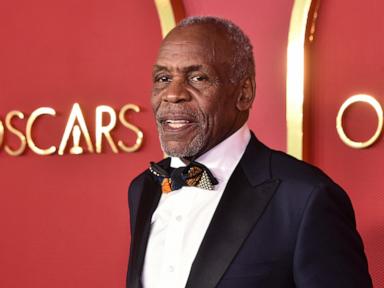
The room is always loudest right before the cameras turn on. Technicians shuffle feet, cables snake across tape-marked floors, and the low hum of studio lighting vibrates in the air. For decades, Danny Glover stepped into that chaotic energy and instantly anchored it. He possessed a presence that didn't demand attention so much as it simply absorbed it. When he spoke, his voice carried the weight of the American South, the grit of San Francisco activism, and the deep, resonant authority of a man who had spent his life standing on the right side of history.
But the quietest moments are the ones that stick with you.
Imagine standing in a green room, watching a giant of cinema look down at his hands, searching for a name that was right there a second ago. It is a subtle glitch in the matrix of a brilliant mind. It isn't dramatic like a movie script. It is a slow, creeping realization that the map you have used to navigate your own soul for eighty years is suddenly missing a few streets.
When news broke that Danny Glover was facing Alzheimer’s disease, the public reaction followed a familiar script. Shock. Sadness. A flurry of social media posts flashing iconic stills from Lethal Weapon or The Color Purple. But reducing a life like Glover's to a tragic headline misses the entire point of the battle he is fighting. This isn't just a story about a celebrity getting sick. This is a story about memory itself, about what happens when a lifelong keeper of history must fight to hold onto his own.
The Weight of the Archive
To understand what Alzheimer's takes, you have to understand what Danny Glover accumulated over his eight decades. He was never just an actor who picked up a placard when it was trendy. Long before Hollywood called, he was a student activist at San Francisco State University, participating in the longest student strike in US history to demand a Black Studies department. He walked the lines with Cesar Chavez. He stood shoulder to shoulder with Nelson Mandela.
His mind was an archive of the civil rights movement.
When a person with that level of historical consciousness faces cognitive decline, the stakes shift. We aren't just talking about forgetting where the car keys are. We are talking about the fading of firsthand witnesses. Consider the terrifying vulnerability of knowing that the stories that shaped generations are locked inside a vault, and the key is slowly rusting away.
Neurologists often describe Alzheimer's using the analogy of a bookshelf. The top shelves hold the newest memories—what you had for breakfast, the name of the person you met last week, the appointment scheduled for Tuesday. As the disease progresses, it kicks the shelf from the top down. The newest memories tumble off first. The bottom shelves, containing the deeply rooted memories of childhood, early adulthood, and core emotional experiences, hold on the longest.
For Glover, those bottom shelves are heavy with the weight of revolution, art, and struggle. The tragedy of the disease is that it forces a man who spent his life looking forward, fighting for the future, to retreat entirely into the past just to stay anchored.
The Physiology of the Whisper
The human brain is a marvel of electrical impulses and chemical bridges. Billions of neurons talk to one another across tiny gaps, passing messages that allow us to recite Shakespeare, recognize our children, or remember the rhythm of a favorite song. In a healthy brain, these pathways are kept meticulously clean by a microscopic cleanup crew.
In an Alzheimer’s brain, that cleanup crew goes on strike.
Proteins called amyloid beta begin to clump together, forming sticky plaques between the neurons. Imagine trying to walk through a crowded room where everyone has suddenly stopped moving and locked arms. You can't get across. At the same time, inside the cells, another protein called tau twists into tangled knots, choking off the nutrient supply line. Starved of what they need, the neurons begin to wither. They die.
The brain physically shrinks.
It is a brutal, mechanical process that contrasts sharply with the poetry of human consciousness. When Glover began to notice the gaps, it wasn't a sudden plunge into darkness. It was a gradual dimming of the lights. A line of dialogue that took three tries to memorize instead of one. A momentary disorientation in a familiar city. The feeling of reaching into a drawer for a tool you use every day, only to find the drawer empty.
Yet, there is a profound dignity in how he chose to handle the diagnosis. In a culture obsessed with flawless youth and permanent vitality, acknowledging cognitive decline is considered a form of social suicide for a public figure. It is an admission of vulnerability that Hollywood rarely forgives. By speaking out, Glover did what he has always done: he turned his personal reality into a platform for advocacy.
The Invisible Epidemic
Glover’s diagnosis shines a harsh, unforgiving light on a statistic that our society routinely ignores. Alzheimer's does not discriminate, but the healthcare systems that treat it certainly do.
Black Americans are roughly twice as likely to develop Alzheimer's or other dementias than older white Americans. The reasons are a complex, tangled web of systemic inequities, higher rates of cardiovascular disease, and chronic stress caused by lifelong exposure to discrimination—a phenomenon researchers call "weathering."
Yet, despite being hit the hardest, Black patients are significantly less likely to receive an early diagnosis, less likely to be enrolled in clinical trials, and less likely to have access to advanced care.
When Glover stepped forward, he wasn't just asking for sympathy for himself. He was pulling back the curtain on a silent crisis tearing through communities of color. He became, once again, an activist. He lent his fading voice to amplify a scream that millions of families are letting out in empty rooms across the country.
Consider what happens next for an ordinary family dealing with this reality. They don't have the resources of a Hollywood star. They don't have private care or specialized clinics. They have a daughter skipping work to make sure her father doesn't leave the stove on. They have a husband watching his wife of fifty years look at him with polite, terrified stranger's eyes. The financial cost is staggering; the emotional cost is absolute.
The Art of Holding On
There is no cure for Alzheimer's. Not yet. The latest medications offer modest victories—slowing the progression by a matter of months, clearing some of the plaque but leaving the underlying damage untouched. It is a war of attrition fought with a ticking clock.
But humans are remarkably resilient creatures. When the brain’s traditional pathways are blocked, it searches for detours.
Music often becomes the ultimate back door. Neurologists have found that the parts of the brain that store musical memories are often the last to be touched by the disease. An individual who cannot remember their own name can sometimes sit at a piano and play a sonata beautifully, or sing every lyric of a song they haven't heard since 1965. The emotional resonance bypassed the damaged hardware.
For an actor like Glover, the detour is often found in the muscle memory of performance and the deep-seated instinct for human connection. The words might falter, but the intent remains crystal clear. The eyes still flash with the same fire that defined his roles from Places in the Heart to his work on the international stage.
We live in a world that evaluates people based on their utility—what they can produce, what they can remember, how fast they can deliver a return on investment. Alzheimer's strips away that superficial utility, leaving behind the raw, unvarnished essence of the human being.
Danny Glover is not defined by what he is losing. He is defined by what he refuses to give up.
The true legacy of his final act isn't found in the tragedy of a fading mind, but in the stubborn survival of his spirit. Long after the specific dates, names, and awards fade from his memory, the baseline of who he is remains untouched. He is a man who cared deeply about the world. He is a man who used his body, his privilege, and his voice to lift up others. That kind of moral clarity doesn't just disappear when the neurons fail. It leaves an indelible print on the soul.
The cameras may eventually stop rolling, and the studio lights will dim. But in the quiet that follows, the echo of his life's work still rings out, clear, loud, and utterly unrepeatable.