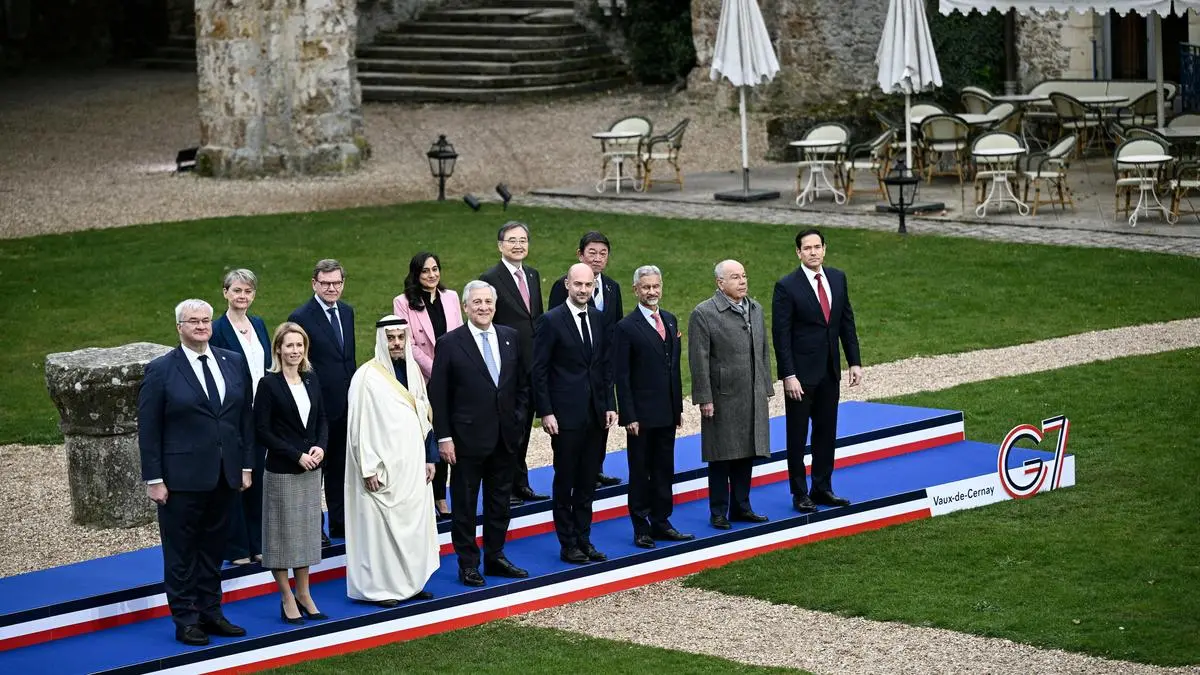
The foreign policy establishment is currently obsessed with a mirage. When External Affairs Minister S. Jaishankar sits down with Ukraine’s Foreign Minister in Paris to discuss West Asia, the media treat it as a masterclass in "multi-alignment." They paint a picture of India as the world’s indispensable bridge-builder, a nation that can simultaneously hold hands with Moscow, Kiev, Washington, and Tehran without breaking a sweat.
It is a comforting narrative. It is also completely wrong.
What we are witnessing isn't the rise of a new global mediator. We are seeing the desperate, high-stakes hedging of a mid-tier power trying to survive a fragmenting world order. To call this "strategic autonomy" is like calling a gambler’s diversified portfolio "market leadership." India isn't leading the conversation; it is trying to ensure it doesn't get buried by it.
The Myth of the Great Mediator
The mainstream press loves the optics of these meetings. They see a handshake in France and assume India is moving the needle on the Russia-Ukraine conflict or cooling tempers in the Middle East. Let’s look at the cold reality. India’s influence on the kinetic outcome of the war in Ukraine is near zero. Its influence on the structural tensions between Israel and Iran is even lower.
India talks to Ukraine not because it has a peace plan, but because it has a branding problem. After decades of relying on Soviet and Russian hardware, New Delhi is terrified of being permanently lumped into an "axis of revisionism" alongside Russia and China. Every photo op with a Ukrainian official is a calculated deposit into the "we are still a democracy" bank, intended to keep Western technology transfers flowing.
If you look at the trade data, the "autonomy" looks a lot more like dependency. India’s imports of Russian crude didn't surge because of some deep ideological bond; they surged because the price was right. When the West complains, New Delhi points to its meetings with Ukraine as proof of "balance." It is a PR maneuver, not a geopolitical strategy.
West Asia is Not a Side Quest
The reports suggest Jaishankar and his Ukrainian counterpart "discussed West Asia." This is the ultimate red herring. Ukraine has no equity in the Middle East. India, however, has everything at stake.
From the IMEC (India-Middle East-Europe Economic Corridor) to the millions of Indian expats sending remittances from the Gulf, India’s economic heart beats in the Middle East. When New Delhi discusses this region with European or Ukrainian peers, it isn't looking for a partner. It is looking for insurance.
The "lazy consensus" suggests that India can remain neutral in the Middle East just as it has in Eastern Europe. This is a massive miscalculation. In Eastern Europe, India is a distant observer. In West Asia, India is a primary stakeholder. The destabilization of the Red Sea shipping lanes—specifically by Houthi rebels using Iranian-supplied tech—directly hits the Indian bottom line.
You cannot be "autonomous" when your energy security and maritime trade are at the mercy of non-state actors and regional hegemons. India isn't mediating; it is frantically trying to keep the shipping lanes open while pretending it isn't picking a side.
The Cost of Staying in the Middle
I’ve watched diplomats waste years trying to maintain "perfect balance." It works during times of peace. It fails miserably during a systemic shift.
The global system is no longer a single "landscape." It is a series of hard-edged blocs. By trying to be everything to everyone, India risks becoming nothing to anyone.
- To the West: India is a frustrated partner that won't commit to the "rules-based order."
- To Russia: India is a customer that is slowly looking for a new supplier.
- To the Global South: India is a giant that talks about representation but acts in its own narrow interest.
Real expertise in international relations requires admitting the downside: hedging is expensive. Every time Jaishankar defends India’s right to buy Russian oil while shaking hands with a Ukrainian, he burns a little more diplomatic capital in Washington. Every time he leans into the Quad to counter China, he loses a bit of leverage in the Kremlin.
The "nuance" the media misses is that this isn't a position of strength. It is a position of extreme vulnerability.
The False Premise of "Strategic Autonomy"
Let’s define our terms. Strategic autonomy originally meant the ability to make decisions without being pressured by external powers. In 2026, that is a fantasy.
If the U.S. decides to tighten secondary sanctions on Russian financial entities, India’s "autonomy" vanishes in a single banking cycle. If China decides to escalate on the Line of Actual Control (LAC), India’s "autonomy" will involve a very quick phone call to the Pentagon for intelligence and cold-weather gear.
The people asking "How is India balancing these relationships?" are asking the wrong question. The real question is: "At what point does the cost of neutrality exceed the benefit of the cheap oil?"
The Brutal Reality of Regional Dynamics
Stop looking at these meetings as "peace talks." Look at them as supply chain management.
- Defense Diversification: India is desperately trying to wean itself off the S-400/Sukhoi nipple. Ukraine, ironically, was a key supplier for gas turbine engines for Indian Navy frigates.
- Food Security: The Black Sea Grain Initiative matters more to New Delhi than the borders of the Donbas.
- Technology Access: To build a semi-conductor industry, India needs the U.S., France, and Israel. It doesn't need Russia or Ukraine.
The meeting in France was about securing India's place in the Western tech ecosystem while trying to ensure the war in Ukraine doesn't further spike global commodity prices. It’s not about "West Asia" in a vacuum; it’s about preventing a total collapse of the global trade routes that India’s GDP growth depends on.
Stop Falling for the Press Release
Whenever you see a headline about "broad-based discussions" or "mutual concerns," translate it. It usually means: "We disagree on the fundamentals but we both need something from the French."
France is the ideal venue for this because Paris itself loves to play the role of the "third way" power. But just like India, France is ultimately tethered to a larger alliance.
If you want to actually understand where this is going, stop reading the communiqués. Watch the shipping insurance rates in the Persian Gulf. Watch the percentage of French components in the next batch of Indian fighter jets. Watch the spread between Ural crude and Brent. That is where the real foreign policy is being written.
The era of the "unaligned" giant is over. You are either part of the infrastructure or you are the road. India is currently trying to be both, and the cracks are starting to show.
Forget the "bridge-builder" nonsense. India is a vault-hunter in a collapsing ruin, trying to grab as much as it can before the roof comes down. It’s not pretty, it’s not "balanced," but it is the only move they have left.
Pick a side or get crushed in the middle. The clock is ticking.