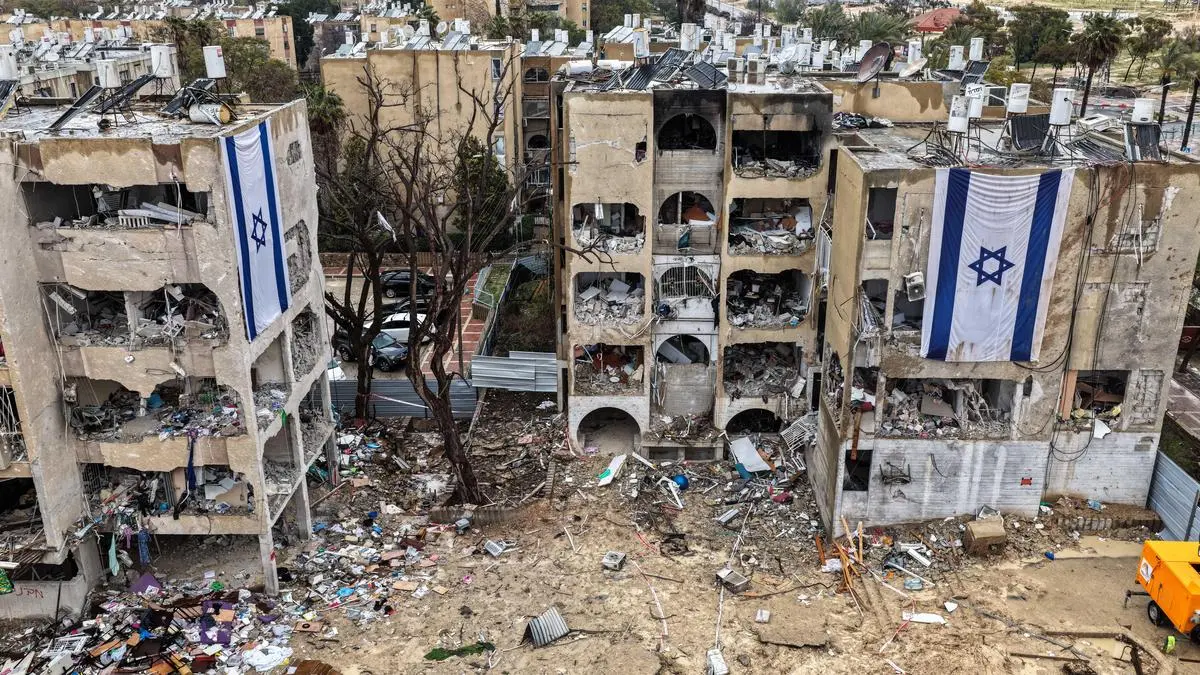
The latest volley of Israeli airstrikes against Iranian military infrastructure has stripped away the final remains of the "shadow war" that defined the region for decades. We are no longer watching a series of tactical skirmishes. This is a fundamental shift in the mechanics of regional power where the traditional brakes on escalation—diplomatic backchannels, international pressure, and the fear of total war—have effectively failed. While the international community calls for restraint, the technical reality on the ground suggests that both Jerusalem and Tehran have moved past the point of no return.
These strikes targeted sophisticated air defense batteries and missile production facilities, aiming to tilt the balance of power before the next inevitable exchange. However, the strategic math remains broken. Israel cannot bomb Iran into a change of government, and Iran cannot use its proxy network to force an Israeli retreat. The result is a kinetic deadlock. It is a cycle of violence that persists not because it is effective, but because neither side can afford the perceived weakness of stopping.
The Failure of the Invisible Red Line
For years, the conflict operated under a set of unwritten rules. Iran used its regional partners to harass Israel, and Israel responded with targeted assassinations and cyber operations. Both sides stayed below the threshold of direct, state-on-state kinetic action. That era died in April 2024, and the current wave of strikes confirms its burial.
The primary driver here is the collapse of credible deterrence. In military theory, deterrence works when the cost of an action is so high that the opponent chooses a different path. Today, the costs are being paid, and the paths haven't changed. Israel’s security establishment has concluded that Iran’s nuclear and missile programs are existential threats that must be addressed through physical destruction, regardless of the diplomatic fallout. Tehran, meanwhile, views any sign of hesitation as an invitation for more strikes.
We are seeing a dangerous feedback loop. Each side believes that one more show of force will finally establish a new "status quo." Instead, each strike lowers the bar for what constitutes an acceptable level of violence.
The Technical Objective Behind the Fire
To understand why these strikes happened now, you have to look at the hardware. Israel’s Air Force focused on S-300 air defense systems and facilities manufacturing solid-propellant rockets. This wasn't a random selection of targets. By degrading Iran’s ability to defend its airspace and replenish its missile stockpiles, Israel is attempting to create a window of vulnerability.
If Iran cannot see incoming jets or replace the missiles it fires, its leverage disappears. Or so the theory goes. The reality is that Iran has spent forty years building a decentralized military-industrial complex. Much of it is buried deep within mountain ranges or hidden under urban centers. You can damage the capacity, but you cannot delete the capability.
The Diplomacy of the Void
While jets were in the air, the world’s diplomats were largely silent or ineffective. The reason is simple: there is nothing left to negotiate. The Joint Comprehensive Plan of Action (JCPOA) is a ghost. The regional normalization deals, while significant, haven't provided the security umbrella some expected.
The United States finds itself in a reactive posture. It provides the hardware and intelligence that makes Israeli operations possible, yet it lacks the political capital to dictate the endgame. There is a profound disconnect between Washington’s desire for regional stability and the local actors' drive for total security. In the Middle East, "stability" is often viewed as a luxury that only those far away can afford.
The Proxy Network Under Pressure
One of the biggest miscalculations in recent years was the belief that Iran’s proxies—Hezbollah, the Houthis, and various militias—would serve as a permanent "insurance policy" against a direct strike on Iranian soil. That insurance policy is currently being cashed in, and the payout is underwhelming for Tehran.
Hezbollah is entangled in its own survival struggle in Lebanon. The Houthis are a nuisance to global shipping but do not pose a direct threat to the Israeli state's survival. This leaves Tehran in a precarious position. If the proxies cannot protect the center, the center must protect itself. This explains the shift from "strategic patience" to direct missile launches from Iranian territory.
The shift from proxy war to direct war changes the logistics of the entire region.
- Airspace Sovereignty: Countries like Jordan, Iraq, and Saudi Arabia are now forced to decide whether they will defend their skies or allow them to become a highway for missiles and jets.
- Energy Markets: The proximity of strikes to oil infrastructure keeps the global economy on a knife-edge, even if the wells themselves aren't the primary targets.
- Intelligence Saturation: The level of surveillance required to track these movements is unprecedented, turning the region into a laboratory for modern electronic warfare.
The Myth of the Limited Strike
Military planners often use the term "limited strike" to reassure political leaders. It suggests a surgical operation with a clear beginning and end. But in the current climate, there is no such thing as a limited strike. Every action carries the weight of history and the demand for a future response.
When an Israeli F-35 drops a payload on a base near Tehran, it isn't just hitting a building. It is hitting the Iranian leadership's sense of internal security. To not respond is to admit that the state cannot protect its own capital. This creates a political necessity for retaliation that overrides military logic.
Internal Pressures and Political Survival
We cannot ignore the domestic realities in both Jerusalem and Tehran. Prime Minister Benjamin Netanyahu leads a coalition that views total victory as the only acceptable outcome. For him, a permanent state of high-intensity conflict provides a shield against the political fractures within Israel. As long as the nation is under fire, the difficult questions about judicial reform or the failures of October 7th are pushed to the periphery.
In Tehran, the Supreme Leader and the Islamic Revolutionary Guard Corps (IRGC) face a different but equally potent pressure. The Iranian economy is buckling under sanctions and mismanagement. Public dissent is a constant, simmering threat. For the hardliners, an external enemy is a necessary tool for internal control. They cannot afford to look weak in the face of "Zionist aggression" because their legitimacy is tied to their role as the vanguard of the resistance.
The two leaderships are, in a dark way, symbiotic. They both need the conflict to justify their hold on power.
The Intelligence Gap
One of the most striking aspects of this new wave of strikes is the sheer depth of Israeli intelligence penetration. To hit specific missile mixing facilities requires granular, real-time data from inside the Iranian military apparatus. This suggests a massive breach within the IRGC or the Ministry of Defense.
This intelligence advantage is a double-edged sword. It allows for precision, but it also creates a false sense of security in Jerusalem. If you think you know everything your enemy is doing, you become arrogant. History is littered with "unbeatable" militaries that were blinded by their own technical superiority.
The Risk of Miscalculation
The greatest danger isn't a planned escalation, but a mistake. A missile that goes off course and hits a high-density civilian area. A pilot who is shot down and taken captive. A cyberattack that accidentally shuts down critical life-support systems instead of a military network.
When both sides are operating at peak intensity, the margin for error disappears. The "hotline" between the US and Russia during the Cold War existed for a reason. In the Middle East, no such direct line exists between the primary combatants. They communicate through explosions.
The Economic Toll of Eternal Readiness
The cost of this conflict is measured in more than just lives and burnt-out radar stations. Both nations are burning through capital at an unsustainable rate. Israel’s economy, long the envy of the region, is facing labor shortages and a massive increase in defense spending. The tech sector—the engine of the country—thrives on stability and global connectivity, both of which are under threat.
Iran is in a far worse position. Decades of isolation have left its infrastructure crumbling. Every rial spent on a ballistic missile is a rial not spent on the water crisis or the failing power grid. The regime is betting that it can outlast the West's patience, but it is a race against time and its own population.
The Erosion of International Law
The repeated exchange of long-range strikes across sovereign borders further weakens the global norms regarding state sovereignty. If two of the most powerful militaries in the world can ignore borders with impunity, others will follow. We are moving toward a world where "self-defense" is used as a blanket justification for any preemptive action, regardless of the evidence or the proportionality.
This creates a vacuum where international institutions like the UN become spectators. They issue statements that are ignored before the ink is dry. This isn't just a Middle Eastern problem; it's a blueprint for how 21st-century conflicts will be fought—without rules, without referees, and without an exit strategy.
The Hard Reality of the Next Phase
There is a persistent hope among some analysts that a "grand bargain" is possible—a deal where Iran stops its nuclear program in exchange for security guarantees and economic integration. This is a fantasy. The level of distrust is now so deep that no piece of paper can bridge it.
Israel will continue to strike whenever it perceives a shift in Iranian capabilities. Iran will continue to build those capabilities and use its "Ring of Fire" to pressure Israel. The intensity will fluctuate, but the direction is clear. We are seeing the normalization of high-end, state-on-state warfare in a region that holds the keys to global energy and trade.
The real story isn't the number of targets hit or the types of missiles used. It is the total disappearance of the "off-ramp." Both sides have convinced themselves that the only way to survive is to ensure the other side is too damaged to fight back. In a region as volatile as the Middle East, that is a recipe for a war that never truly ends, but simply relocates.
The immediate takeaway for the global observer is to stop waiting for a breakthrough. The diplomatic machinery is broken, and the kinetic machinery is just getting started. Prepare for a decade where the headlines are dominated not by peace processes, but by the technical specifications of intercepted warheads and the radius of blast zones. This is the new baseline.
Jerusalem has demonstrated it can reach out and touch Tehran. Tehran has shown it can overwhelm defenses with sheer volume. Now that both points have been proven, neither side seems to know what to do with the information other than to prepare for the next time they have to prove it again.


