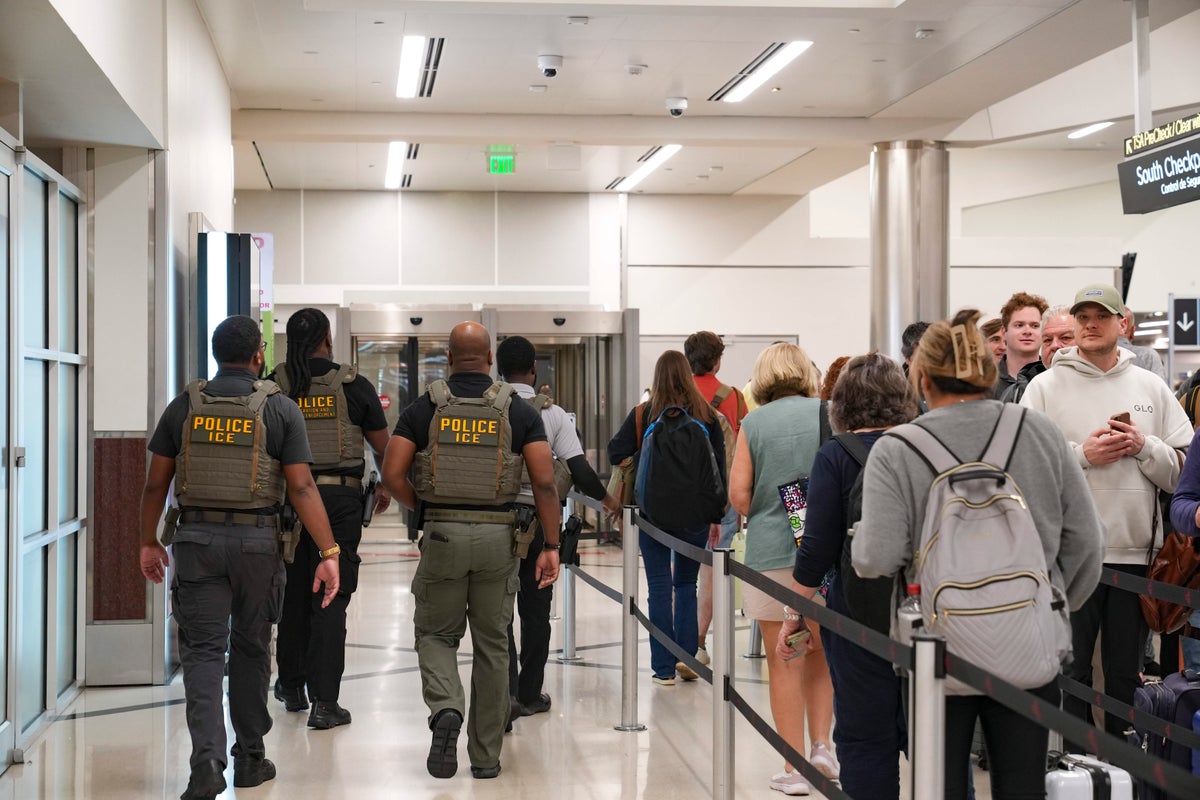
The media is obsessed with a metric that doesn’t matter. Reporters are currently wringing their hands over the fact that deploying Immigration and Customs Enforcement (ICE) personnel to assist the Transportation Security Administration (TSA) hasn't "dent" wait times. They treat the airport security line like a customer service problem. They analyze it as if they are reviewing a slow brunch spot on Yelp.
They are missing the point so spectacularly it borders on professional negligence.
If you think the goal of surge staffing at airports is to get you to your gate five minutes faster, you have succumbed to the "convenience fallacy." You are viewing a national security and border integrity maneuver through the lens of a frustrated vacationer. The reality is far grittier, far more tactical, and has nothing to do with how long you spend standing on those circular floor decals.
The Mathematical Myth of the Extra Body
The prevailing critique suggests that if you add 400 ICE agents to the TSA’s roster, the lines should move faster. This is basic arithmetic, but it’s failed logistics.
TSA officers are specialized. They are trained in specific X-ray diffraction patterns, the nuance of Terahertz imaging, and the behavioral detection of intent. You cannot take an ICE field officer—trained in removals, surveillance, and fugitive recovery—and stick them behind a Rapiscan monitor. It doesn't work that way. Federal regulations and literal machine-specific certifications prevent it.
When these "extra bodies" arrive, they perform perimeter tasks: document checking, line management, and "exit lane" monitoring. These are the low-skill nodes of the security process. They are not the bottleneck. The bottleneck is the machine capacity and the ratio of TSO (Transportation Security Officer) specialists to active lanes.
Adding an ICE agent to a terminal is like adding more ushers to a theater when the problem is that there’s only one door. The ushers can organize the crowd all they want; the door remains the same size.
The Deterrence Dividend
Why do it then? If it doesn’t move the line, why spend the political capital and the budget?
Because the airport is the ultimate "choke point" for identity verification.
When the Department of Homeland Security (DHS) moves ICE assets into civil aviation spaces, they aren't looking for a prohibited bottle of shampoo. They are conducting a high-visibility enforcement action. The "wait time" data is a smoke screen for the real objective: Atmospheric Pressure.
- Cross-Pollination of Intelligence: ICE agents bring a different database access and a different set of eyes to the front line. While a TSA agent is looking for a weapon, an ICE agent is looking for a person.
- Psychological Deterrence: High-visibility uniforms from enforcement-heavy agencies alter the behavior of bad actors. It’s the "cop on the corner" effect.
- Surge Capacity Testing: The government uses these deployments as "stress tests" for inter-agency mobilization. They are practicing for a scenario where a real threat requires the total integration of DHS components.
I’ve seen federal agencies burn through millions on "inter-operability" exercises that yield zero measurable improvement in "efficiency." But efficiency is a corporate goal. For the state, the goal is presence.
Stop Asking About Wait Times
The "People Also Ask" section of your brain is likely stuck on: "Will this make my flight more stressful?" or "Is this a waste of taxpayer money?"
The answer to the first is: only if you’re bothered by the sight of tactical gear. The answer to the second is: yes, if your only metric for "value" is a 12-minute wait instead of a 15-minute one.
But here is the brutal truth: The TSA was never designed to be fast. It was designed to be a "visible deterrent." It is security theater, yes, but theater only works if the actors look the part. Bringing in ICE is an upgrade in the production value. It signals a shift from "administrative screening" to "active enforcement."
The Hidden Logistics of Federal Staffing
To understand why this "fails" to help the traveler, you have to understand the General Schedule (GS) reality.
- TSA Pay Grades: Historically lower, higher turnover, seen as a "stepping stone" job.
- ICE Pay Grades: Higher-tier law enforcement officers (LEOs) with different authorities.
When you mix these two, you create a management nightmare. You have LEO-certified agents doing the work of entry-level screeners. This isn't just "inefficient"—it’s a massive drain on high-value human capital. It’s like using a surgeon to hand out Band-Aids.
The reason wait times don't drop is that the ICE agents aren't actually doing TSA work. They are standing there so the TSA agents can be pulled for "additional training" or "administrative leave" without the checkpoint looking empty. It’s a shell game of optics.
The Myth of the "Innocent Traveler"
The critique of these moves often leans on the idea that "regular people" shouldn't be subjected to the presence of "hard" immigration enforcement. This is a naive distinction.
In the eyes of DHS, there is no "regular person." There is only a "cleared" or "uncleared" entity. By introducing ICE into the airport ecosystem, the department is effectively dissolving the line between domestic travel and border enforcement. It turns every terminal into a de facto border crossing.
Is this an overreach? Potentially. Does it make the line move faster? Absolutely not. But if you're arguing that it "failed" because you're still waiting in line, you’re missing the fact that the department considers the deployment a success simply because the agents were there, visible, and integrated.
The Real Bottleneck: Technology, Not Trousers
If the government actually wanted to fix wait times, they wouldn't send agents. They would send Compute.
$T = \frac{V}{C \cdot R}$
Where:
- $T$ = Total Wait Time
- $V$ = Volume of Passengers
- $C$ = Number of Active Channels (Lanes)
- $R$ = Rate of Processing per Channel
Adding ICE agents does nothing to $C$ (because they can't run the machines) and nothing to $R$ (because the machines have a fixed physical speed). To decrease $T$, you need to increase $R$ through automated screening or AI-driven threat detection that removes the human element from the decision-making loop.
An ICE agent standing by a stanchion is a static variable in a dynamic equation.
The Playbook for the Modern Traveler
Stop looking at the news reports on "wait times" as an indicator of whether a policy is working. They are a distraction. If you want to navigate this new era of "integrated enforcement" airports, you have to change your own math.
- Assume the Airport is a Border: Even for a flight from Peoria to Chicago, act as if you are clearing international customs. The presence of ICE makes this the functional reality.
- Opt-In or Get Out: The only way to bypass the "theater" is to pay for the "VIP" lanes like PreCheck or Clear. These programs are the government’s way of saying, "We’ve already scanned your data so we don't have to scan your shoes."
- Ignore the Uniforms: The agents are there for a "show of force." If you aren't the target of that force, they are essentially high-cost wallpaper.
The media will continue to talk about "inefficiency" and "wait times" because that is the only way they know how to measure the airport experience. They are evaluating a fortress by the quality of its lobby coffee.
The deployment of ICE to airports isn't a failed attempt at customer service. It is a successful expansion of the surveillance state's footprint. If you’re still checking your watch and complaining about the line, you’ve already lost the plot. The line isn't the problem. The line is the point.
Stop expecting the government to treat your vacation with urgency. Their priority is the perimeter. Your priority is the plane. Those two things haven't been aligned since 2001, and no amount of "surging" agents will ever change that.
The system isn't broken. It’s performing exactly as intended. You're just not the customer; you're the cargo.