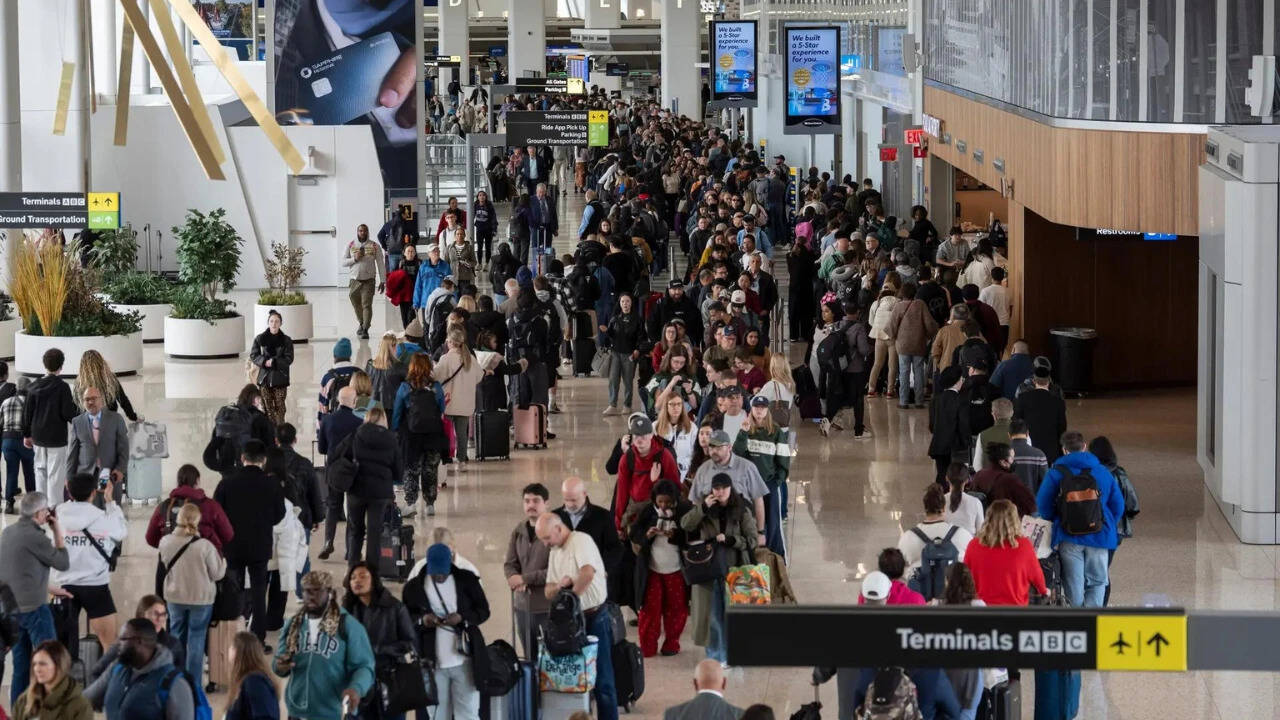
The United States aviation infrastructure faces a systemic failure point not because of a lack of technology or demand, but through a breakdown in the fiscal transmission mechanism that powers the Transportation Security Administration (TSA). While headlines often focus on the spectacle of "shuttered airports," the actual risk is a cascading operational paralysis. This occurs when the gap between federally mandated security requirements and available discretionary funding exceeds the threshold of functional staffing levels. The current deadlock represents more than a political disagreement; it is a stress test on the elasticity of the national airspace.
The Triad of Operational Failure
To understand the current "dire situation" cited by TSA leadership, one must categorize the threat into three distinct layers of impact. These layers interact to create a feedback loop that degrades security while simultaneously stifling economic throughput.
- Labor Attrition and the Retention Cliff: TSA personnel are historically among the lowest-paid federal employees relative to the critical nature of their mission. When funding stalls, the immediate casualty is the pay equity initiative designed to bring TSO (Transportation Security Officer) salaries in line with the General Schedule (GS) scale.
- Technological Stagnation: Security infrastructure, specifically Computed Tomography (CT) scanners and Credential Authentication Technology (CAT), requires significant capital expenditure (CAPEX). A funding freeze halts the rollout of these units, forcing a reliance on legacy systems that require higher manpower to achieve lower detection rates.
- Throughput Compression: As the ratio of active lanes to passenger volume decreases, the physical capacity of the airport terminal becomes the primary bottleneck. This triggers a secondary economic effect where delayed passengers miss flights, leading to "cascading gate congestion" and aircraft groundings due to crew timeout regulations.
The Cost Function of Security Delays
The economic impact of a TSA funding failure is non-linear. A 10% reduction in screening capacity does not lead to a 10% increase in wait times; it can lead to a 50% or 100% increase during peak periods due to the physics of queueing theory. In a standard $M/M/1$ queueing model, as the arrival rate ($\lambda$) approaches the service rate ($\mu$), the average time in the system increases exponentially.
$$W = \frac{1}{\mu - \lambda}$$
When the TSA cannot staff lanes, $\mu$ (the service rate) drops. If $\mu$ falls below $\lambda$ even momentarily, the queue length becomes theoretically infinite until the arrival rate stops. For major hubs like Atlanta Hartsfield-Jackson (ATL) or Los Angeles International (LAX), even a minor decrease in TSO availability creates a backlog that takes hours to clear, often extending beyond the physical footprint of the terminal.
Strategic Asset Misallocation
The current deadlock highlights a fundamental flaw in how the U.S. treats aviation security: as a discretionary cost rather than a core utility. Unlike Air Traffic Control, which has seen moves toward modernization and more stable funding structures, the TSA remains tethered to the annual appropriations cycle. This creates a high-risk environment for long-term planning.
The Recruitment-Training Latency
It takes approximately six months to recruit, background check, and train a TSO to full operational capacity. If funding is cut or frozen in March, the impact isn't just felt in March—it creates a "hollowed-out" workforce in August. This latency means that even if a budget is passed today, the damage to the summer travel season is already baked into the system.
The Maintenance Backlog
Beyond personnel, the physical machinery of security—X-ray tubes, conveyor belts, and explosive trace detection sensors—requires constant calibration and part replacement. Under a funding deadlock, agencies often move to "emergency-only" maintenance. This increases the Mean Time Between Failures (MTBF) and leads to more frequent lane closures, further reducing the service rate ($\mu$).
Regional Vulnerability vs. Global Hub Resiliency
The "shutdown" of airports will not happen uniformly. Instead, we see a divergence in survival capabilities between different airport categories.
- Category X and I Hubs: Large airports (JFK, ORD, DFW) have the highest volume but also the most complex security requirements. They are vulnerable to "mass call-outs" if TSO pay is delayed, as the cost of living in these metro areas is higher.
- Category II and III Regional Airports: These smaller facilities are the true points of failure. If a small regional airport loses 30% of its security staff, it may no longer be able to maintain its Part 1542 security program requirements. When an airport cannot meet these federal standards, airlines are legally prohibited from landing commercial aircraft there.
This creates "Aviation Deserts." A traveler in a rural area may find their local airport functionally closed, not because the runway is broken, but because the federally mandated security "seal" cannot be maintained. This forces a migration of traffic to larger hubs, which are already over-capacity, accelerating the system-wide collapse.
The Logic of the Funding Gap
The TSA is partially funded by the "September 11th Security Fee" paid by passengers. However, a significant portion of this revenue is often diverted by Congress to offset the general federal deficit rather than being reinvested directly into security operations.
- The Diversion Variable: Billions of dollars in passenger fees have been diverted over the last decade.
- The Unfunded Mandate: Every year, the TSA is asked to implement new protocols (e.g., enhanced biometric tracking) without a corresponding increase in the base budget.
This creates a structural deficit where the agency is perpetually "borrowing" from its future maintenance and staffing budgets to meet today's operational requirements. A funding deadlock is the moment this debt comes due.
Security Integrity and the "Soft Target" Risk
From a risk management perspective, the greatest danger of a funding crisis is the degradation of detection quality. As TSOs are pressured to clear "infinite" queues with fewer resources and aging equipment, the cognitive load increases.
Human factors research in security screening shows a direct correlation between fatigue/stress and a decrease in the probability of detection ($P_d$). In a high-pressure, underfunded environment:
- False alarm rates may increase, leading to more manual bag searches and further slowing the line.
- Alternatively, the "miss" rate may increase as screeners rush to meet throughput targets.
Neither outcome is acceptable. If the $P_d$ falls below a certain threshold, the entire purpose of the TSA is invalidated, turning the checkpoint into "security theater" that provides no actual protection against sophisticated threats.
Tactical Reconfiguration of National Airspace
To mitigate the impending deadlock, the aviation industry must move toward a decentralized security model. This involves three specific shifts in logic:
1. Private Screening Conversion
Under the Screening Partnership Program (SPP), airports can opt to use private security firms that follow TSA protocols. While still federally funded, these contracts can sometimes offer more flexibility in staffing and localized pay scales. However, the transition period for an airport to move to the SPP is months, not days, making it an ineffective short-term fix for a sudden funding lapse.
2. Risk-Based Segmentation
The TSA must aggressively expand PreCheck and other "known traveler" programs to offload volume from standard lanes. The logic is simple: spend fewer resources on low-risk individuals to focus dwindling resources on high-risk or unknown variables. The limitation here is the "enrollment bottleneck"—if the TSA cannot staff the enrollment centers, the program cannot grow.
3. Synchronized Gate-Flow Management
Airlines must be prepared to implement "flow control" at the check-in counter. If the security wait time exceeds 120 minutes, the rate of baggage check-in must be throttled to prevent overcrowding in the "landside" (pre-security) areas of the terminal, which are themselves high-risk targets for large crowds.
The deadlock is a symptom of treating a critical logistics network like a discretionary social program. The solution requires a permanent decoupling of security fees from the general fund and a transition to a "Utility Model" where funding is tied to passenger volume in real-time. Until this structural shift occurs, the U.S. aviation system will remain one budget cycle away from a total operational stall.
Airlines should immediately prepare contingency schedules that prioritize "high-load factor" flights and consider consolidating regional routes into larger hubs to maximize the utility of every screened passenger. For the individual traveler, the only viable strategy is a 4-hour lead time for domestic departures and a reliance on carry-on luggage to bypass the secondary failure point of ground handling.