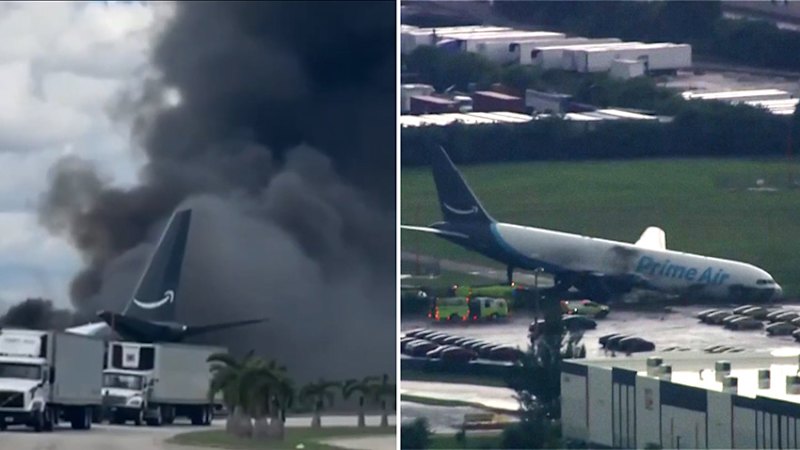
The operational limits of transport infrastructure are defined by kinetic energy management, braking coefficients, and precise spatial boundaries. When an aircraft fails to decelerate within a designated stopping distance, the resulting excursion exposes structural vulnerabilities in airport perimeter safety and third-party logistics oversight. The incident involving a Boeing 767-300 cargo aircraft operated by 21 Air for Amazon Prime Air, which overran a runway at Miami International Airport and impacted vehicles on an adjacent perimeter roadway, demands a rigorous deconstruction of landing-phase variables, aircraft kinetic parameters, and the regulatory oversight governing air cargo networks.
Evaluating a runway overrun requires analyzing the conversion of kinetic energy into thermal and mechanical work during the landing roll. An aircraft's landing distance is a function of its approach speed, touchdown point, gross weight, configuration, and runway surface condition. The physical equation governing stopping distance relies on the deceleration rate achieved through wheel braking, aerodynamic drag, and thrust reversers. When a heavy cargo jet arrives from a regional hub such as San Juan, Puerto Rico, carrying a substantial payload, any variance in touchdown dispersion or environmental braking degradation significantly alters the required safety margin.
Runway surface friction coefficients fluctuate based on micro-texture, macro-texture, and fluid film presence. Hydroplaning occurs when a water wedge separates the tire tread from the pavement, eliminating directional control and friction-based deceleration. While environmental conditions during the Miami incident remain under federal review by the National Transportation Safety Board and the Federal Aviation Administration, historical overrun profiles across the aviation sector universally point to a breakdown within one of three operational phases: approach stabilization, touchdown execution, or deceleration deployment.
The structural integration of corporate logistics networks with commercial air carriers introduces distinct operational variables. Amazon Prime Air does not typically operate its fleet under its own air carrier certificate, relying instead on contracted wet-lease or charter operators like 21 Air. This contractual separation creates a complex oversight matrix. While the direct operator maintains regulatory responsibility for flight crew training, maintenance, and operational control under Federal Aviation Regulations Part 121, the contracting enterprise exercises commercial influence over scheduling, turnaround times, and network velocity.
Evaluating the systemic risks of modern logistics networks requires examining the velocity-versus-safety trade-off. High-frequency e-commerce distribution models demand strict adherence to delivery schedules, placing pressure on turnaround intervals at origin and destination airports. Although regulatory frameworks mandate strict rest and safety limits for flight crews, the operational tempo of cargo fleets operating around the clock creates cumulative fatigue variables that must be factored into human factors engineering analyses.
The physical architecture of urban-adjacent airports compounds the severity of runway excursions. Miami International Airport features intersecting and diagonal runways positioned within dense commercial and infrastructural corridors. The presence of perimeter roads, such as Northwest 67th Avenue, immediately adjacent to runway safety areas transforms potential minor excursions into multi-fatality urban incidents. Runway safety areas are engineered to absorb or safely decelerate an aircraft that departs the paved surface, but spatial constraints in legacy urban airports frequently limit the physical dimensions of these buffer zones.
Mitigating future runway excursions in high-density cargo networks requires targeted operational adjustments rather than generalized safety pledges. Fleet operators must re-evaluate dispatch risk algorithms, factoring in real-time braking action reports and localized meteorological shifts more conservatively. Furthermore, airport operators managing constrained urban footprints should accelerate the deployment of Engineered Materials Arresting Systems. These crushable concrete beds absorb an aircraft's kinetic energy without relying on pilot-executed braking, providing a physical safeguard where geographical expansion of safety areas is impossible.


.jpeg?width=1200&auto=webp&trim=46%2C0%2C353%2C0)