Two a.m. in a dimly lit studio apartment in Chicago, and the radiator is clanking like a dying engine.
Outside, sleet needles the glass. Inside, a thirty-two-year-old software architect named Maya—let’s treat her as a composite of thousands of remote workers currently staring down the barrel of another stagnant winter—is staring at a spreadsheet. On the left column is her rent: three thousand two hundred dollars a month for four hundred square feet and a view of a brick wall. On the right column is a single question that has kept her awake since midnight.
Why am I paying luxury prices to live inside a box when my entire office weighs four pounds and fits in a backpack?
Maya is not alone. Across North America and Europe, a quiet stampede is underway. For the last decade, the remote work movement treated geography like a punchline—a collection of beach hammocks in Bali, crowded coworking cafes in Lisbon, and cheap iced coffees in Chiang Mai. It was loud, transient, and largely ignored by major industrial economies that viewed laptop-toting travelers as glorified tourists on extended spring break.
That era is over.
Asia has become the undisputed gravitational center of the location-independent workforce, and the region’s heavyweights are no longer content to watch from the sidelines while Southeast Asian beach towns scoop up billions in foreign spending. Enter South Korea—a nation famous for hyper-speed fiber optics, relentless work ethic, and historically rigid immigration walls—suddenly throwing open its doors with a dedicated digital nomad visa.
The Architecture of a Global Shift
To understand why South Korea’s move matters, you have to look past the glossy travel brochures and examine the cold arithmetic driving national policy.
For years, countries treated immigration like a fortress drawbridge. You lowered it for corporate transfers, high-net-worth investors, or seasonal laborers, and you kept it bolted shut against everyone else. If you wanted to work from Seoul for six months while keeping your job at a tech firm in Austin or London, you had two bad options: lie to border control on a ninety-day tourist waiver and do "visa runs" to Tokyo every quarter, or drown in corporate sponsorship paperwork that no overseas employer would ever sign.
I remember the low-grade paranoia of those early border-hopping days. You’d stand in the customs line with a carry-on full of hard drives and adapters, rehearsing your cover story, praying the officer wouldn’t ask why your passport looked like a game of Tetris or why you had three different SIM cards taped to the inside of your notebook. It was exhausting. Worse, it turned millions of high-earning, law-abiding professionals into shadow residents—people paying for apartments, groceries, and train passes without a legal footprint, health coverage, or tax clarity.
Governments finally noticed the money left on the table.
According to data tracked across global mobility reports, the number of American digital nomads alone surged past seventeen million in recent years—nearly tripling from pre-pandemic baselines. Globally, the remote-working traveler population now rivals the citizenship of a mid-sized European nation, injecting tens of billions of dollars annually into local economies without taking a single local job.
Consider the economic logic from Seoul’s perspective. A traditional tourist stays for six days, buys souvenirs, eats at three famous restaurants, and flies home. A digital nomad stays for twelve months. They rent apartments in residential neighborhoods, buy groceries every Tuesday, join local gyms, pay for high-speed data plans, and spend their foreign-earned salaries inside the domestic economy every single day—all while placing zero strain on the local job market.
In January 2024, South Korea’s Ministry of Justice officially launched the F-1-D Workcation Visa, and the signal sent across the Pacific was unmistakable. The country wasn't just tolerating remote workers anymore. It was actively recruiting them.
Inside the Korean Playbook
Most countries design digital nomad visas like obstacle courses. They demand endless notarized translations, local bank guarantees, or bizarrely specific insurance riders that take six months to untangle.
South Korea took a remarkably pragmatic approach, though it comes with a distinctly Korean price tag. To qualify for the F-1-D visa, applicants must prove they have worked in their industry for at least one year, clear a clean criminal background check, hold private health insurance covering at least one hundred million Korean won (roughly seventy-five thousand dollars), and—most critically—demonstrate an annual income equal to or greater than twice South Korea’s Gross National Income per capita from the previous year.
In plain terms, that income floor sits right around eighty-five thousand dollars a year.
Let’s pause on that number, because it reveals everything about Seoul’s strategy.
Unlike destinations chasing volume—the backpacker-turned-freelancer scraping by on two thousand dollars a month—South Korea priced its welcome mat specifically for seasoned professionals, senior engineers, founders, and high-earning creatives. The visa allows successful applicants and their immediate families to live in the country for up to one year, with the option to extend for a second year.
Think about what two uninterrupted years in one of the world’s most technologically advanced societies actually looks like on the ground.
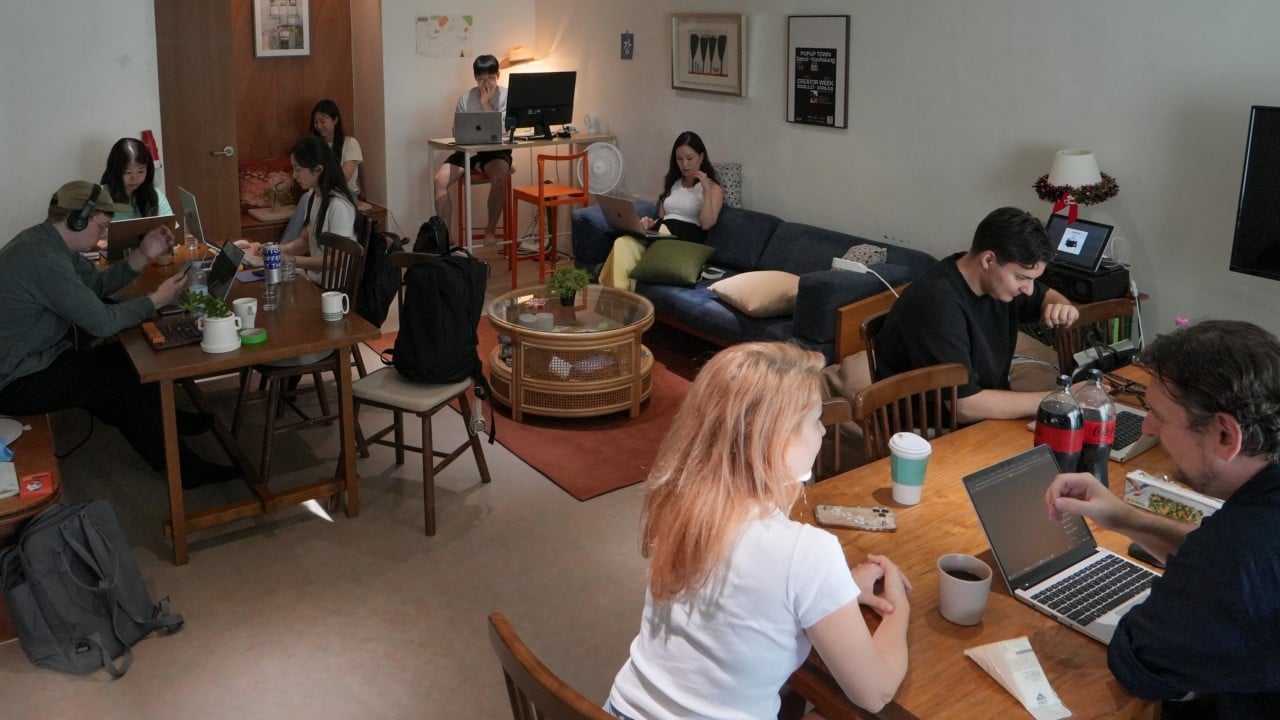
Picture Maya—our hypothetical Chicago architect—landing at Incheon International Airport not with the frantic energy of a tourist trying to cram forty sights into five days, but with the calm certainty of a resident. Within forty-eight hours, she has her Residence Card. She signs a lease on a sunlit loft in Seongsu-dong, Seoul’s answer to Brooklyn, where former shoe factories have been converted into minimalist coffee roasters, design studios, and brick-walled workspaces.
Her internet speed isn't a prayer; it’s a near-gigabit certainty, whether she’s uploading massive architecture files from her kitchen table, a bullet train hurtling toward Busan at three hundred kilometers an hour, or a quiet cafe overlooking the volcanic cliffs of Jeju Island.
Why Asia Won the Remote Work War
If you zoom out on a map of global migration patterns, the tilt toward Asia isn't a fluke. It is a structural correction.
For decades, Western cities held a monopoly on career ambition. If you wanted to build a serious life in tech, finance, design, or media, you swallowed the rent hikes in New York, San Francisco, London, or Paris because that was where the infrastructure lived. You traded half your paycheck for proximity to opportunity.
Remote work broke that bargain. Once companies realized they didn't need bodies in cubicles to ship code or close deals, Western cities suddenly had to compete on quality of life—and many of them were caught flat-footed. Crime rates ticked upward in major transit hubs, housing costs detached completely from reality, and basic public infrastructure groaned under decades of deferred maintenance.
Meanwhile, East and Southeast Asia spent the last twenty years building the future.
Walk through the subway stations of Seoul, Tokyo, or Taipei at midnight. They are spotless, whisper-quiet, and safer than most gated suburbs in the West. Step out of the station and within two hundred yards you will find five pharmacies, a twenty-four-hour clinic where an MRI costs less than a nice dinner in Manhattan, fiber-optic connectivity that makes American broadband look like dial-up, and neighborhoods humming with life at every hour.
Japan recognized this gravitational pull when it rolled out its own six-month digital nomad visa targeting high earners. Taiwan launched its Employment Gold Card, luring thousands of tech executives and remote specialists with tax incentives and residency pathways. Thailand revamped its visa architecture with the Destination Thailand Visa, stretching stays to five years with multiple entries. Malaysia built the DE Rantau program specifically to turn Kuala Lumpur and Penang into regional remote hubs.
Every major economy in the region looked at the same demographic wave and reached the same conclusion: talent is now liquid, and whoever builds the best container wins.
The Invisible Friction Nobody Mentions
Still, it would be dishonest to paint South Korea—or any Asian hub—as a frictionless utopia where every Western remote worker steps off the plane and immediately finds bliss.
I’ve watched plenty of seasoned travelers hit an invisible wall about ninety days into their stay, and the bruises are almost always cultural rather than logistical.
South Korea operates at a velocity that can leave outsiders breathless. The concept of ppalli-ppalli—"hurry, hurry"—isn't just a cute cultural idiom; it is the operating system of the entire peninsula. Packages arrive within hours. Restaurant orders hit the table in four minutes. Trends flare into national obsessions on Tuesday and vanish completely by Friday. For a remote worker used to the slow, meandering pace of a European café town, Seoul’s relentless electric hum can feel intoxicating for the first month and overwhelming by the third.
Then there is the language barrier and the subtleties of social integration. While younger Koreans in Seoul speak functional English and signage in major districts is bilingual, deep social belonging requires patience. Banking apps can feel like cryptographic puzzles designed exclusively for Korean national ID holders. Finding a flat without navigating the traditional jeonse system—a uniquely Korean housing model where tenants historically handed over massive lump-sum deposits instead of monthly rent—requires working with English-speaking realtors who understand short-term corporate or foreign leases.
And there is the quiet psychological toll of living in a city where everyone around you is sprinting while you are trying to protect your work-life balance. South Korea has spent years wrestling with its own intense corporate culture and demographic headwinds, including the lowest birth rate in the developed world. Ironically, that very demographic crisis is part of why policymakers in Seoul are eager to bring vibrant, spending-ready international residents into aging districts and regional hubs outside the capital.
When you walk past a shuttered storefront in a smaller coastal town or see local governments offering subsidized coworking spaces on Jeju Island and in Gangwon Province, you realize this isn't just about tourism revenue. It is about breathing fresh economic oxygen into communities facing rapid population decline.
The End of the "Digital Nomad" Label
Perhaps the strangest part of watching South Korea enter this arena is realizing that the phrase "digital nomad" itself is becoming obsolete.
The term always carried a whiff of novelty—an image of twenty-somethings balancing MacBooks on surfboards while pretending to answer emails. That caricature no longer matches reality. The people applying for Korea’s F-1-D visa, Taiwan’s Gold Card, and Japan’s remote residency tracks are rarely kids backpacking between hostels. They are thirty-eight-year-old product managers with toddlers. They are forty-five-year-old independent consultants. They are cybersecurity engineers, documentary editors, and quantitative analysts who simply refused to go back to a ninety-minute highway commute once they tasted autonomy.
They don't want a hostel bunk. They want reliable pediatricians, international preschools, quiet libraries, fast trains, and neighborhoods where you can walk home at one in the morning listening to headphones without looking over your shoulder.
South Korea understands this demographic down to its bones, because South Korea built its entire modern identity around efficiency, safety, and hyper-connectivity.
Think back to Maya in that freezing Chicago apartment, staring at her rent spreadsheet while sleet ticks against the windowpane. Six months after her F-1-D approval, her life hasn't turned into a vacation. She still wakes up early, still wrestles with stubborn code, still sits through three-hour product reviews on Zoom. The work itself hasn't changed by a single keystroke.
What changed is everything around the edges.
When she closes her laptop at six in the evening, she steps out onto a warm, lantern-lit street smelling of roasted chestnuts and sizzling street food. Her rent is half what it was in Illinois. Her train arrives in ninety seconds. And for the first time in her adult life, she isn't burning her best years just to afford the privilege of standing still.
Across the Pacific, governments are finally realizing that borders are no longer walls to keep people out, but invitations competing for where the future chooses to live—and Seoul just slid its key across the table.