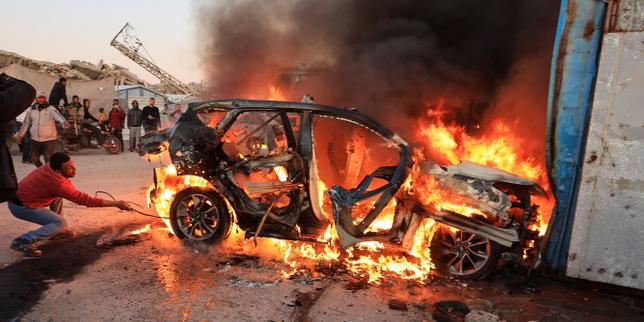
The death of a journalist in a kinetic environment is rarely a localized event; it represents a degradation of the primary data-gathering infrastructure essential for global situational awareness. When Al Jazeera reported the death of Mohammed Washah in a strike in Gaza, the incident highlighted a systematic breakdown in the protected status of non-combatant information nodes. This analysis deconstructs the operational realities of reporting in high-intensity urban warfare, the technical vulnerabilities of the press, and the resulting entropy in reliable intelligence flows.
The Triad of Information Risk in Gaza
The survival of a correspondent in a high-threat theater depends on three intersecting variables: geographical positioning, technical signature, and institutional protection. When any of these pillars fails, the risk of terminal attrition becomes a statistical certainty rather than a manageable variable.
Geographic Saturation and Urban Density
Urban warfare in Gaza operates within a high-density environment where the distinction between military objectives and civilian infrastructure is functionally blurred. The strike on Washah underscores the lack of "green zones" for media operations. In traditional conflicts, clear front lines allow for the establishment of rear-guard press pools. In asymmetric urban combat, the entire battlespace is active, meaning the distance between a high-value military target and a press asset can be measured in meters.The Electronic Signature Constraint
Modern journalism requires high-bandwidth transmission to remain relevant. To file video reports, a journalist must utilize satellite uplinks (BGAN), local cellular networks, or high-gain Wi-Fi. Each of these emits a distinct Radio Frequency (RF) signature. In a theater dominated by signals intelligence (SIGINT) and electronic warfare (EW), an active transmitter is a beacon. While the press uses these tools for communication, an adversary’s automated targeting system may interpret high-bandwidth RF emissions as command-and-control (C2) activity.Erosion of Institutional Immunity
The legal framework of the Geneva Convention classifies journalists as civilians. However, the operational utility of this status relies on the belligerents' willingness to acknowledge press markers (e.g., "PRESS" vests, marked vehicles). When combatants perceive the media not as neutral observers but as components of an adversary’s information operations (IO) strategy, the "Press" identifier ceases to function as armor and instead becomes a target identifier.
The Cost Function of Information Decay
The loss of a singular journalist like Washah triggers a cascading failure in the quality of available ground-truth data. This decay follows a predictable trajectory:
- Reduction in Verifiable Proximal Data: As field reporters are neutralized, the ratio of firsthand observation to unverified social media content shifts. This creates a vacuum filled by "grey" information, which is easily manipulated by state and non-state actors.
- Expansion of Blind Spots: In a kinetic environment, certain sectors become "black zones" where no professional observation is possible. This lack of visibility allows for operational escalations that might otherwise be constrained by the threat of international exposure.
- Incentivizing Remote Reporting: The physical danger forces news organizations to pull personnel back to border positions or remote bureaus. This distance introduces a latency in reporting and a reliance on digital forensics over physical verification, which is inherently less reliable for real-time tactical assessments.
Structural Failures in Deconfliction Protocols
Deconfliction is the process of sharing GPS coordinates of non-combatant assets with military forces to prevent "blue-on-brown" or collateral strikes. The persistent attrition of media personnel in Gaza suggests a fundamental failure in these protocols. This failure stems from three specific bottlenecks.
The first bottleneck is the Time-Sensitive Target (TST) Loop. When a military force identifies a target based on real-time intelligence, the window for cross-referencing that location against a list of protected press assets is often seconds. If the data is not integrated into the automated targeting heads-up display (HUD), the human operator will never see the conflict.
The second bottleneck is Data Asymmetry. News organizations often provide their locations to international bodies or the IDF, but there is no guarantee that this information flows down to the tactical level—the individual drone pilot or artillery commander.
The third bottleneck is the Classification of Combatants. In asymmetric conflicts, the definition of a "journalist" is often contested. If a state actor believes a journalist is also functioning as a scout or propagandist for an armed group, the deconfliction status is unilaterally revoked. This leads to a circular logic where the presence of a journalist at a sensitive site is used as evidence of their complicity rather than their professional duty.
The Logistics of Targeted Attrition
Quantifying the risk to journalists in Gaza requires looking at the sheer volume of incidents compared to previous conflicts. The death of Washah is not an outlier but a data point in a trend line that exceeds the fatality rates of the Vietnam War or the Iraq War. This high rate of attrition suggests that the traditional methods of risk mitigation—armored vests, helmets, and clearly marked vehicles—are obsolete against precision-guided munitions (PGMs).
PGMs are designed to collapse specific structures. If a journalist is in a building targeted by a PGM, the protective gear is irrelevant. The threat model has shifted from "stray small arms fire" to "calculated structural destruction." This shift requires news organizations to move away from individual protection and toward a model of decentralized, remote-operated, and automated data collection (e.g., stationary high-zoom cameras and AI-assisted satellite monitoring) to preserve the lives of their human assets.
The Strategic Pivot for News Organizations
The current trajectory indicates that traditional field reporting in high-intensity urban conflict is reaching its limit of viability. To maintain information flow, news agencies must adapt their operational posture.
- Hardening of Communication Links: Implementing low-probability-of-intercept (LPI) communication hardware to minimize the RF footprint of field teams.
- Redundant Verification Nodes: Establishing "verification hubs" in third-party countries that use multi-spectral satellite imagery to corroborate ground reports in real-time.
- Legal Counter-Pressure: Treating the death of personnel not just as a tragedy, but as a breach of contract between the state and the international community, requiring formal evidentiary discovery in international courts to force the release of targeting logs.
The death of Mohammed Washah demonstrates that in modern warfare, the "fog of war" is not just a byproduct of chaos, but a condition that can be manufactured by the systematic removal of observers. Maintaining the integrity of the information ecosystem requires a transition from the "brave correspondent" model to a high-tech, signature-aware, and legally aggressive operational framework. Failure to adapt will result in the total blindness of the international community during the most critical phases of future conflicts.
The immediate tactical requirement is the integration of media GPS data directly into the kinetic targeting software of all active belligerents, backed by an automated alert system that triggers when a munition is locked onto a verified press coordinate. Without this hard-coded technical safeguard, the verbal assurances of deconfliction will remain functionally useless.