Massive walls of ice, rock, and water tore down Himalayan river systems last week, catching workers completely off guard. Now, rescue teams face a brutal race against time. Hundreds of laborers remain trapped deep inside massive underground hydropower tunnels across Nepal's Rasuwa and Nuwakot districts.
If you are following the disaster, you already know the official death toll across Nepal and Tibet has surged past 950, with thousands still missing. But the hidden emergency unfolds underground. Private power sector groups report that at least 900 workers are unaccounted for across 12 major hydropower sites. Roughly 500 of them are believed to be sealed inside gigantic concrete water-control tunnels filled with thick, suffocating mud.
The Logistical Nightmare Inside the Tunnels
These aren't narrow mining shafts. Many of these engineering corridors are wide enough to drive heavy trucks through. That massive scale makes them vital for energy production, but it also turns them into lethal traps when flash floods hit.
When the torrent struck, power lines cut out instantly. Pitch darkness followed. Mud, debris, and boulders rushed through the entry points, choking off escape routes and sealing workers miles underground.
According to Mohan Kumar Dangi of the Independent Power Producers' Association of Nepal, workers managed brief phone calls right when the disaster started. Those who escaped warned that dozens of colleagues remained stranded further inside. Days later, establishing contact has become nearly impossible.
Why Rescuers Are Struggling on the Ground
You cannot simply walk into these disaster zones. The terrain itself fights back. More than 40 bridges have been washed away, isolating entire valleys. Rescue coordinators rely heavily on military helicopters to drop personnel into remote gorges.
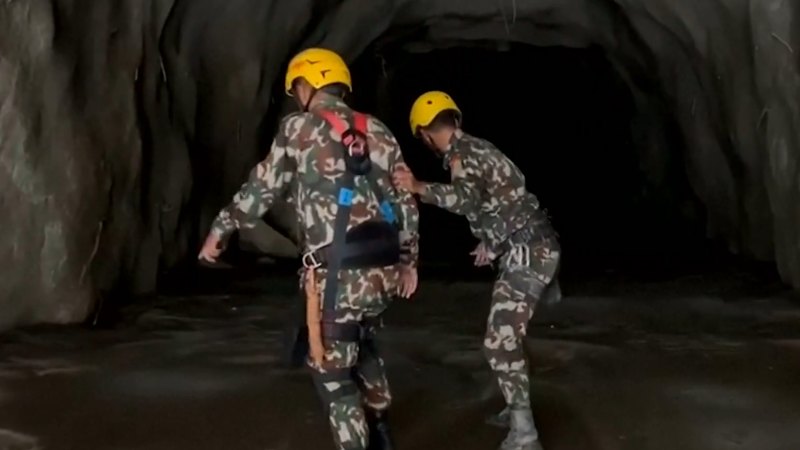
Specialized teams from the Nepal Army, alongside mountaineering guides and international experts from India, are using heavy excavators and pumps to clear 10-to-12-foot walls of thick muck. Ashish Gurung, a mountain guide assisting with the operations at the Chilime plant, described the brutal conditions. Inside the tunnels, the mud is deep, shifting, and exhausting to navigate. Rescuers use wooden planks and safety ropes just to probe the sludge without getting swallowed up themselves.
Compounding the terror, secondary hazards loom. Heavy rains continue to pound the border regions, and unstable landslide-blocked lakes threaten to overflow at any moment, forcing temporary suspensions of rescue operations.
The Accountability Gap in Himalayan Infrastructure
Beyond the immediate human tragedy, this catastrophe exposes a grim reality about large-scale construction projects in high-risk zones. Officials note that many affected sites are still under construction. That means the official corporate rosters likely miss dozens of casual or unregistered laborers hailing from Nepal, India, China, and South Korea.
The actual number of people trapped underground may well exceed initial corporate estimates once unregistered workers are fully accounted for. With roughly 700 megawatts knocked out of service—wiping out about ten percent of the nation's total power capacity—the infrastructure damage is catastrophic. Yet right now, electrical grids take a back seat.
Specialized teams continue drilling, pumping, and tunneling through the debris. Every hour counts. While geoscientists note that some segments of the massive underground networks might retain pockets of breathable air, dropping oxygen levels and dwindling water supplies mean the window to pull survivors alive is closing fast.