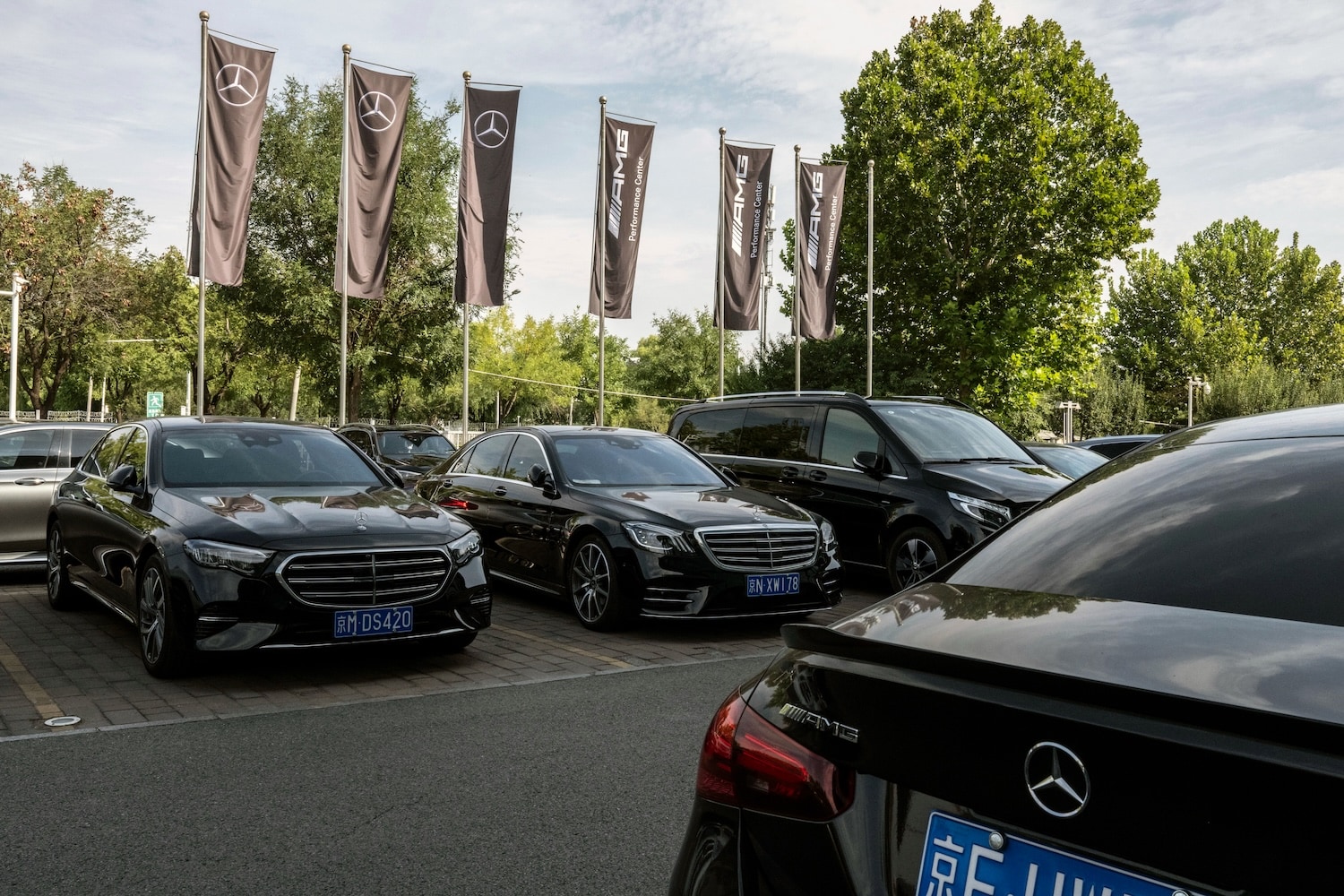
The financial press is currently hyperventilating over a 6% dip in Mercedes-Benz global sales and a 27% "plunge" in China. They smell blood. They see a legacy giant stumbling. They see a brand losing its grip on the world’s most important car market.
They are fundamentally wrong. If you enjoyed this post, you might want to look at: this related article.
The panic over volume is the "lazy consensus" of analysts who still think we are living in 2015. These are the same people who cheered when Mercedes chased "entry-level luxury" with the A-Class, diluting the three-pointed star until it was basically a glorified Volkswagen with a higher lease payment.
What the headlines call a "plunge" is actually the first stage of a deliberate, agonizing, and necessary purge. Mercedes-Benz isn't dying in China; it is finally stoping the desperate scramble for market share that was eroding its soul. For another perspective on this story, check out the latest update from Business Insider.
The Volume Trap is a Death Sentence
For decades, the automotive industry has been addicted to volume. The logic was simple: more cars sold equals more economies of scale, which equals more profit. But in the age of electrification and software-defined vehicles, that logic has become a trap.
When you see a 27% drop in China, you aren't seeing a lack of demand for "Mercedes." You are seeing the collapse of demand for mediocre Mercedes. The Chinese consumer is the most sophisticated EV buyer on the planet. They don't want a C-Class with an iPad glued to the dashboard. They want a rolling supercomputer or they want a true, uncompromising luxury experience.
By pulling back, Mercedes is signaling that it will no longer compete in the race to the bottom against BYD or Xiaomi. You cannot win a price war against companies that own their own battery supply chains and enjoy state-backed subsidies. If Mercedes tries to fight on price, they lose their margins. If they lose their margins, they lose their ability to innovate.
I have watched Tier-1 suppliers go bankrupt trying to shave $0.50 off a door handle for "high-volume" projects. It is a grueling, soul-crushing way to run a business. Mercedes-Benz CEO Ola Källenius is betting the entire company on a different path: Luxury over Volume.
The China Delusion
People ask: "How can Mercedes survive if China stops buying?"
This is the wrong question. The right question is: "How can Mercedes survive if it keeps selling discounted cars in China?"
The Chinese market has shifted from a growth phase to a replacement phase. The "new money" that used to buy an E-Class just to show they had arrived is now buying domestic brands like Li Auto or Nio. Why? Because those brands offer better software integration.
Mercedes’ "plunge" is a recognition that their current ICE-derived platforms are no longer the benchmark. Instead of burning billions in incentives to move units that nobody actually wants, they are letting the numbers fall. It is a strategic retreat. You don't defend a burning building; you move to the high ground and rebuild.
The "Top-End Luxury" strategy—focusing on the S-Class, Maybach, and G-Wagon—is the only way forward. These vehicles have margins that make the A-Class look like a charity project. In the most recent quarter, even as volume dropped, the mix of high-end vehicles remained the only thing keeping the balance sheet from looking like a disaster zone.
The Myth of the "Affordable" Mercedes
Let’s be brutally honest: The A-Class and B-Class were mistakes.
They were "brand entry points" that ended up being "brand exits." When you sell a car with a cheap interior and a buzzy four-cylinder engine just to hit a $35,000 price point, you aren't "fostering" (to use a banned word I’m mocking) brand loyalty. You are telling the customer that your logo is for sale to the highest bidder.
True luxury is defined by exclusivity. If everyone has a Mercedes, nobody wants one. The 6% global sales drop is the sound of the air escaping the bubble. It is the correction the brand needed.
Imagine a scenario where Mercedes halves its total production but triples its profit per unit. To the "volume is king" analysts, this looks like a failure. To a shareholder who understands brand equity, it is the Holy Grail. Ferrari doesn't care about "plunging" deliveries if the waiting list for a $400,000 car is three years long.
Mercedes is trying to move closer to the Ferrari model and further from the Toyota model. This transition is ugly. It involves shuttering plants, laying off workers who build "cheap" parts, and pissing off dealers who rely on high-volume service traffic.
The Software-Defined Reality Check
The real reason for the struggle in China isn't just "competition." It’s the $MBOS$—the Mercedes-Benz Operating System.
The Germans are historically terrible at software. They build the best mechanical machines in the world, but their user interfaces have traditionally felt like they were designed by an angry committee of engineers.
The 27% drop in China is a direct reflection of the fact that Chinese buyers prioritize the digital cockpit over the suspension tuning. While Mercedes was perfecting the "thunk" of the door closing, local Chinese brands were perfecting the in-car voice assistant and seamless 5G integration.
Mercedes is currently in the middle of a massive pivot to a centralized electronic architecture. This is expensive. This is slow. And while they are building it, their current lineup looks dated to a tech-savvy 28-year-old in Shanghai.
The drop in sales is the market telling Mercedes: "Your software isn't good enough yet."
Acknowledging this is the first step toward fixing it. If they had kept sales high through massive discounting, they would have never felt the urgency to fix the underlying tech debt. The "plunge" is the cold shower that wakes the engineers up.
Why the "Experts" are Wrong About the EV Transition
The consensus view is that Mercedes is failing because they aren't selling enough EVs (the EQ line).
Actually, Mercedes is struggling because the EQ line was a compromise. They tried to make "electric versions" of their gas cars. They ended up with "jellybean" styling that lacked the prestige of the traditional long-hood, short-deck Mercedes proportions.
The market has rejected the EQE and EQS because they don't look like $100,000 cars. They look like high-end bars of soap.
The contrarian take here is that the sales drop is actually a good thing for the EV transition. It is forcing Mercedes to abandon the "one size fits all" platform approach and return to what they do best: building aspirational, beautiful objects.
The upcoming MMA (Mercedes Modular Architecture) and the electric G-Wagon are shifts back toward "desire" rather than "efficiency." Mercedes realized that nobody buys a luxury car to save the planet. They buy it to feel better than everyone else. If the car is ugly, the mission fails.
The Brutal Truth About "Global Reach"
The "global" 6% drop also masks a fundamental shift in where money is actually made.
Europe is stagnant. China is a knife fight. The United States, however, remains a bastion of high-margin SUV demand. The North American market is where the G-Wagon and the GLS-Class reign supreme.
By obsessing over the "total volume" number, the media misses the regional nuance. Mercedes could lose 50% of its volume in Europe (where small, low-margin cars dominate) and replace that profit by selling 5% more Maybachs in the US and Middle East.
If I am an investor, I don't want to see "growth." I want to see "margin expansion."
Growth is for startups. Margin is for icons.
The Risk of the Pivot
Is there a downside? Of course.
The "Luxury-First" strategy is incredibly risky. If you stop being a "mass luxury" brand, you lose the safety net of the middle class. If the global economy enters a prolonged depression, the billionaires who buy S-Classes might stop buying, and you won't have any A-Class sales to keep the lights on.
Furthermore, you risk alienating the very workforce that built the company. It’s hard to tell a factory worker in Stuttgart that their job is gone because the company decided it’s "too prestigious" to build the car they spend their lives making.
But the alternative—staying the course—is certain death. Look at what happened to the American luxury brands in the 80s and 90s. Cadillac and Lincoln tried to be everything to everyone and ended up being nothing to anyone.
The Execution Gap
The problem isn't the strategy; it's the lag.
There is a gap between the "old Mercedes" (high volume, many models, mediocre software) and the "new Mercedes" (ultra-luxury, focused lineup, proprietary OS). We are currently in that gap. It is a valley of death.
The 27% drop in China is the sound of the company walking through that valley.
Stop asking when sales will "recover." They shouldn't recover. If Mercedes-Benz returns to its peak volume levels, it means they have failed. It means they went back to the crack-cocaine of discounting and fleet sales.
The goal is to be smaller, meaner, and significantly more expensive.
If you want a car that "everyone" drives, buy a Tesla. If you want a car that "everyone" can afford, buy a BYD.
Mercedes is finally remembering that its logo used to mean something exclusive. The "plunge" isn't a bug; it's the most important feature of their survival plan.
Sell fewer cars. Charge more money. Kill the cheap models. If the board has the stomach to see this through, the "6% drop" will be remembered as the moment the brand saved itself from irrelevance.
The era of the "accessible" Mercedes is over. Good riddance.