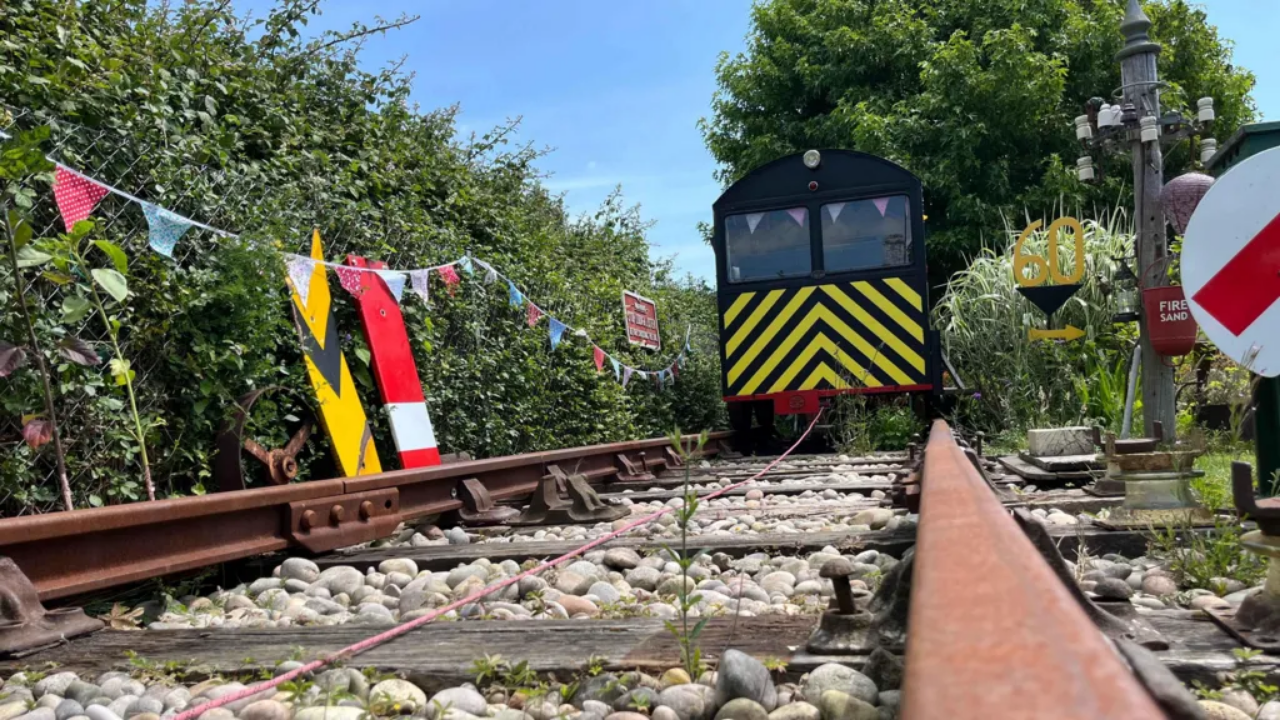
Retirement is often spoken of as a quiet fading away, a gradual surrender to the armchair and the ticking clock. For most, the decades of early mornings, scheduled trains, and greasy overalls dissolve into a haze of garden upkeep and afternoon tea. But steel does not easily leave the blood of a man who spent his life watching it carry the weight of a nation.
When you spend forty years studying the geometry of iron rails, the precise cant of a curve, and the steady, rhythmic heartbeat of a locomotive network, you do not simply forget the language. You translate it. You find a smaller vocabulary. You take it home. Recently making headlines recently: Why Trying to Have a Good Sunday in Los Angeles is Ruining Your Life.
In a quiet corner of East Sussex, where the morning mist clings to damp lawns and the English countryside rolls on with an ancient indifference, one former rail engineer decided to rebuild the world he left behind. Not on a grand, national scale, but fifty feet at a time.
Quiet. More details regarding the matter are explored by The Spruce.
That is what people notice first when they visit his garden. There is no roar of a diesel engine, no frantic screech of iron wheels fighting a poorly aligned switch. There is only the low, ambient hum of sunlight being gathered, stored, and quietly converted into momentum.
To understand why a retired engineer would spend his golden years hauling ballast, bending metal, and laying a miniature rail line through his flowerbeds, you have to understand the peculiar psychology of the builder. For a lifetime, his work belonged to corporations, timetables, and faceless commuters. Every bolt tightened was part of an anonymous machine. But this track? This fifty-foot ribbon of precision cutting through the cabbage patch? This belongs to him.
Building a garden railway is an act of defiance against entropy.
Consider the sheer stubbornness required. At an age when many are content to watch the seasons change from behind a double-glazed window, he was on his knees in the mud. He hauled wooden sleepers. He measured tolerances down to the millimeter. A railway, even a miniature one, is a merciless taskmaster. If the grade is off by a fraction of a degree, gravity takes over. If the drainage fails, the winter frost heaves the track like a sleeping beast stretching its limbs.
He didn't hire contractors. He didn't order a prefabricated kit from a glossy catalogue. He engineered it from scratch, drawing on decades of muscle memory honed on the mainline tracks of Britain.
The centerpiece of this backyard empire is a custom-built trolley, powered entirely by the sun.
In an era obsessed with complex, digital solutions to modern energy crises, there is something deeply grounding about watching a solar panel quietly drinking in the Sussex daylight, feeding a modest battery, and translating those invisible rays into raw, mechanical motion. It is an exercise in elegance. The sun beats down on the petunias, and five minutes later, a miniature electric locomotive hums down the line, carrying tools, garden waste, or simply a cup of tea from the back patio to the greenhouse.
It is clean. It is silent. It is entirely self-reliant.
Neighbors often stop by the fence. At first, they thought it was a whim, a quirky project that would be abandoned by autumn, swallowed up by weeds and forgotten machinery. But precision has a way of commanding respect. The ballast remained neat and weed-free. The rails gleamed in the afternoon sun, brushed clean of falling leaves. The trolley ran with the quiet dependability of a Swiss watch.
Soon, the neighborhood children began to linger near the property line, waiting for the distinct, low voltage whine of the motor. They didn't care about the engineering specs or the photovoltaic conversion rates. They saw magic. They saw a man who had built a portal to a larger world right there among the runner beans.
There is a profound lesson hidden in those fifty feet of track. Modern life often leaves us feeling untethered, drifting through digital spaces where our labor yields nothing tangible. We push pixels, answer emails that vanish into the ether, and consume products designed to break just as the warranty expires. Nothing lasts. Nothing bears the weight of our hands.
By contrast, steel and wood have weight. They resist. They demand patience.
When the engineer flips the switch and the trolley glides forward, he is not just moving a load of garden soil from one end of the yard to the other. He is proving a point about human agency. He is demonstrating that retirement is not the end of creation, but perhaps the first time in a man's life when he is finally free to build purely for the joy of the craft.
The sun sets over East Sussex, painting the clouds in bruised shades of purple and amber. The garden cools. The dew begins to settle on the grass, slicking the tiny steel rails until they shine like silver threads in the dusk.
The trolley sits silent on a siding, its solar panels resting, having done their day's work without burning a single drop of oil or drawing a single watt from the grid.
Down the garden path, the porch light flickers on. The tools are put away. The iron is quiet. But tomorrow, the sun will rise again over the horizon, hitting the panels, waking the batteries, and waiting for the engineer to step outside and start the engine.