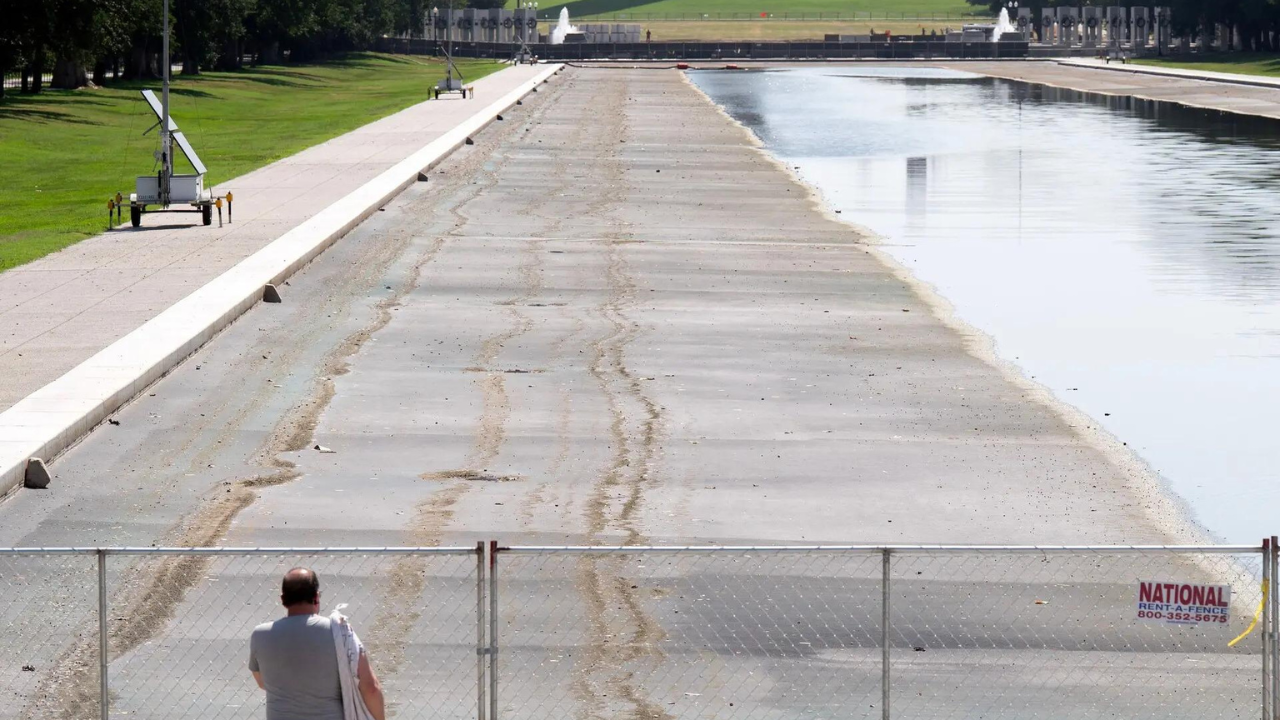
If you recently took a stroll down the National Mall expecting to capture that perfect, glassy reflection of the Washington Monument, you were probably met with a depressing sight instead. The Lincoln Memorial Reflecting Pool is empty. Again.
Just weeks after a highly publicized $14 million facelift, the massive basin was drained, leaving behind a barren concrete floor and a flurry of political finger-pointing.
Why does a multi-million-dollar renovation fall apart in less than two months?
The official narrative points to late-night vandals armed with box cutters. The critics point to a rushed, cheap paint job. The real answer, as always, is a messy mix of bureaucratic pressure, basic chemistry, and the sheer difficulty of maintaining nearly seven million gallons of stagnant water under the swampy Washington sun.
The Dream of American Flag Blue Meets Reality
The trouble started when the bottom of the pool was coated in what was proudly dubbed "American flag blue" paint.
It looked great on camera for a minute. But submerging pool paint under millions of gallons of chlorinated water is a precise science. If the concrete isn't prepped perfectly, or if the curing process is rushed to meet a political deadline like Independence Day, the paint loses its grip.
Within weeks, massive sheets of blue coating began peeling away from the concrete floor. The paint started bubbling up and floating to the surface like giant, synthetic lily pads.
Then came the finger-pointing. The administration claimed that vandals deliberately slashed the pool's waterproof liner. A high-profile arrest of a former Olympic canoeist, David Hearn, made headlines when he was accused of damaging the pool. His defense team argued he merely touched a piece of paint that was already peeling off.
[Concrete Base] ---> [Waterproof Liner] ---> [Blue Paint Coating (Peeling)] ---> [7 Million Gallons of Water]
Regardless of who did what, the visual evidence on the ground showed a coating system that was failing on its own terms.
The Algae Problem That Won't Go Away
Even if the paint had stayed put, the water itself was turning into a pea-soup nightmare. Algae thrives on three things:
- Sunlight
- Warm temperatures
- Nutrients like nitrogen and phosphorus
The Reflecting Pool is a massive, shallow concrete pan baking under the hot summer sun. When you refill it with municipal water, that water already contains trace nutrients. Add in duck droppings, pollen, and leftover debris from the Fourth of July fireworks, and you have a literal petri dish.
To fight the green slime, crews resorted to dumping massive quantities of hydrogen peroxide into the basin and running specialized "nanobubble" filtration systems. While nanobubblers help suppress phosphorus, they are temporary band-aids. They don't fix the core structural design of a stagnant body of water.
What Happens Next
Draining four million gallons of water from the pool is not a quick process. Water crews have to empty the basin slowly so they don't overwhelm the city's storm drain and sewer systems.
Once the pool is completely dry, crews have to perform a massive cleanup. This involves:
- Pressure-washing the concrete floor to blast away the remaining loose blue paint.
- Sweeping up the charcoal and chemical residue left over from the July 4th fireworks display.
- Patching the actual tears in the waterproof liner.
- Letting the new sealants dry completely before attempting another slow, days-long refill.
The National Park Service has not provided a definitive timeline for when the water will return. If you are planning a trip to the National Mall anytime soon, temper your expectations. Instead of a majestic, mirrored image of the sky, you are probably going to see a giant, gray concrete ditch fenced off by construction barriers.