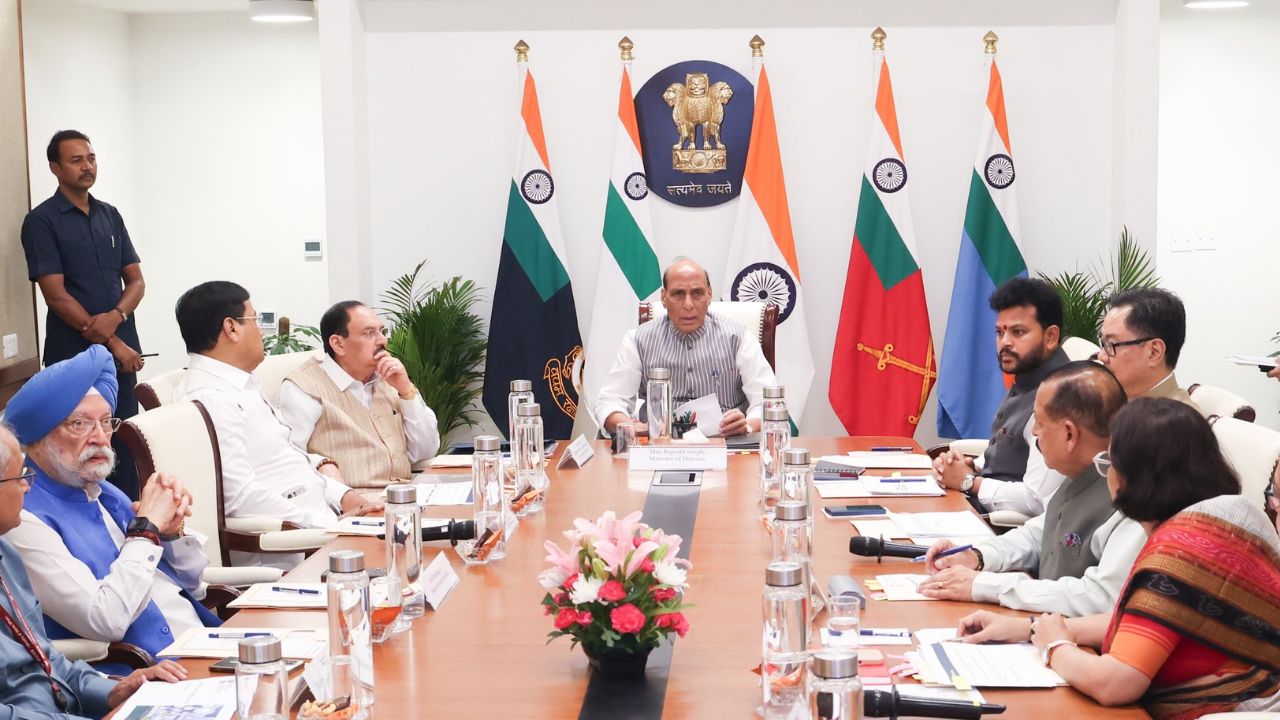
The lights in the situational awareness room of the Ministry of Defence do not flicker. They are steady, cool, and clinical, casting a pale glow over a map of West Asia that looks less like a geography lesson and more like a nervous system. When Defence Minister Rajnath Singh sat at the head of that table recently, he wasn't just looking at coordinates. He was looking at the price of a liter of petrol in a rural village in Uttar Pradesh. He was looking at the steady hum of a factory in Chennai.
He was looking at the fragile thread that connects your morning commute to a series of explosive flashpoints thousands of miles away. Building on this topic, you can also read: The Balochistan Disappearances and the Cost of Silence.
Geopolitics often feels like an abstraction—a game played by men in suits with silver pens. But for a nation like India, which imports over 80 percent of its crude oil, geopolitics is a physical weight. It is the literal energy that keeps the country moving. When the Middle East catches a fever, India feels the chills. This high-level ministerial meeting wasn't a routine briefing; it was a deep dive into the logistics of survival in a world where the sea lanes are increasingly contested.
The Anatomy of a Chokepoint
To understand why the Cabinet gathered in such a hurry, you have to look at the water. Specifically, the Persian Gulf and the Red Sea. These aren't just bodies of water. They are the carotid arteries of global trade. Experts at The New York Times have shared their thoughts on this situation.
Imagine a merchant ship captain—let’s call him Rajesh. Rajesh is commanding a VLCC (Very Large Crude Carrier) hauling two million barrels of oil toward the port of Jamnagar. As he approaches the Straight of Hormuz, the space between Oman and Iran narrows to a mere 21 miles wide. He knows that through this tiny gap flows a fifth of the world’s daily oil consumption.
For Rajesh, the "West Asia crisis" isn't a headline. It’s the drone signature on his radar. It’s the increased insurance premiums his company pays just to sail through "war risk" zones. It’s the haunting knowledge that if a single missile finds its mark, the economic shockwaves will reach his family back home before he even hits the pier.
During the meeting, Rajnath Singh and his colleagues—including top brass from the Ministry of External Affairs and petroleum experts—weren't just discussing "supply chain resilience." They were discussing how to keep Rajesh safe, and by extension, how to keep the Indian economy from seizing up.
The Butterfly Effect of a Barrel
When we talk about "energy security," the term feels cold. Let's make it warm.
Let's make it the heat coming off a stove in a small apartment where a mother is cooking dal. If the ships stop moving through the Bab-el-Mandeb strait because of Houthi rebel attacks, the cost of shipping that oil triples. The oil companies pass that cost to the refineries. The refineries pass it to the petrol pumps. The petrol pumps pass it to the truck drivers who haul vegetables from the farms to the cities.
Suddenly, the price of an onion in a Mumbai market is dictated by a skirmish in the mountains of Yemen.
The ministerial review focused heavily on this domino effect. India has spent decades diversifying its energy sources—buying from Russia, increasing domestic production, pivoting toward green hydrogen—but the reality remains stubborn. The Middle East is the heart of the world’s energy body. You cannot simply bypass the heart. You have to protect it.
The Strategy of the Shield
The meeting wasn't just a hand-wringing exercise over rising costs. It was a tactical assessment of the Indian Navy’s "Forward Presence."
Over the last few months, India has quietly deployed guided-missile destroyers like the INS Visakhapatnam and the INS Kochi into the Arabian Sea. They aren't there for show. They are there to act as the world’s most expensive bodyguards. When a commercial vessel sends out a distress call after a drone strike or a boarding attempt by pirates, it is often an Indian hull that arrives first.
This is a shift in India’s posture. We are no longer just a passive consumer of global stability; we are becoming a provider of it. Rajnath Singh’s review of these naval assets highlighted a crucial truth: in the modern world, your economy is only as strong as your navy’s reach.
The ministers pored over charts of "dark fleet" movements and the shifting allegiances of regional powers. They talked about the "Look West" policy, which has seen India build unprecedentedly strong ties with the UAE, Saudi Arabia, and Israel simultaneously. It is a delicate dance. India must be friends with everyone because it cannot afford to be enemies with anyone who controls a tap or a strait.
The Hidden Stakes of the Grid
There is a psychological element to these high-level meetings that rarely makes it into the press releases. It is the management of anxiety.
If the public senses that the energy supply is at risk, hoarding begins. If the markets sense that the government doesn't have a plan, the rupee slides. The very act of Rajnath Singh chairing this meeting is a signal to the world and to the Indian citizen: We are watching the horizon so you don't have to.
But the horizon is crowded. The conflict between Israel and Hamas, the tensions between Iran and its neighbors, and the persistent threat to Red Sea shipping create a "polycrisis." There is no single solution. You cannot just "fix" West Asia. You can only manage the fallout.
The meeting touched on the "Strategic Petroleum Reserves"—huge underground salt caverns filled with millions of barrels of oil, buried deep in the earth at places like Visakhapatnam and Mangalore. This is India’s "in case of emergency, break glass" fund. If the straits were to close tomorrow, these reserves would keep the lights on for a few weeks. It’s a terrifyingly short window, which is why the diplomatic efforts reviewed in that room are far more important than the military ones.
The Human Cost of the Map
Think back to the situational awareness room. The map on the wall is digital, glowing with thousands of tiny icons representing ships, pipelines, and refineries. Each icon is a community. Each pipeline is a lifeline.
The ministers discussed the safety of the nearly nine million Indians living and working in the Gulf. These workers send back billions in remittances, fueling the economies of states like Kerala and Punjab. If the region destabilizes, it isn't just about the price of oil. It’s about a massive human exodus. It’s about families being torn apart. It’s about the sudden loss of the primary income for millions of households.
This is the "human-centric" reality of a ministerial briefing. It’s not just about "reviewing supply chains." It’s about ensuring that the person driving an auto-rickshaw in Delhi can still afford to feed his children at the end of his shift.
The Long Shadow of the Straight
As the meeting adjourned, the sun was likely setting over the Raisina Hills, casting long shadows across the stone corridors of South Block. The decisions made in that room—to increase naval patrols, to speed up diplomatic back-channels, to secure long-term LNG contracts from Qatar—will take months to manifest.
We live in an era where distance has been erased by the speed of crisis. A spark in a suburb of Tel Aviv or a drone launched from a desert in Yemen travels at the speed of light to the stock exchange in Mumbai. We are all connected by these invisible threads of carbon and commerce.
The true work of government in these moments isn't just about reacting to the news. It’s about anticipating the silence. The silence of a factory that has run out of fuel. The silence of a port that has no ships to dock.
By the time the ministers left the room, the map was still glowing, the icons still moving across the digital blue of the Persian Gulf. The crisis in West Asia hasn't ended. It has merely been met with a calculated, quiet resolve.
The ship captain, Rajesh, continues his journey. He watches the radar. He feels the thrum of the engine beneath his feet. He doesn't know the specifics of what was said in the Ministry of Defence, but he knows the Indian Navy is somewhere just over the horizon. And for now, that is enough to keep the pressure in the pipes and the food on the table.
In the end, geopolitics is nothing more than the art of keeping the lights on in a darkening room.