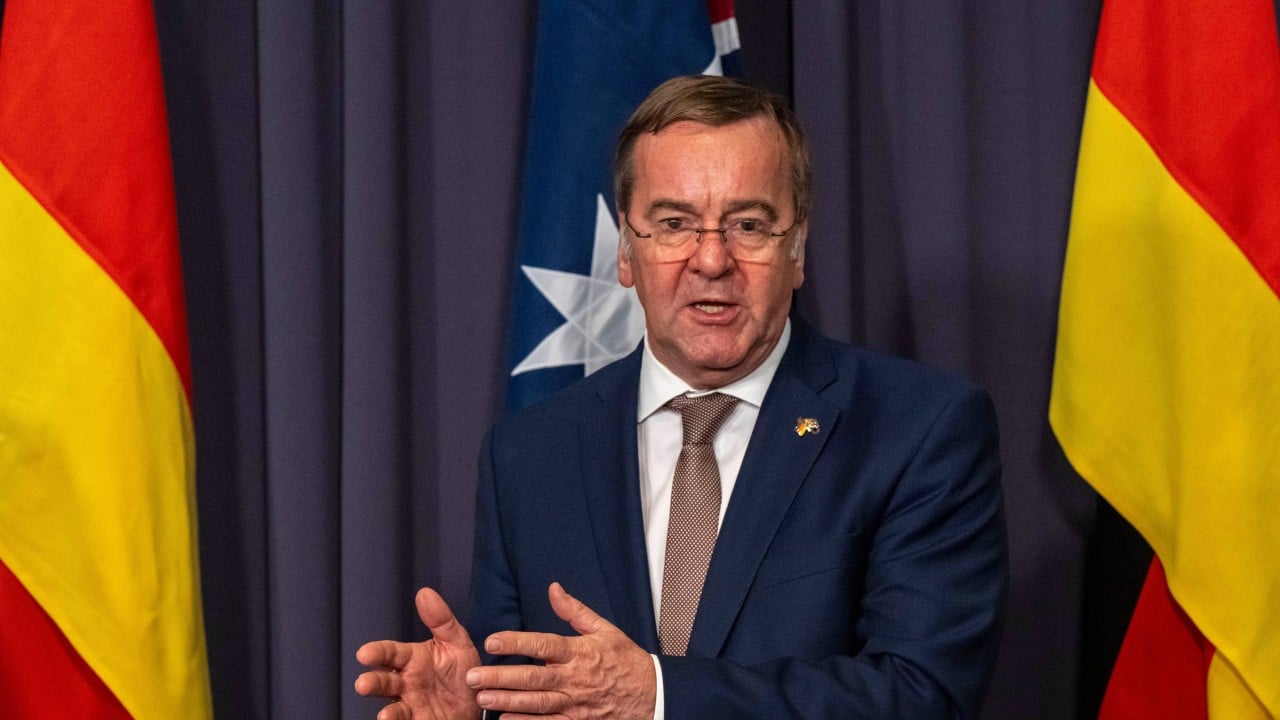
Imagine standing on a pier in Kiel, the salt air of the Baltic biting at your face, while your mind is stuck ten thousand miles away in the South China Sea. For Boris Pistorius, Germany’s Defense Minister, this isn't a mental exercise. It is the daily reality of a man trying to convince a continent that the safety of a Munich bakery or a Hamburg shipping terminal is inextricably linked to a series of tiny, disputed atolls in the Indo-Pacific.
The world is shrinking. Not in physical distance, but in the speed at which a tremor in one hemisphere becomes an earthquake in another. When Pistorius stands before international audiences to urge a "strong and reliable" American presence in the Indo-Pacific, he isn't just reciting diplomatic talking points. He is describing a survival strategy for a global order that feels increasingly brittle.
There is a specific kind of silence that follows a warning nobody wants to hear. In Europe, that silence is often born of the hope that if we look at the Atlantic long enough, the Pacific will take care of itself. But the cargo ships tell a different story. They carry the lithium for our electric cars, the semiconductors for our hospitals, and the clothes on our backs through waters that are becoming a geopolitical chessboard. If those lanes close, the lights don't just go out in Taipei or Manila. They flicker in Berlin.
The Weight of the Presence
Power is rarely about the shots fired. It is about the shots that are never taken because the cost of pulling the trigger is too high. This is the essence of deterrence. When the United States maintains a carrier strike group in the Indo-Pacific, it isn't just a display of hardware. It is a physical manifestation of a promise. It is the "invisible line" that keeps regional tensions from boiling over into a conflict that would paralyze global trade.
Pistorius understands that Germany—and Europe at large—has long been a passenger in this security arrangement. For decades, the West relied on a predictable rhythm of commerce. You build a product, you ship it, it arrives. But that rhythm is being disrupted by a new reality: the rise of a China that views the current maritime rules as a Western vestige rather than a universal standard.
Consider a hypothetical merchant sailor named Elias. He isn't a strategist. He doesn't read white papers. He cares about the weather and the depth of the water under his keel. If Elias feels that his route through the Taiwan Strait is no longer governed by international law, but by the whim of a single regional power, the insurance premiums for his ship skyrocket. Then the shipping company reroutes. Then the prices at your local grocery store climb. This is how abstract "security concerns" become the "cost of living crisis" at your kitchen table.
Beyond the Horizon
The German Defense Minister’s call for American involvement is also a mirror held up to Europe’s own limitations. It is an admission of vulnerability. For years, the Indo-Pacific was seen as a secondary theater, a place for "interest" but not necessarily "investment." That era ended the moment the global supply chain became a weapon of war.
Pistorius is pushing for a shift in the German psyche. He wants a Germany that doesn't just watch from the sidelines but contributes to the stability it consumes. This means sending frigates on long-range deployments. It means joint exercises with partners like Japan and Australia. It means acknowledging that the defense of "rules-based order" isn't a slogan—it’s the infrastructure of our modern lives.
But why the United States? Why can't the regional powers or Europe handle it alone?
Because history has a long memory. The presence of the U.S. acts as a stabilizer in a region where historical grievances run deep and trust is a scarce commodity. Without that "strong and reliable" anchor, the Indo-Pacific risks falling into a spiral of rapid militarization, where every nation feels it must arm itself to the teeth to survive the neighbors. In that world, a single mistake by a junior naval officer can trigger a cascade that no diplomat can stop.
The High Stakes of Hesitation
There is a persistent myth that we can choose which parts of the world matter to us. We talk about "de-risking" or "decoupling" as if we can neatly snip the threads of a global tapestry. The truth is messier. We are stitched together by fiber-optic cables on the ocean floor and trade routes that have existed since the days of sail.
When China asserts control over vast swaths of international waters, it isn't just claiming territory. It is claiming the right to decide who gets to participate in the global economy. If the U.S. pivots away—or if Europe fails to support that presence—we aren't just losing a strategic partner. We are surrendering the idea that the sea belongs to everyone.
The tension in Pistorius’s voice reflects a race against time. He sees the buildup of naval forces. He sees the "gray zone" tactics—the use of fishing fleets and coast guards to bully smaller nations without technically starting a war. These are not distant problems. They are the early warning signs of a world where "might makes right" replaces the rule of law.
The Human Cost of an Empty Sea
Think of a young tech entrepreneur in Seoul or a fisherman in the Philippines. Their entire future depends on the assumption that the waters surrounding them remain open. If that assumption fails, the capital dries up. The fish disappear. The dream of a stable, prosperous life evaporates.
This is what Pistorius is fighting for. It isn't about ships and planes. It’s about the girl in a village who can study by LED light because a shipment of components arrived on time. It’s about the stability of the pension funds that hold the savings of millions of workers. It’s about the quiet, uncelebrated peace that allows us to worry about mundane things instead of wondering if a blockade will start tomorrow.
The Minister's plea is a call to wake up. He is telling us that the "Far East" isn't far anymore. It is right here, in our pockets, in our cars, and in the very fabric of our democracy.
The invisible line across the Pacific is the only thing standing between a world of cooperation and a world of chaos. We can choose to reinforce that line, or we can watch it wash away with the tide, leaving us to wonder how we let something so precious slip through our fingers while we were busy looking the other way.
The waves hitting the shore in Kiel are the same ones that will eventually reach the South China Sea. We are all on the same beach, watching the same horizon, waiting to see if the ships still have a clear path home.