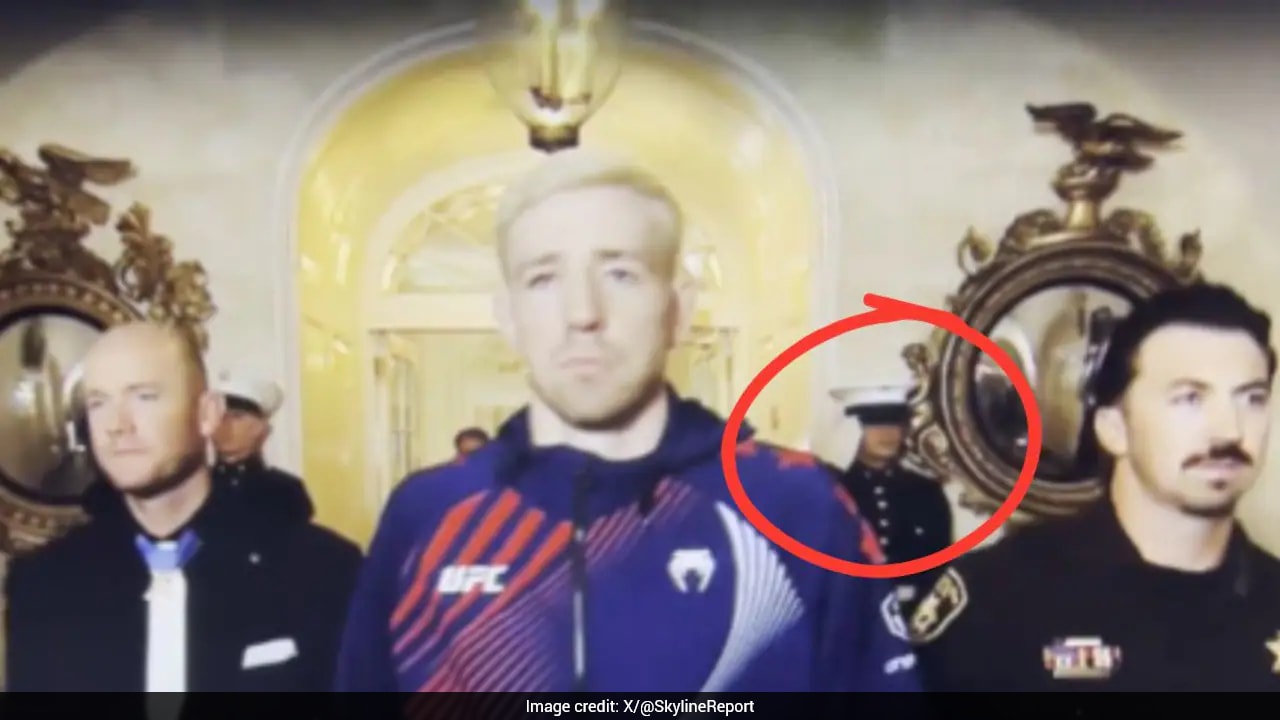
The brief clip captured exactly what millions wanted to see, or precisely what they feared American civic culture had become. In the video, two rows of U.S. Marines in dress blues stand at rigid attention on the South Lawn of the White House. As a shirtless, tattooed Ultimate Fighting Championship combatant strides past them toward a temporary steel cage, the Marines snap their hands to their brows in a crisp, synchronized military salute.
To the casual observer scrolling through social media, the visual message was unambiguous. The elite forces of the American military were rendering the ultimate sign of institutional respect to a professional prizefighter. Within minutes of the broadcast of UFC Freedom 250, the internet exploded. Critics decried the absolute degradation of military protocol, while enthusiastic fans cheered the ultimate crossover of warrior cultures.
Both sides missed the truth. The Marines were not saluting the fighter.
Behind the fighter, obscured by the camera angle and the chaotic energy of the walkout, walked Ty Carter, a former Army staff sergeant and a recipient of the Medal of Honor. By strict military regulation and deep-seated tradition, service members salute recipients of the nation’s highest military decoration, regardless of rank. The Marines were executing their duties precisely by the book. Yet the fact that this distinction required tedious internet fact-checking points to a much larger, coordinated effort to blend state power, military optics, and commercial blood sports for political theater.
The Choreography of Deception
The misunderstanding was entirely intentional. When you orchestrate a multi-million-dollar mixed martial arts event on the South Lawn of the Executive Mansion to coincide with a presidential 80th birthday and a geopolitical backdrop, nothing happens by accident. The event producers knew exactly how those walkouts would look on television.
By pairing fighters with aging combat veterans, wounded warriors, and Medal of Honor recipients for the walk to the Octagon, the organizers created a deliberate optical blur. On screen, the distinction between a state-sanctioned hero and a pay-per-view athlete dissolved. Heavyweight Josh Hokit walked out to the cage accompanied by a veteran in a wheelchair while Hulk Hogan’s theme song blared across the historic grounds. The visual currency of the American military was effectively borrowed to elevate a commercial enterprise.
This is the mechanics of modern political spectacle. It relies on the viewer absorbing the raw emotion of the image rather than analyzing its structural components. The average viewer does not look for the tiny blue silk ribbon around a civilian’s neck; they see the uniform, they see the athlete, and they conclude that the state is honoring the gladiator.
The Breakdown of Military Protocol
To understand why this caused such a visceral reaction among veterans, one must understand what a salute actually signifies. It is an act of official military courtesy, a recognition of the chain of command, and a profound acknowledgment of exceptional valor under fire.
According to Joint Ethics Regulations, active-duty personnel in uniform are strictly prohibited from participating in events that imply official Department of Defense endorsement of a private business or political cause. By placing these Marines along the walkway of a commercial sports broadcast, the lines were deliberately smudged.
- The Technicality: The Marines were positioned as an official honor guard for the venue, validating their presence on federal property.
- The Reality: They were utilized as human set dressing for a sports entertainment product, framed to generate viral engagement.
- The Consequence: The erosion of the military's perceived political neutrality in the eyes of the general public.
This tactical deployment of military imagery serves a dual purpose. It wraps a highly controversial event—hosting cage fights on the historic lawn of the White House during ongoing international tensions—in an armor of unassailable patriotism. To criticize the event becomes synonymous with criticizing the troops standing at attention.
The Privatization of Presidential Prestige
Historically, the White House lawn has been reserved for state dinners, foreign dignitaries, and the occasional celebration of championship team achievements. Transforming it into an arena for commercial blood sport marks a fundamental shift in how presidential prestige is leveraged.
The event was not a charity exhibition; it was a high-stakes corporate spectacle. By bringing the UFC directly into the seat of American executive power, the administration essentially granted an unprecedented multi-million-dollar branding opportunity to a private corporation. The Cabinet Room and the Roosevelt Room were converted into fighter warm-up areas. The Blue Room served as a staging ground.
This level of access cannot be bought with traditional advertising dollars. It requires a specific convergence of political alignment and personal relationships. When a corporate entity is allowed to use the architecture of democracy as its backdrop, the institution itself undergoes a subtle transformation. It ceases to be a solemn house of statecraft and becomes a highly lucrative stage for corporate synergy.
The Gladiator Ethos and Executive Power
There is a deeper, psychological undercurrent to this event that goes beyond mere optics or corporate favoritism. The deliberate alignment of executive authority with the raw, violent physical dominance of combat sports sends a specific message about power.
For decades, politicians have courted mainstream athletes—inviting Super Bowl winners or Olympic champions to the Oval Office for polite handshakes. But the UFC represents something entirely different. It is an subculture built on survival, individual dominance, and direct, unfiltered physical conflict.
By embedding this specific subculture into the fabric of the presidency, the administration signals a preference for a different kind of authority. It is an ethos that values strength, confrontation, and the total defeat of an opponent over the traditional, often tedious processes of diplomatic consensus and institutional norms. The cage on the lawn was not just an entertainment choice; it was a physical manifestation of a governing philosophy.
The danger lies not in the sport itself, which operates under strict athletic regulations and features world-class competitors, but in the flattening of American civic identity. When the ultimate symbols of military sacrifice, corporate entertainment, and executive power are melted down into a single, seamless prime-time broadcast, the public loses its ability to distinguish between public service and private spectacle. The Marines on the lawn did their duty perfectly, executing a flawless salute to a genuine hero. The tragedy is that they were placed in a circus designed to make us believe otherwise.