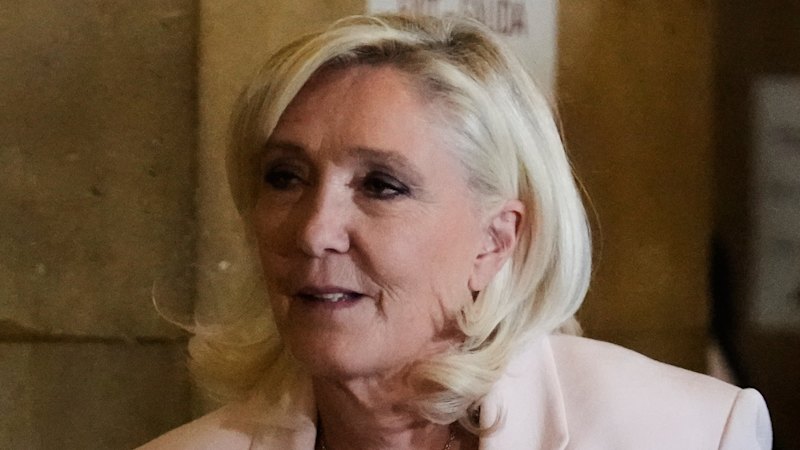
The highest office in France is now theoretically within reach of a convicted embezzler wearing a state-issued tracking device. On Tuesday, the Paris Court of Appeal delivered a ruling that managed to simultaneously confirm Marine Le Pen’s systemic corruption and offer her a legal escape hatch to run for the presidency in 2027. By shortening her initial five-year ban from public office to 45 months, with 30 of those months suspended, the three-judge panel wiped away the time obstacle that would have legally disqualified her. Because the remaining 15-month ban has been running since her original conviction in March 2025, she has technically served her time in the eyes of the law.
But the judicial system did not let her off scot-free. The appeals court upheld her conviction for orchestrating a massive, decade-long scheme to siphon millions of euros from the European Parliament to fund her cash-strapped domestic political apparatus. While reducing her overall prison sentence to three years, the court ordered that the mandatory one-year non-suspended portion be served under house arrest with an electronic ankle monitor. This creates an unprecedented political paradox. A major national candidate must now negotiate her campaign schedule with a sentencing judge, submitting to nightly curfews while asking the French electorate for the keys to the Elysee Palace. Also making waves lately: The Anatomy of Populist Risk Mitigation: A Brutal Breakdown.
For a nationalist party that built its modern reputation on hardline law-and-order rhetoric, the visual reality of a candidate in an ankle tag presents an existential crisis. Le Pen immediately huddled with lawyers and party top brass at the National Rally headquarters in Paris to plot her survival strategy. She has previously insisted that campaigning under such restrictive conditions would be completely unfeasible, leaving her dependent on judicial whims just to visit a local market or hold an evening rally. The judicial compromise may look like a victory on paper, but in reality, it sets up an operational nightmare that could force the far-right movement to make a agonizing choice between its historic leader and her 30-year-old protégé, Jordan Bardella.
A Verdict Structured to Protect Democracy or Protect the System
The appeals court ruling reveals a judiciary deeply uncomfortable with the accusation of engineering a judicial coup. When the lower court handed down its sweeping five-year ban last year, Le Pen’s allies accused the establishment of trying to eliminate the frontrunner of the 2027 election through legal warfare. The presiding appeals judge, Michèle Agi, noted that the court had to weigh the severity of the offense against the fundamental right of voters to choose their candidates. By declaring that the 15 months already served sufficed to address the breach of integrity, the court shielded itself from charges of election interference. More insights on this are covered by Al Jazeera.
Yet, this legal tightrope walk satisfies almost no one. Left-wing lawmakers immediately criticized the decision as an institutional surrender to political corruption, arguing that any ordinary citizen convicted of embezzling over four million euros would face immediate jail time rather than a custom-tailored campaign dispensation. Conversely, the National Rally views the electronic tag as an ongoing mechanism of political sabotage designed to hobble their leader during peak campaign season.
The mechanics of the sentence are brutally practical. In the coming weeks, a specialized enforcement judge will summon Le Pen to establish the precise parameters of her house arrest. While electronic monitoring is traditionally designed to let convicted individuals maintain regular employment, a national presidential campaign does not fit neatly into standard bureaucratic boxes. If the judge enforces a standard evening curfew, Le Pen’s signature prime-time television appearances and nighttime regional rallies will become legally impossible.
Inside the Industrial Machine of Far Right Funding
To understand why the court refused to completely pardon Le Pen, one must look at the sheer scale of the financial deception uncovered during the lengthy investigation. This was not a case of administrative mismanagement or a few rogue staffers filling out timesheets incorrectly. Prosecutors successfully demonstrated that between 2004 and 2016, the National Rally operated a centralized, highly structured system designed to cheat European taxpayers.
The financial reality of the party during those years was grim. The National Front, as it was then known, was chronically broke, frozen out by mainstream French banks, and struggling under the weight of mounting debts. The European Parliament provided a convenient pot of gold. Every member of the European Parliament receives generous budgets meant to hire assistants based in Brussels or Strasbourg to help with legislative work.
Instead, Le Pen and her inner circle used these funds to pay salaries for individuals whose actual jobs were entirely focused on building the party’s domestic infrastructure in France. European money paid for Le Pen’s personal bodyguard, her party secretaries, and graphic designers working exclusively on French regional elections. The paper trail left by the defendants was overwhelming, featuring internal emails explicitly discussing how to shift staff onto the European payroll to save the party from bankruptcy.
The Paper Trail that Upheld the Conviction
- The Fictional Contracts: Multiple individuals signed contracts as Brussels-based parliamentary assistants despite rarely setting foot in Belgium or possessing any knowledge of European legislative files.
- The Internal Alarm Bells: Financial administrators within the party sent explicit warnings to Le Pen regarding the legal dangers of utilizing European funds for domestic operational expenses.
- The Bodyguard Loophole: The court verified that public funds earmarked for legislative research were diverted to provide personal security services for Jean-Marie Le Pen and his daughter during purely domestic political activities.
The Gathering Shadow of Jordan Bardella
The structural dilemma created by the ankle monitor accelerates a quiet succession crisis that the National Rally has tried to suppress for months. Publicly, Jordan Bardella remains fiercely loyal to his mentor, blasting the judiciary and insisting that Le Pen remains the natural candidate for 2027. Privately, the dynamics of the party have fundamentally shifted.
Bardella has spent the last two years cementing his own independent power base. As a member of the European Parliament with a massive social media following, he represents a polished, modern iteration of the far right that appeals to younger voters who carry no memory of the party’s toxic roots under Jean-Marie Le Pen. If Marine Le Pen concludes that the physical and psychological toll of campaigning with an ankle monitor is too great, Bardella stands ready to step into the vacuum.
+-----------------------------------------------------------------+
|              THE NATIONAL RALLY DILEMMA FOR 2027                |
+-----------------------------------------------------------------+
|  MARINE LE PEN                   |  JORDAN BARDELLA             |
+-----------------------------------------------------------------+
|  • Decades of political stature  |  • Unblemished legal record  |
|  • Deep loyalty from party base  |  • Massive youth appeal      |
|  • Restricted by ankle monitor   |  • Total freedom of movement |
|  • Open to corruption attacks    |  • Lacks presidential weight |
+-----------------------------------------------------------------+
Replacing Le Pen is a high-stakes gamble. A Le Pen has been on the ballot in every French presidential election since 1988. The brand is synonymous with the movement, and many older, working-class voters view Marine Le Pen as a martyr persecuted by a globalist establishment. Bardella is highly capable, but he has never faced the intense, multi-week scrutiny of a national presidential campaign where opponents will dissect his policy gaps and lack of executive experience.
The Logistical Absurdity of a Monitored Candidate
The true impact of this ruling will be felt on the asphalt of the campaign trail. Presidential campaigns in France are grueling, chaotic marathons. They require spontaneous travel, late-night strategy sessions in Parisian restaurants, and early morning visits to wholesale food markets to shake hands with workers.
An electronic tag shatters this playbook. If Le Pen is required to be at her residence from 8:00 PM to 6:00 AM, her campaign team will have to build a bizarre schedule that cuts off all public activity before sunset. She would be effectively banned from attending late-night debates or participating in the crucial post-rally dinners where local political alliances are forged.
Furthermore, the psychological image of a potential commander-in-chief checking her watch to ensure she does not trigger an automated alarm to the local police department undermines the core message of nationalist strength. Her political opponents will waste no time turning her curfew into an emblem of hypocrisy, contrasting her party's demands for strict criminal sentencing with its leader's bespoke custody arrangement.
The Strategic Calculation for the French Left and Center
For the fragmented centrist coalition left behind by Emmanuel Macron and the resuscitated alliance of the French Left, the verdict provides a powerful weapon, though one that requires careful handling. Over-indexing on Le Pen's legal status could backfire by reinforcing her narrative of political martyrdom.
Instead, her rivals are likely to pivot toward the core issue of state financial integrity. They will ask voters a simple question: Can France afford to elect a president who is legally restricted from leaving her home at night because she stole public funds?
The ruling ensures that the 2027 election will not just be a debate over immigration, economic sovereignty, or France’s place in Europe. It will be a referendum on the basic rule of law. By leaving Le Pen legally eligible but physically restricted, the Paris Court of Appeal has placed the ultimate verdict in the hands of the voters, forcing the country to decide if a criminal record is a disqualifier or a badge of honor for the highest office in the land.