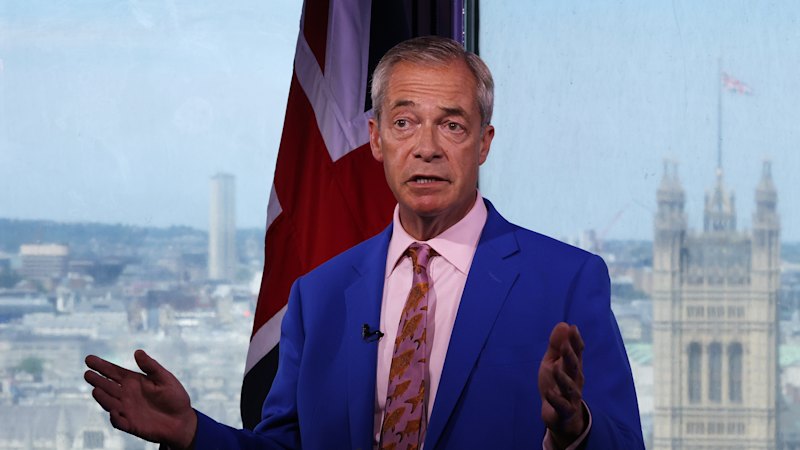
The announcement by Reform UK leader Nigel Farage to resign his parliamentary seat in Clacton-on-Sea to force an immediate by-election is not a spontaneous act of defiance. It is a calculated structural maneuver designed to exploit a loophole in legislative oversight and neutralize an accelerating compliance liability. By voluntarily vacating his seat amidst escalating investigations by the Parliamentary Commissioner for Standards regarding £5 million from cryptocurrency investor Christopher Harborne and undisclosed financial support from George Cottrell, Farage has applied a classic corporate asset-protection strategy to electoral politics.
The primary objective of this maneuver is the arbitrage of regulatory jurisdiction. Under parliamentary protocol, when a Member of Parliament resigns, ongoing standards investigations are typically paused or suspended, given that the subject is no longer within the immediate disciplinary purview of the House of Commons. Farage is capitalizing on this procedural friction to alter the timeline of his legal and political vulnerability.
The Calculus of Regulatory Arbitrage
To understand the mechanics of this decision, one must analyze the strategic bottleneck Farage faced. The Parliamentary Commissioner for Standards was advancing toward a verdict on the £5 million pre-election gift from Harborne, which Farage failed to declare upon entering parliament. The secondary vulnerability emerged via revelations concerning undeclared operational benefits—including private security, staff, and accommodation—provided by convicted fraudster George Cottrell.
Left uninterrupted, the regulatory trajectory followed a highly predictable cost function:
- A formal finding of a serious code of conduct breach.
- A recommended suspension from the House of Commons exceeding the 10-day threshold.
- The automatic triggering of the Recall of MPs Act 2015.
- A constituency-led recall petition requiring just 10% of eligible voters to permanently vacate the seat.
By triggering a voluntary by-election before the commissioner can deliver a final verdict, Farage short-circuits this deterministic sequence. The move converts an uncontrollable, legally mandated recall process into a self-controlled, front-run political contest. Farage has effectively priced the cost of a by-election—offering to have Reform UK cover the estimated £250,000 administration fee—against the catastrophic downside risk of a forced expulsion under the stigma of structural sleaze.
The Collusion of Avoidance: Opposition Contradictions
The strategic equilibrium shifted immediately following the announcement, as the major political entities—Labour, the Conservatives, and the Liberal Democrats—coordinated a total electoral boycott of the special election. Each party framed this as a refusal to participate in a "media circus" or "vanity project." However, a rigorous structural analysis reveals that this collective non-participation is an optimal risk-mitigation strategy for the establishment parties as well, disguised as moral high ground.
For the ruling Labour Party, entering a high-variance by-election in a heavily right-leaning leave constituency like Clacton presents an unfavorable expected value ($E[V]$). Defeat would inject fresh momentum into Reform UK, while victory is statistically improbable given Farage’s existing 8,400-vote majority from 2024.
The Conservative Party, led by Kemi Badenoch, faces an even sharper structural trap. Contesting the seat and losing badly would solidify Reform UK’s claim as the true vehicle of the British right. By opting out and labeling the contest a "fake by-election," the opposition parties are attempting to deny Farage the external conflict required to fuel his populist narrative framework.
This creates a highly unusual political vacuum. The institutional boycotted by-election ensures Farage will run virtually unopposed by major brands, guaranteed to reclaim the seat. However, this strategy carries a distinct structural limitation for Farage. The "people versus the establishment" narrative requires an active adversary. If the establishment refuses to enter the arena, the legitimacy of the mandate reclaimed in the ballot box is mathematically diminished.
The Residual Liability Framework
The fundamental flaw in Farage’s tactical reset is that it acts as a delay mechanism rather than a permanent shield. Regulatory arbitrage only functions if the underlying liability is extinguished. It is not.
The parliamentary rules dictate that if an individual under investigation is re-elected to the House of Commons, the Parliamentary Commissioner for Standards retains the discretionary power to resume the suspended probe, provided it remains proportionate and in the public interest. Consequently, the operational timeline is merely elongated:
[Voluntary Resignation] ──> [By-Election Victory] ──> [Re-entry to Parliament] ──> [Reactivation of Standards Probe]
When Farage returns to parliament post-by-election, the commissioner's investigation will inevitably conclude. If the final report mandates a suspension of over 10 days, the statutory recall mechanisms under the 2015 Act will reactivate. This would force a second by-election later in the year—one that the Conservative and Labour parties have already explicitly stated they will contest, as the legal facts of the financial non-disclosures will then be fully quantified and transparent to the electorate.
Farage’s strategy assumes that a massive electoral victory in the interim will create a political shield so formidable that the standards commissioner or the broader House of Commons will lack the institutional will to enforce a suspension. This is an application of the Trumpian playbook: attempting to override statutory compliance requirements via a direct mandate of populist validation.
The execution of this voluntary by-election yields an immediate tactical asset: it shifts the media narrative from defensive explanations of hidden crypto-wealth to an offensive campaign structure. But it exposes a long-term strategic deficit. Farage has spent his capital to buy a temporary reprieve from a compliance architecture that will be waiting for him the moment he steps back onto the floor of the House.


