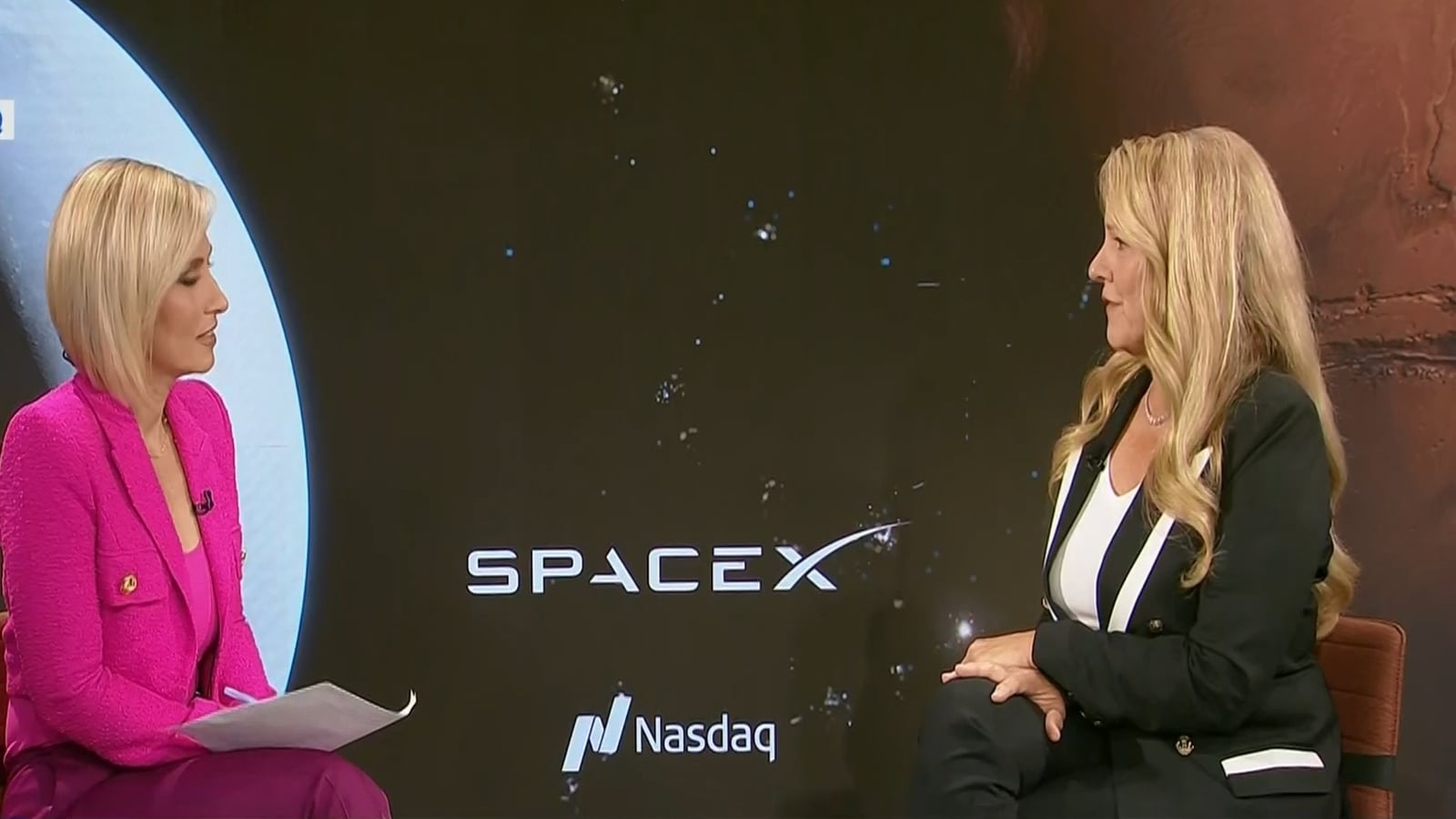
The largest stock market listing in history took place today, and it was not for an artificial intelligence company. SpaceX debuted on the Nasdaq under the ticker SPCX, hunting for a valuation that stretches toward $1.77 trillion. It raised $75 billion in a single stroke, vacuuming up institutional liquidity with an efficiency that has sent a chill through the broader tech ecosystem.
For years, Silicon Valley operates on the assumption that generative AI is the only game in town. The narrative was simple: build bigger models, burn more cash, and Wall Street will inevitably foot the bill. But the sheer scale of the SpaceX public offering changes the physics of the capital markets. It creates a massive gravitational pull that threatens to leave premier AI labs like OpenAI and Anthropic stranded in orbit.
Both AI giants have spent the spring filing confidential paperwork for their own trillion-dollar public debuts. They are hunting for the same institutional billions that just went into Elon Musk’s rocket company. The hard reality of public markets is that capital is finite. By taking $75 billion off the table on day one, SpaceX has exposed the structural vulnerability of the AI infrastructure boom. It is a massive crowding-out event that forces investors to choose between physical assets with captive revenue and purely digital models with ballooning expenses.
The Illusion of Infinite Institutional Liquidity
The standard defense from the venture capital contingent is that public markets are deep enough to absorb everything. They point to the $60 trillion commanded by the S&P 500. They argue that index inclusion alone will force hundreds of billions into these mega-listings over the next twelve months.
This argument ignores how institutional allocations actually work. Large-scale mutual funds, sovereign wealth vehicles, and pension boards do not have separate, bottomless buckets for "speculative tech." They operate within strict risk parameters and asset-class limits.
Mega-IPO Capital Demand (Summer 2026 Estimates)
┌───────────────────┬─────────────────────────┐
│ Company           │ Target Capital Raise    │
├───────────────────┼─────────────────────────┤
│ SpaceX            │ $75 Billion (Completed) │
│ Anthropic         │ $65 Billion (Sought)    │
│ OpenAI            │ $50+ Billion (Sought)   │
└───────────────────┴─────────────────────────┘
When a single company devours $75 billion in cash, asset managers rebalance. They do not simply add another $100 billion to their tech exposure the following month. Renaissance Capital data shows that the top three mega-deals are on track to raise more money than the rest of the US IPO market combined. This is not a rising tide lifting all boats. It is a tidal wave that leaves smaller listings, and even massive fast-followers, gasping for air.
Infrastructure Versus Interface
To understand why the SpaceX listing hurts OpenAI and Anthropic, one must look at what the companies actually sell. Public market investors are cynical by nature. They look for defensive moats, physical infrastructure, and predictable customer lock-in.
SpaceX is fundamentally an infrastructure play disguised as an aerospace company. Over 60% of its $18.7 billion in annual revenue comes from Starlink. It owns the physical satellites, the launch vehicles, and the ground stations. It is building orbital data centers designed to run AI workloads directly in space. If an enterprise wants satellite internet or space-based compute, they pay SpaceX. There is no open-source alternative to a Falcon 9 rocket.
Compare this to the structural position of OpenAI and Anthropic.
Both companies boast spectacular top-line growth. OpenAI is tracking an annualized revenue run rate of $25 billion, while Anthropic has surged toward $47 billion on the back of enterprise adoption for its Claude ecosystem. Yet, neither company owns its underlying infrastructure. They are entirely dependent on third-party cloud providers—primarily Microsoft, Amazon, and Google—to host their models and run their training clusters.
Every dollar of revenue generated by ChatGPT or Claude requires an immense payout to the cloud titans for compute power. They are interfaces built on top of someone else's hardware. When public investors analyze these S-1 filings, they see companies with massive revenues but structurally capped gross margins. SpaceX, despite its own heavy capital expenditures and quarterly losses, owns its destiny. OpenAI and Anthropic own a massive bill from their cloud providers.
The AI Capex Black Hole
The divergence in financial plumbing becomes obvious when evaluating how these entities spend money. SpaceX loses billions, posting a net loss of $4.28 billion in the first quarter alone. But that capital goes toward building reusable starships, manufacturing satellites, and securing real estate. It is capital expenditure that results in hard, depreciable assets that sit on the balance sheet.
The losses at the top AI labs are spent differently. They disappear into the compute furnace. Training a next-generation frontier model requires hundreds of thousands of specialized chips running for months at a time. Once that model is trained, its competitive edge lasts for perhaps twelve to eighteen months before a rival releases a cheaper, more efficient architecture.
The AI Capital Cycle: Private valuations of $850 billion to $960 billion assume that these labs can achieve a permanent monopoly on intelligence. In reality, they are trapped in an escalating arms race where the cost of entry rises exponentially, but the pricing power of the output trends toward zero due to intense open-source and commercial competition.
When Anthropic seeks an IPO valuation near $1 trillion after raising $65 billion in private markets, it is asking Wall Street to underwrite an ongoing research project. SpaceX is asking Wall Street to underwrite a utility network that already controls global orbital logistics.
The Valuation Disconnect
The timing of these filings reveals a deep anxiety within the AI sector. Private funding rounds have become so gargantuan—with OpenAI and Anthropic closing multi-billion-dollar chunks of capital just to stay ahead of training costs—that the venture capital ecosystem can no longer sustain them. The private markets are tapped out. The only way to survive is to transfer the burden to public equity markets.
But public markets require a level of transparency that could break the AI narrative. A private valuation is an agreement between a handful of optimistic insiders and a visionary founder. A public valuation is a daily, cold-blooded assessment by thousands of portfolio managers who care more about free cash flow than artificial general intelligence.
If SpaceX, with its tangible monopoly over space launch and satellite telemetry, faces scrutiny over its path to GAAP profitability, public investors will be brutal with companies whose core product can be mimicked by a well-funded engineering team anywhere in the world. The SpaceX IPO hasn't paved the way for OpenAI and Anthropic. It has raised the bar so high that their upcoming roadshows may face unprecedented skepticism. Investors who just deployed billions into physical orbital infrastructure are unlikely to turn around and risk the remainder of their portfolios on high-margin software businesses that lack a traditional software margin profile.