Money talks. Sometimes, it screams.
Walk through the bowels of a modern football stadium on a Tuesday night long after the floodlights have dimmed, and you can still hear the quiet hum of financial machinery. Balance sheets rustle like autumn leaves. Transfer fees echo off concrete walls. There is a comforting certainty to a checkbook, a clean mathematical logic that suggests if you spend fifty million pounds on a player, you are buying fifty million pounds worth of certainty. For a deeper dive into similar topics, we recommend: this related article.
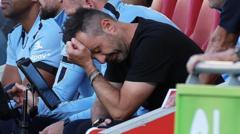
Roberto De Zerbi stood on a touchline recently, staring out at a pitch where logic goes to die.
He had inherited a project draped in expectation and funded by an abundance of capital. Yet, watching his team fold under the weight of an old, familiar inertia, the Italian manager looked less like a tactician plotting a victory and more like a man trying to nail jelly to a wall. You can buy the boots. You can buy the training ground with its heated turf and biometric sensors. You can even buy the player's signature on a lucrative, long-term contract. To get more details on this issue, in-depth coverage is available on NBC Sports.
You cannot buy the invisible ghost that haunts the dressing room.
The Anatomy Of A Rotten Habit
Habit is a terrible thing. It settles into the bones of a club slowly, like damp in an old cottage. At first, it is just a dropped point here, a missed tackle there, an excuse whispered in the tunnel. Then, it hardens into culture.
We have all worked in places where failure is the path of least resistance. You know the environment. The atmosphere is heavy with a strange, defensive fatigue. When things go wrong, shoulders drop. Eyes drift to the floor. The collective heartbeat of the group stutters, stops, and waits for someone else to carry the burden.
Spurs have wrestled with this ghost for decades. It is a losing mentality that defies rational explanation. You can change the manager, stripping away the old guard and bringing in a charismatic visionary like De Zerbi, who demands bravery, high-intensity possession, and relentless forward motion. You can hand him a war chest. You can line up world-class talent across the pitch.
And still, when the temperature rises and the match hangs in the balance, the old panic creeps back in.
Consider a hypothetical veteran midfielder, a player who has won league titles elsewhere, walking into this environment for the first time. He steps onto the training pitch, kicks a ball, and immediately notices the crispness of the passing, the sheer technical quality of his new teammates. On paper, this squad is terrifying. On the pitch, during a rainy Tuesday night away at a mid-table side, the same player feels a cold shiver down his spine. The moment the first goal goes in against them, he looks around. He sees the panic in the eyes of younger teammates who have only ever known how to collapse under pressure.
Cash cannot fix that. You cannot transfer a spine from a winning club into a losing one via a digital bank wire. Courage is not a commodity listed on the stock exchange.
The Mirage Of The Quick Fix
Modern football ownership is addicted to the illusion of velocity.
When a team stumbles, the board reaches for the defibrillator. Fire the manager. Sign a marquee striker. Splash the cash in the January transfer window. It is an understandable impulse. Action feels better than patience. Writing a massive check gives owners a fleeting sense of control, a dopamine hit that masks the deeper, structural rot beneath the surface.
De Zerbi knows this trap intimately. His career has been built on the unglamorous, agonizingly slow work of teaching players how to think differently. He does not want passive executors of game plans; he wants thinkers, risk-takers, players willing to invite pressure just to break it. That requires trust. It requires an environment where failure is treated as data rather than a capital offense.
When you inject millions into a club with a fractured psychological foundation, you often achieve the exact opposite of what you intended. You amplify the pressure. You create a gilded cage. Every misplaced pass is magnified by the price tag attached to the boots that made it. The supporters, exhausted by years of nearly-but-not-quite, run out of patience before the concrete foundation can even be poured.
The Price Of Fear
Fear is remarkably expensive.
Look at the ledger. Millions spent on wages for players who retreat into their shells when the crowd starts to murmur. Millions more paid in severance to a succession of elite managers who discovered, too late, that tactical brilliance is useless against a collective psychological block.
Football is ultimately a human drama played out under a magnifying glass. It strips away pretense. When a player is tired, bruised, and hearing fifty thousand people roar their disapproval, statistics cease to matter. Expected goals become meaningless numbers on a spreadsheet. In that microsecond of chaos, the player relies entirely on instinct.
If his instinct is conditioned by a history of late collapses, he will flinch.
De Zerbi is trying to rewire those instincts. It is a grueling, invisible task that will not show up on next quarter's financial report. It requires difficult conversations, dropping big names, breaking sacred cows, and enduring the ugly, messy transition period where things often get worse before they get better.
The Unforgiving Mirror
The real crisis at clubs like this is never about the talent on the pitch or the money in the bank. It is about a profound, systemic reluctance to look in the mirror.
Buying your way out of a crisis is an admission of cowardice. It says that you believe human spirit can be outsourced, that grit and resilience can be found in the next catalogue of international stars if you just pay enough commission.
Until that illusion is shattered, no manager, no matter how passionate or tactically astute, can lift the curse. The cash will flow, the stadiums will gleam, and the ghost in the dressing room will sit quietly in the corner, waiting for the first whistle to blow.