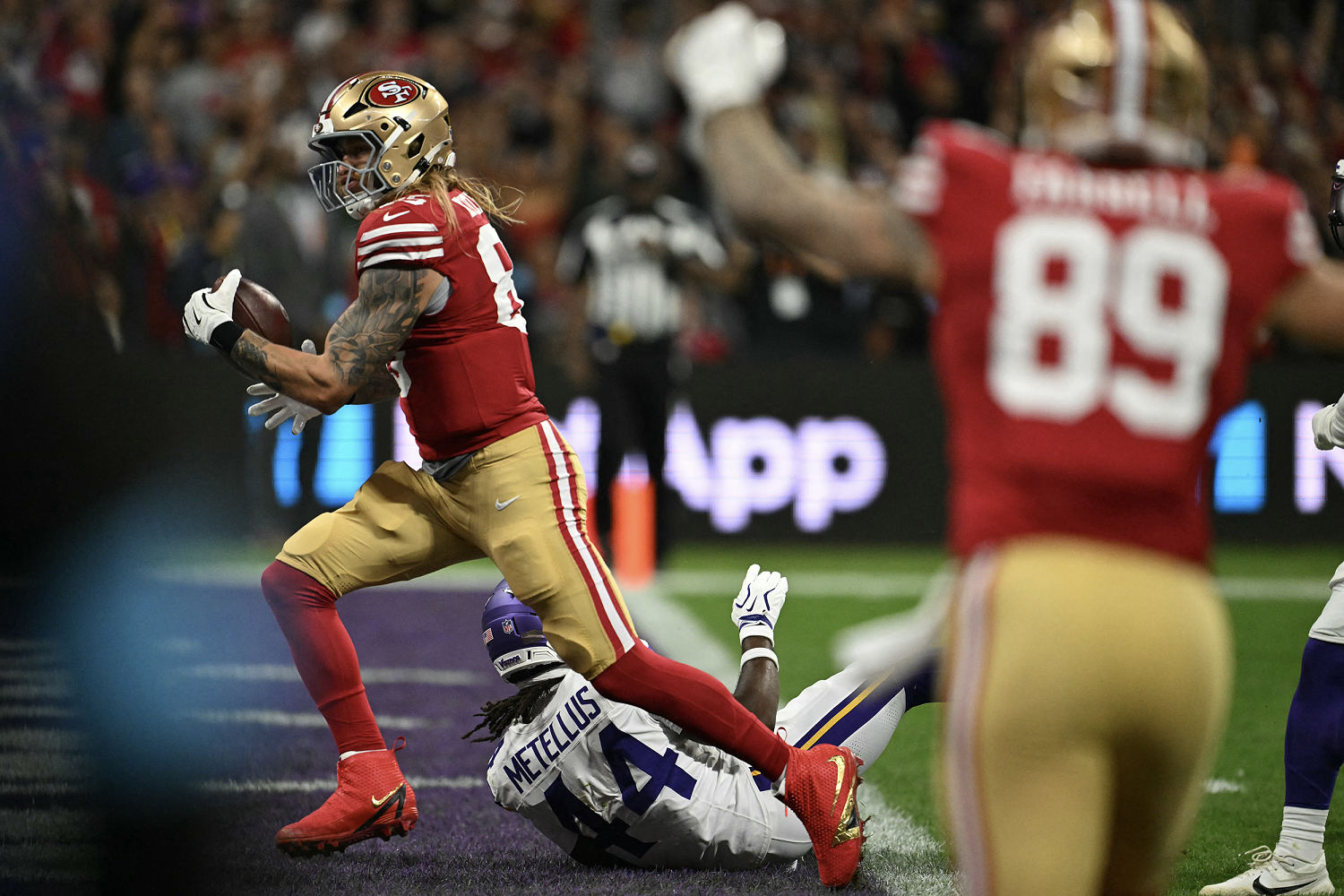
Winning an NFL game by 25 points while losing the time-of-possession battle and gaining only 19 more total yards than the opponent exposes a fundamental flaw in traditional box-score evaluation. On November 22, 2026, at Estadio Banorte in Mexico City, the San Francisco 49ers defeated the Minnesota Vikings 35-10. Conventional sports journalism framed the outcome as a heroic endurance test at 7,352 feet of elevation against the league’s most aggressive defensive unit. Operational analysis reveals a different reality: San Francisco systematically dismantled Minnesota’s defensive architecture through structural efficiency, spatial isolation, and superior conversion mechanics rather than sheer volume.
The Vikings entered Week 11 boasting a 7-3 record built on defensive chaos—a high-variance scheme designed to generate negative plays, sacks, and turnovers via disguised pressure packages. Against the 49ers, that engine stalled completely. Minnesota recorded just one sack, zero takeaways, and surrendered a season-high 35 points. Meanwhile, San Francisco improved to 9-1, posting 343 total yards on only 53 offensive snaps compared to Minnesota’s 324 yards on 65 snaps. Understanding how a team generates a 25-point margin from a 19-yard differential requires breaking down the mechanics of offensive efficiency, environmental resource allocation, and red-zone compression.
The Efficiency Paradox of Yardage Versus Scoring
Standard football metrics treat all yards as equal commodities. In practice, yardage value fluctuates wildly based on down, distance, field position, and play volume. During the Mexico City matchup, the Vikings held possession for 32 minutes and 23 seconds, running 12 more plays than San Francisco. A surface-level reading suggests a competitive, territorial struggle. The underlying rate metrics tell the exact opposite story.
San Francisco averaged 6.5 yards per play, whereas Minnesota managed 5.0. The divergence becomes sharper when isolating the passing game. Quarterback Brock Purdy completed 21 of 26 attempts (an 80.8% completion rate) for 255 gross yards and three touchdowns, yielding 9.4 net yards per pass attempt and a 146.0 passer rating. Conversely, Minnesota’s passing attack—split primarily between Kirk Cousins (26 of 38 for 235 yards, zero touchdowns, one interception) and Carson Wentz (3 of 5 for 29 yards)—produced just 5.9 net yards per attempt.
This disparity illustrates the Three Pillars of Offensive Conversion:
- Explosive Play Rate Over Drive Sustenance: Minnesota’s offense relied on low-yield, high-volume horizontal distribution. Wide receiver Tai Felton drew 12 targets for just 42 yards (3.5 yards per target), while Jauan Jennings caught three of six targets for 20 yards. Accumulating 19 first downs across 65 plays requires flawless execution over 10- to 12-play drives. Every additional snap increases the statistical probability of a drive-killing penalty, drop, or turnover. San Francisco bypassed this attrition entirely by generating 20 first downs on 53 plays, led by wide receiver Mike Evans averaging 18.2 yards per reception (six catches for 109 yards and a score).
- Red-Zone Compression Efficiency: Moving the ball between the 20-yard lines holds zero intrinsic value without terminal conversion. San Francisco entered the red zone four times and scored four touchdowns (100% touchdown efficiency), including two goal-to-go conversions. Minnesota reached the red zone three times and scored a single touchdown, settling for a field goal and coming away empty on another trip. When field space compresses near the end zone, vertical speed is neutralized, forcing offenses to rely on scheme design and contested-catch physicality. Tight end George Kittle caught three passes for 34 yards, yet two of those receptions resulted in touchdowns.
- Turnover Differential as a Force Multiplier: In a low-possession, high-efficiency game, a single non-offensive score alters the win-probability curve irreparably. San Francisco committed zero turnovers. Minnesota lost a fumble and threw an interception that safety Ji'Ayir Brown returned 18 yards for a touchdown. That single play accounted for seven points on zero offensive snaps, artificially depressing San Francisco’s time of possession while widening the scoreboard gap.
Neutralizing High-Variance Blitz Architecture
Defensive coordinators who rely on heavy blitz rates operate on a clear mathematical trade-off: they sacrifice coverage integrity in the secondary to shorten the quarterback’s processing window. Against undisciplined offenses, this creates a negative feedback loop of sacks, hurried throws, and third-and-long situations. Against Kyle Shanahan’s offensive structure, high-volume blitzing becomes a liability.
To defeat a blitz-heavy defense without surrendering sacks, an offense must solve three structural problems simultaneously: protection identification, hot-route alignment, and post-snap spatial exploitation. San Francisco executed all three at an elite operational level.
First, pre-snap motion and formation condensation forced Minnesota’s defenders to declare their leverage before the snap. When a defense brings five or six rushers, it must play either man-to-man coverage behind the pressure or drop into soft spot zones with clear voids in the intermediate middle. By aligning receivers tight to the formation and utilizing motion, Purdy identified the blitz origin before the ball was snapped, allowing the offensive line and running back Christian McCaffrey to slide protections toward the overload.
Second, Shanahan’s route concepts inherently punish aggressive second-level defenders. When linebackers vacate the middle of the field to blitz the A- or B-gaps, they leave an immediate vacuum behind them. San Francisco attacked those exact vacated zones using quick-developing in-breaking routes, seam passes to Kittle, and isolated one-on-one matchups on the perimeter for Evans. Because Purdy released the ball in rhythm, Minnesota’s pass rush rarely had time to reach the pocket, explaining why the Vikings managed only a single sack despite their season-long reputation for disruption.
Third, run-pass balance prevented Minnesota from pinning its ears back on obvious passing downs. Although San Francisco rushed for a modest 90 yards on 25 carries (3.6 yards per attempt), with McCaffrey contributing 49 yards and a touchdown on 12 carries, the threat of the outside-zone run game held Minnesota’s linebackers in place for a fraction of a second at the snap. In NFL pass protection, a half-second hesitation from a blitzing linebacker is the difference between a quarterback hit and a 20-yard completion.
The Physiological Economics of High-Altitude Competition
Playing at Estadio Banorte in Mexico City introduces an acute environmental variable: an elevation of 7,352 feet. At this altitude, barometric pressure drops significantly, reducing the partial pressure of oxygen in the atmosphere. While the percentage of oxygen in the air remains roughly 20.9%, each breath delivers approximately 20% to 25% fewer oxygen molecules to the bloodstream compared to sea level.
For an NFL roster, hypoxia alters the metabolic cost of every sprint. Anaerobic recovery slows down, lactic acid accumulates faster in skeletal muscle, and cognitive fatigue sets in earlier during the third and fourth quarters. Sideline oxygen tanks help accelerate recovery between series, yet they cannot prevent respiratory exhaustion during a 10-play defensive stand.
This physiological reality creates an asymmetric penalty depending on game state and defensive style. A blitz-heavy defense like Minnesota’s requires maximum-effort sprints from defensive linemen and defensive backs on every snap. When an offense sustains long drives or forces a defense to defend the entire width of the field, the defenders' anaerobic reserves deplete rapidly.
San Francisco weaponized the altitude through Time-of-Possession Inversion. By scoring 21 points in the second quarter alone, the 49ers seized a commanding lead before halftime. Once ahead by multiple scores, San Francisco forced Minnesota into a predictable, pass-heavy script in the second half. Minnesota ran 43 pass plays against just 21 rushing attempts. Conversely, San Francisco kept its own defense fresh by playing only 53 offensive snaps while allowing its defensive front to rotate freely and pin its ears back against a one-dimensional Vikings offense that was shut out entirely in the third and fourth quarters.
Structural Limitations and Operational Vulnerabilities
Evaluating a 35-10 victory purely as a flawless execution model ignores the underlying vulnerabilities embedded in San Francisco’s box score. Operational rigor demands isolating the friction points that could compromise this blueprint against different defensive archetypes in the postseason.
The primary limitation in San Francisco’s performance was early-down rushing inefficiency. Averaging 3.6 yards per carry on 25 attempts indicates that the 49ers struggled to generate consistent movement at the line of scrimmage. Against a defense that commits extra bodies to the box to stop the run, a 3.6-yard average is acceptable because it opens up the passing game. However, against a discipline-oriented, two-high shell defense—such as the structures employed by top AFC contenders—an offense cannot rely on a 9.4-yard passing average to compensate for a stagnant ground game. Two-high defenses concede underneath run lanes specifically to eliminate explosive intermediate passes. If San Francisco encounters a front four capable of stopping McCaffrey without needing linebacker blitzes, Purdy’s efficiency metrics will regress toward the league mean.
A second vulnerability emerged in penalty discipline. San Francisco committed six penalties for 49 yards, double Minnesota’s three infractions for 23 yards. In a game where the 49ers dominated third-down and red-zone efficiency, those 49 lost yards were absorbed without consequence. In a tight, low-scoring playoff matchup against an opponent that protects the football, surrendering nearly half a field of hidden yardage through procedural or coverage penalties frequently flips field position and stalls drives.
Finally, the 49ers' defensive box score reveals a bend-but-do-not-break fragility. San Francisco surrendered 324 total yards and allowed Minnesota to convert 7 of 14 third downs (50%) and 1 of 3 fourth downs. Minnesota’s running backs, Jordan Mason (11 carries for 38 yards) and Aaron Jones Sr. (8 carries for 30 yards and a touchdown), found moderate traction early, and Justin Jefferson still secured seven receptions for 86 yards on nine targets. The Vikings' offense did not fail to move the ball; it failed to finish drives, undone by two turnovers and red-zone stagnation. Against an opposing quarterback who avoids catastrophic mistakes in the red zone, allowing a 50% third-down conversion rate will result in sustained scoring drives rather than empty possessions.
Strategic Blueprint for Contenders Facing Blitz-Heavy Systems
The 49ers' dismantling of the Vikings provides a replicable operational manual for offensive coordinators preparing to face high-pressure, high-variance defensive schemes during the final stretch of the 2026 season and into the playoffs. Rather than attempting to out-physical a blitzing front, offensive staffs must execute a four-step tactical sequence:
- Eliminate Five- and Seven-Step Drops on Early Downs: Extend the quarterback's launch point artificially through play-action boots, or compress the drop to three steps with built-in hot reads. Do not ask offensive tackles to hold blocks for more than 2.5 seconds against simulated pressures.
- Target the Vacated Hook-to-Curl Zones: Map the defense's blitz tendencies by down and distance, then align tight ends and slot receivers to run shallow crossers and option routes directly into the space vacated by the blitzing linebacker. Force cornerbacks and safeties to make open-field tackles in space.
- Prioritize Red-Zone Isolation Over Volume: When crossing the opponent's 20-yard line, condense the formation to create natural rubs and leverage advantages for big-bodied receivers and tight ends. Avoid horizontal perimeter screens that allow fast, pursuing defenses to rally to the ball.
- Weaponize Early Scoreboard Leverage: Defer the opening kickoff if given the choice, or script an aggressive, high-tempo opening drive aimed at scoring a touchdown rather than establishing the run. High-variance defenses are built to protect leads or play in neutral game scripts; forcing them to play from a two-score deficit strips them of their blitzing optionality and exposes their secondary to sustained vertical stress.