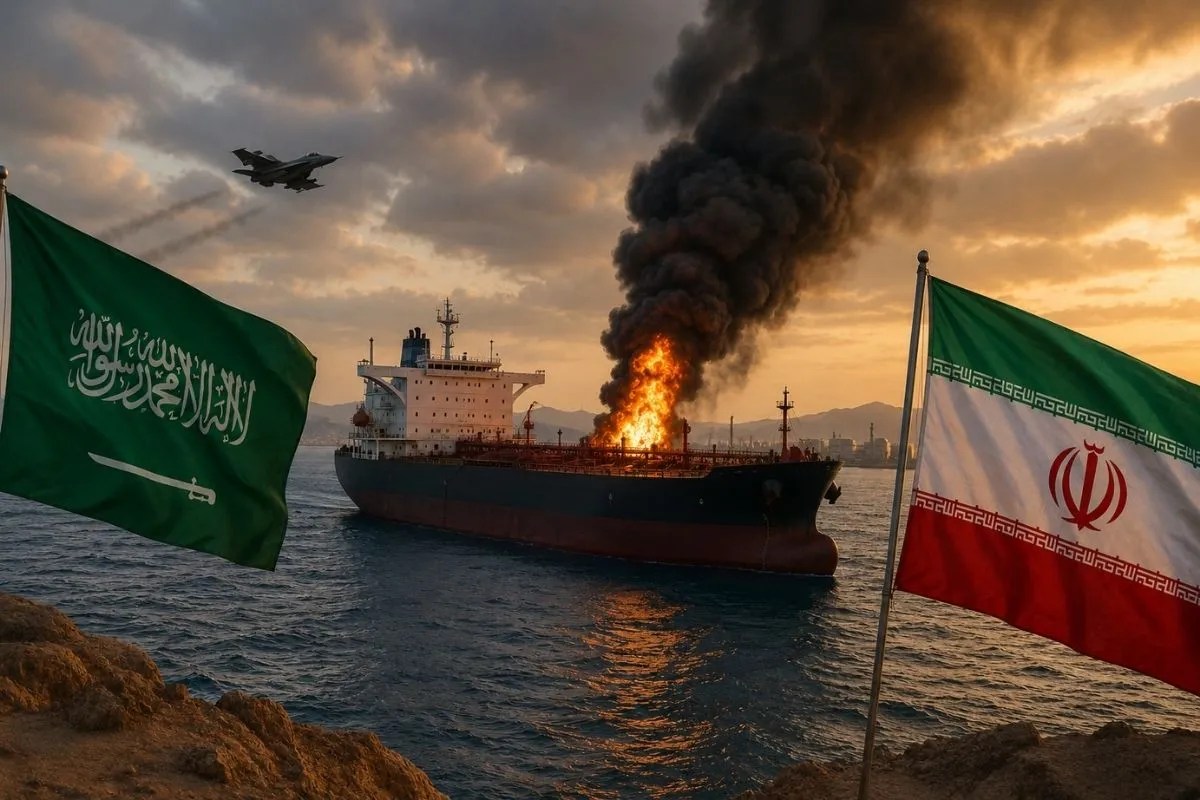
Navigational security through critical maritime choke points operates on a strict economic and military threshold where force projection must directly offset asymmetric deterrence. When the United States military executed a coordinated offensive striking nearly 60 targets while escorting 40 commercial vessels carrying 18 million barrels of oil through the Strait of Hormuz, it exposed the structural mechanics of modern maritime protection under wartime constraints. This operation represents a massive allocation of national power to normalize a baseline throughput that, prior to hostilities, occurred autonomously as routine global commerce. Deconstructing this event requires moving past tactical headlines to examine the underlying cost functions, asset allocation limits, and structural bottlenecks defining energy transit security.
The Asymmetric Defense Cost Ratio
The economic reality of securing a 21-mile-wide channel against a littoral adversary involves severe cost asymmetry. Protecting commercial shipping against distributed asymmetric threats—such as anti-ship cruise missiles, loitering munitions, mobile rocket launchers, and mine-laying capabilities—requires deploying high-value multi-domain assets, including air, sea, and space-based platforms. Learn more on a related topic: this related article.
The fundamental financial equation governing this operation creates an unsustainable long-term ratio:
- Defensive Expenditure: Sustaining air defense batteries, naval combatants, continuous combat air patrols, and specialized electronic warfare assets consumes capital at an exponential rate.
- Offensive Persistence: Adversarial forces employing mobile land-based systems operate on a low-cost capital expenditure model, allowing them to absorb attrition and reconstitute capabilities.
This dynamic explains why military planners privately characterize sustained strike campaigns near the waterway as an iterative cycle of degradation rather than a permanent neutralization. When targets are repeatedly struck to eliminate radar installations, maritime assets, and communications hubs, the adversary absorbs the loss and rebuilds capability through decentralized architecture. Security is thus maintained not by achieving absolute deterrence, but by imposing a localized operational tempo that suppresses hostile tracking long enough for convoy windows to clear. More journalism by TIME delves into comparable views on this issue.
The Throughput Recovery Paradox
Baseline capacity through the Strait of Hormuz historically hovered around 20 million barrels per day. The six-month conflict introduced severe friction, reducing transit to a fractured trickle and injecting persistent volatility into global energy futures. Moving 18 million barrels in a single coordinated surge approaches pre-war volume benchmarks, but this metric masks structural fragility.
Commercial risk appetite cannot be reset by a single high-water mark of military escort execution. Energy companies and marine underwriters evaluate risk on statistical probability of asset loss over time, not isolated tactical successes. Even with intensive naval protection neutralizing incoming drone waves and missile strikes, insurance premiums and war-risk surcharges remain elevated. The operation demonstrates that physical passage is possible under direct naval cover, but it fails to establish self-sustaining commercial confidence. Shippers view the transit corridors as high-threat zones requiring active military babysitting, which restricts volume to rigid, highly choreographed convoy schedules rather than fluid, market-driven dispatching.
Strategic Opportunity Costs and Resource Reallocation
Executing a high-intensity naval escort and suppression campaign requires shifting finite military resources away from other global or regional strategic imperatives. When Central Command directs its primary focus toward maintaining the maritime blockade, suppressing coastal threats, and enforcing economic isolation on Iranian ports, secondary objectives face immediate friction.
Operational bandwidth is zero-sum. The concentration of air, sea, and space assets into the Persian Gulf corridor creates a gravitational pull that forces a re-evaluation of broader defense priorities. Long-term strategic initiatives, such as monitoring advanced nuclear programs or managing multi-theater readiness, experience immediate degradation as assets are re-tasked to tactical force protection and choke point management. This reallocation underscores the primary vulnerability of superpower posture: local tactical escalation can successfully secure an economic corridor while simultaneously straining systemic strategic depth.
The Structural Impasse of Littoral Interdiction
Controlling a maritime choke point bordered by a hostile, heavily armed coastline defies permanent tactical solutions. A naval blockade combined with pre-emptive strikes on infrastructure degrades offensive capabilities, but it cannot alter geography. The Strait of Hormuz remains within range of shore-based anti-ship systems that can be rapidly repositioned, concealed, or rebuilt.
For commercial markets, this means the threat environment is structural rather than episodic. Energy pricing will continue to price in a permanent risk premium as long as transit relies on military convoys to suppress coastal opposition.
Abandon reliance on static escort models for sustained energy flows; instead, enforce an institutionalized, multi-national maritime security framework that permanently distributes the operational asset burden across all net-importing economies dependent on the corridor.