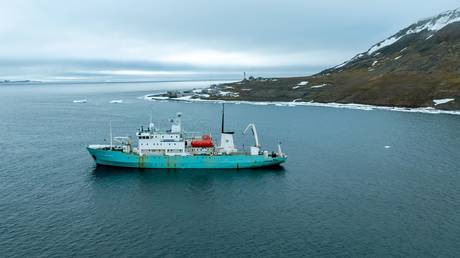
Denmark is deploying its newly minted conscripts directly onto the frozen expanse of Greenland under the banner of military exercises, a high-stakes geopolitical maneuver triggered by intense friction with the United States and escalating superpower competition in the High North. For decades, Copenhagen treated its vast semi-autonomous northern territory as an afterthought, maintaining only a nominal military footprint. That complacency died the moment Washington began treating Greenland not as an allied neighbor, but as an acquisition target. Now, young draftees undergoing expanded military service find themselves thrown into one of the most hostile environments on earth to serve as a literal geopolitical tripwire.
The optics are stark. Conscripts from Denmark’s first cohort under an extended eleven-month national service program are stepping off transport planes into the biting winds of Kangerlussuaq and Nuuk. Officially, this deployment is part of Operation Arctic Endurance, a training cycle nested inside broader NATO initiatives like Arctic Sentry designed to check Russian and Chinese ambitions in the polar ice. Everyone in intelligence and defense circles, however, understands the unspoken reality. This is a message written in human bodies. By planting young European soldiers on the ice, Copenhagen is attempting to raise the political cost of any unilateral American annexation maneuver. For a more detailed analysis into this area, we recommend: this related article.
The Anatomy of a Forgotten Frontier
To understand why a handful of draftees matters, look at a map upside down. The shortest route for intercontinental ballistic missiles between North America and Eurasia arcs directly over the Greenlandic ice sheet. The United States has understood this geographical fact since the Cold War, maintaining a permanent, heavily strategic footprint at Pituffik Space Base in the island's remote northwest. What Washington overlooked—or chose to ignore—was Denmark's chronic underinvestment in local sovereignty enforcement.
For years, the Royal Danish Navy maintained a skeleton crew of dog sled patrols known as the Sirius Patrol, alongside a few aging cutters. It was a picturesque tradition rather than a credible defense strategy. Danish Defense Minister Troels Lund Poulsen openly admitted that his government neglected Arctic defense for generations. When the White House renewed aggressive rhetoric regarding the purchase or acquisition of Greenland under the guise of national security, Copenhagen scrambled. A multi-billion-dollar defense injection followed, featuring plans for new Arctic vessels, advanced drone platoons, and modernized command centers. For broader background on the matter, extensive analysis can also be found at Al Jazeera.
Money, however, takes time to turn into steel and combat power. Conscripts are available right now.
The Conscription Gamble
The timing of Denmark's expanded conscription law is entirely tied to this convergence of geopolitical pressures. Faced with simultaneous threats from a revanchist Russia in Eastern Europe and American coercion in the North Atlantic, the Danish parliament pushed through sweeping military reforms. Compulsory service was stretched from four months to eleven, and the intake quota was scaled upward while opening the draft universally to women.
Pushing these raw recruits into Greenlandic exercises introduces a fascinating layer of operational friction. Arctic survival is unforgiving. Equipment freezes, navigation fails without satellite constellations, and human error compounds rapidly when temperatures plummet far below zero. Company commanders on the ground insist the training is purely about operational competence in harsh climates. Yet, the presence of live ammunition contingencies, blood plasma supplies, and tactical asset reinforcements whispers of a very different operational playbook.
The friction between traditional allies has created bizarre diplomatic contortions. While European partners like France, Germany, and Sweden have dispatched personnel for joint solidarity exercises, other NATO members have balked. Some Southern European capitals privately questioned whether turning an internal Western dispute into a military standoff makes strategic sense. Meanwhile, Moscow watches the infighting with undisguised amusement, while simultaneously condemning NATO's expanded footprint as a provocation that increases the risk of accidental escalation.
The Strategic Reality Beneath the Ice
The fundamental problem with using conscripts as a geopolitical shield is that deterrence only works if the adversary believes you are willing to absorb the blow. A handful of teenagers from suburban Copenhagen shivering on the tundra will not stop a battalion of U.S. Marines if an administration in Washington decides that absolute control of the Arctic is non-negotiable.
Instead, these draftees represent a tripwire strategy lifted straight out of Cold War playbook chapters. Injuring or capturing allied European soldiers during a unilateral land grab creates an immediate political catastrophe for the aggressor. It instantly transforms a diplomatic bullying tactic into an outright casus belli within the Western alliance structure. It forces an existential crisis onto NATO, demanding an answer to what happens when a superpower decides to consume the territory of its own protectorate.
The ice over Greenland is melting due to shifting global climates, opening up unprecedented maritime shipping lanes and vast, untapped mineral wealth beneath the permafrost. That environmental collapse has transformed a quiet indigenous territory into the center of a new global scramble for resources. China maps the seabed with research vessels while building its self-declared near-Arctic status. Russia rebuilds Soviet-era northern bases with nuclear-capable infrastructure.
Denmark is trying to write itself back into a story it nearly slept through. Whether an island nation of six million people can successfully deter both great power competition from the East and predatory ambition from the West using a few hundred rotated conscripts remains the most dangerous unanswered question in the North Atlantic.
The transport planes continue to land at Kangerlussuaq, disgorging fresh platoons into the wind. They are young, they are heavily bundled against the polar gale, and they are standing right on the fault line of the next global resource war.