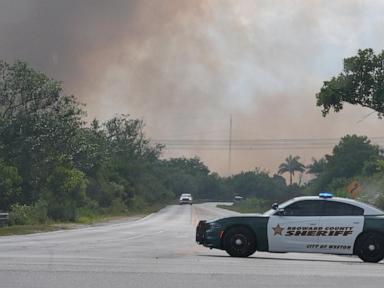
The smoke hanging over the Miami skyline isn't just a seasonal nuisance. It is a warning. As of May 12, 2026, over 11,000 acres of the Florida Everglades are smoldering, with the Max Road Fire in western Broward County serving as the violent centerpiece of a state-wide crisis. While the Florida Forest Service and National Guard scramble to contain the blaze, the narrative being sold to the public—that this is simply a byproduct of a dry spring—is a dangerous oversimplification.
The real story lies in a perfect storm of structural drought, shifting jet streams, and a decades-long mismanagement of the water levels that once kept the "River of Grass" from becoming a tinderbox. For the third day, crews are battling 15-foot flames that have jumped containment lines, threatening the Holly Lake community and forcing "blackout" conditions on U.S. 27. But as the helicopters drop thousands of gallons of water on the sawgrass, the underlying reality remains. Florida is drying out, and the mechanisms we’ve built to control nature are now accelerating its combustion.
The Anatomy of an Outbreak
This isn't a single fire. It is a systemic failure. The Max Road Fire has consumed 11,000 acres and is currently only 50% contained. To the south, the 172nd Avenue Fire near Florida City has scorched another 300 acres, briefly severing the main artery to the Florida Keys.
Firefighters are dealing with "southern rough"—a volatile mix of palmetto, gallberry, and wax myrtle that burns with an intensity usually reserved for the canyons of the West. When the humidity drops into the 20% range, as it has this week, these fuels don't just burn. They explode.
- Fuel Loading: Years of suppressed small fires have led to a massive buildup of dead organic matter.
- The Humidity Trap: With temperatures hitting record highs for May, the air is literally sucking the moisture out of the soil.
- The Wind Factor: Sustained winds of 15 mph with 30 mph gusts are pushing embers miles ahead of the main front, starting new fires in inaccessible marshland.
The Drought Nobody Saw Coming
While the official reports cite a "spring drought," the data suggests something more permanent. Since July 2025, the Southeast has been locked in a moisture deficit that has reached "exceptional" levels on the U.S. Drought Monitor. A persistent high-pressure ridge in the jet stream has acted as a physical barrier, shunting the rain-bearing systems that typically soak the peninsula north toward the Atlantic.
The result is a landscape where the water table has dropped so low that the peat—the very ground beneath the Everglades—is beginning to dry. When peat catches fire, it doesn't burn with a visible flame. It glows underground, moving like a slow-motion ghost that can resurface weeks later, long after the surface fire has been "contained."
This is the nightmare scenario for the Florida Forest Service. You can’t put out a fire that is burning three feet under the surface with a helicopter. You need a rising water table, and right now, that water is being diverted to satisfy the demands of a growing coastal population and industrial agriculture.
The Human Element and Infrastructure at Risk
The Florida Forest Service estimates that nearly 85% of these fires are human-caused. This isn't just about tossed cigarettes. It is about the friction between a sprawling urban interface and a wild ecosystem.
In the current Max Road blaze, the National Guard has been called in to assist because the fire is encroaching on critical infrastructure. Railroads are threatened. Power lines, which can spark and start secondary blazes when hit by debris or even Mylar balloons, are under constant surveillance. The Holly Lake community serves as a grim example of the "Wildland-Urban Interface" problem. Homes are built right up against the sawgrass, leaving residents with a single dirt access road that the fire can—and has—blocked.
The Policy Failure
We have spent a century "reclaiming" the Everglades, which in Florida-speak means draining it. By forcing water out to sea to make room for developments and sugar cane, we have removed the natural firebreak that historically protected South Florida.
Experts like Steve Davis of the Everglades Foundation have been clear: it is natural for the glades to dry down, but not to dry out. When the wetlands dry out, the ecology changes. Native species are replaced by invasive, highly flammable plants like melaleuca. We have essentially replaced a wet sponge with a stack of old newspapers and are now surprised when a spark sets it off.
Survival in the Smoke
For the residents of Miramar, Weston, and Pembroke Pines, the immediate concern isn't land management—it’s breathing. The "blackout" conditions on the roads are caused by a mix of water vapor and particulate matter that creates a literal wall of white.
If you are in the path of the plume, the standard advice to "recirculate air" is a stopgap. The particulate matter in wood smoke, known as PM2.5, is small enough to enter the bloodstream directly through the lungs. For the elderly and those with respiratory issues in South Florida, these wildfires are a public health crisis that rivals a minor hurricane in terms of long-term impact.
Immediate Action Steps
The situation will not improve until the "low-pressure systems" forecast for late May actually deliver significant rainfall. Until then, the state is in a defensive crouch.
- Strict Burn Bans: If your county hasn't issued one yet, act as if it has. Even a lawnmower blade hitting a rock in dry grass can start a five-acre brush fire in minutes.
- Defensible Space: If you live near the Everglades boundary, clear the dead vegetation within 30 feet of your structure. The fire department cannot save a house that is surrounded by a natural fuse.
- Visibility Awareness: If you are driving on US-27 or I-75 and hit a smoke bank, do not slam on your brakes. Turn on your low beams and maintain a steady, slow speed. High beams will only reflect off the smoke and blind you further.
The fires of 2026 are not an anomaly. They are the logical conclusion of a state that continues to build in the path of a fire-dependent ecosystem while simultaneously removing the water that keeps that fire in check. The crews on the ground are doing heroic work, but they are fighting a war that was lost decades ago in planning commission meetings.