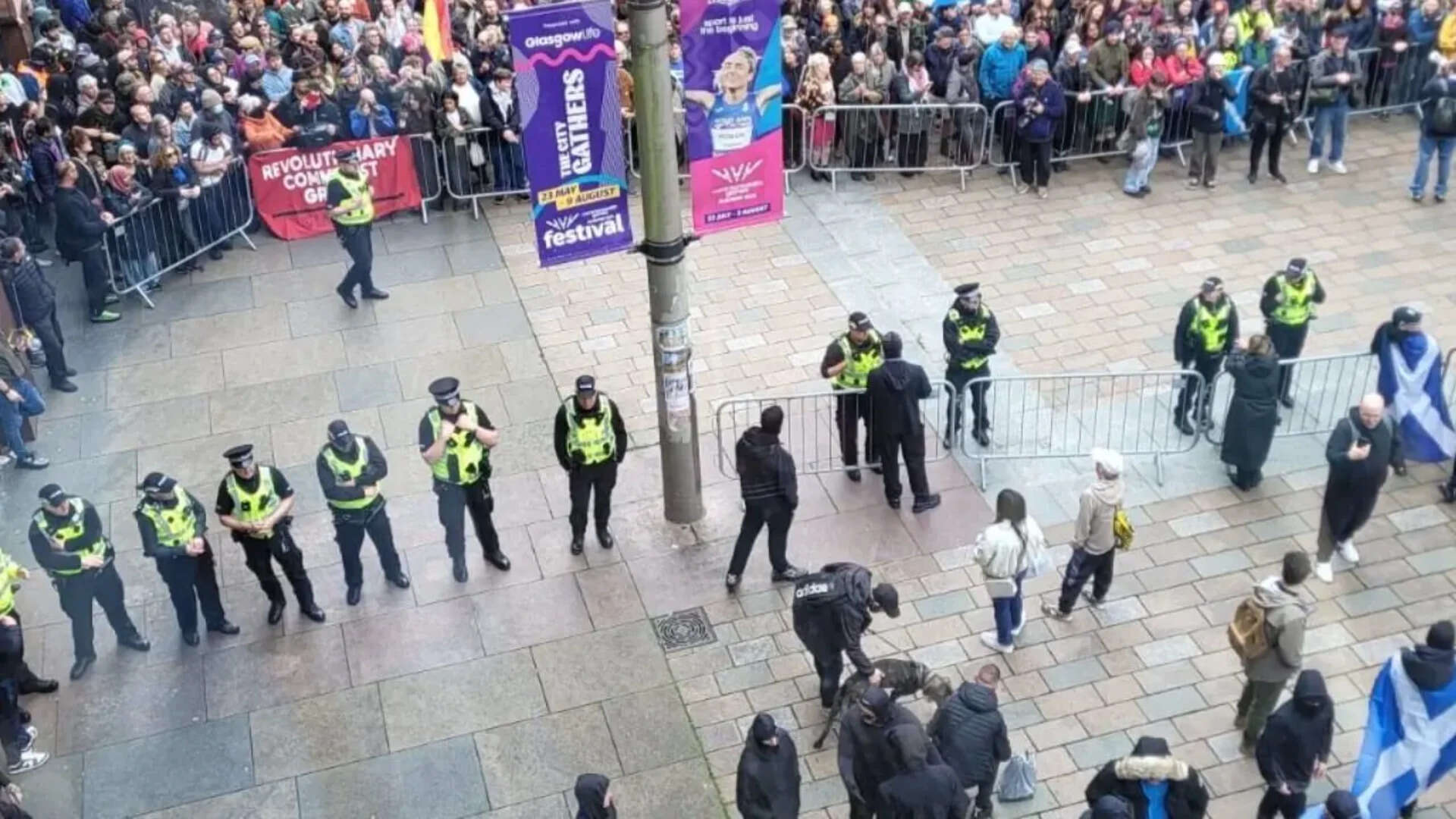
The media playbook for civil unrest is entirely predictable. A horrific crime occurs. Bad actors weaponize it online to spark localized violence. Riots break out. Then, forty-eight hours later, thousands of well-meaning citizens fill the streets holding placards that read "Belfast Against Racism." The editorial boards cheer. The political establishment breathes a sigh of relief. The narrative is neatly packaged: a small, fringe element of bigots tried to tear the city apart, but solidarity won the day.
It is a comforting bedtime story. It is also completely wrong.
By focusing entirely on the optics of the counter-protest, the mainstream media missed the actual mechanics of what just happened in Northern Ireland. They mistook a temporary peace rally for a structural solution. Street protests do not fix deep-seated economic stagnation, failed immigration logistics, or the vacuum left by a paralyzed devolved government. In fact, by treating anti-immigrant unrest as merely a moral failure of the working class rather than a predictable symptom of systemic neglect, the establishment ensures that these riots will happen again.
The Illusion of Solidarity
The lazy consensus insists that public demonstrations of unity are an effective antidote to hate. They are not. They are social valium. They make the middle class feel better about themselves while leaving the material conditions of the affected neighborhoods completely untouched.
When thousands gather in front of Belfast City Hall, who is actually in the crowd? It is largely trade unionists, NGO workers, students, and politicians. They are the individuals who live in affluent suburbs, insulated from the hyper-localized friction that occurs when public services are stretched to their breaking points. Meanwhile, the actual violence occurs in underfunded, post-industrial enclaves where competition for social housing, GP appointments, and low-skilled jobs is at its fiercest.
Calling a rioter a racist is easy. It requires zero intellectual heavy lifting. What is difficult—and what the mainstream media refuses to do—is analyzing why certain communities are so easily radicalized by digital disinformation.
I have spent years tracking how fringe political movements hijack local grievances across the UK and Ireland. The formula never changes. They do not invent anger out of thin air; they exploit a pre-existing vacuum. When a community feels abandoned by its government, a bad actor with an internet connection becomes the only person offering an explanation, no matter how toxic that explanation is.
Dismantling the Counter-Protest Myth
Let us look at the actual utility of these unity rallies. If public displays of solidarity worked, Northern Ireland would be the most harmonious place on earth. This is a region that has spent three decades mastering the art of peace walls, cross-community workshops, and official photo-ops. Yet, underneath the veneer of the Good Friday Agreement, the foundational cracks were never filled.
The table below contrasts the mainstream media narrative of the Belfast unrest against the ground-level economic realities.
| The Mainstream Narrative | The Ground-Level Reality |
|---|---|
| The violence was orchestrated solely by far-right agitators from outside the community. | External actors provided the spark, but local, multi-generational deprivation provided the fuel. |
| Anti-racism rallies prove the city has successfully moved past its historical divisions. | Rallies are segregated by class; the people marching are rarely from the estates where the riots happened. |
| The primary driver of the unrest is purely ideological hatred. | The primary driver is a scarcity mindset engineered by decades of public underinvestment. |
When you treat a structural economic issue as a simple morality play, your solutions will inevitably fail. Sending thousands of people onto the streets to hold hands does not build a single unit of social housing. It does not hire a single doctor. It does not stop a single local pharmacy from closing down. It is an exercise in elite virtue signaling that changes nothing for the people living in the crosshairs of the conflict.
The Logistics of Radicalization
To understand why Belfast erupted after the recent knife attack, you have to look at the mechanics of information distribution in working-class loyalist and republican areas. For decades, paramilitary organizations held a monopoly on violence and social control in these neighborhoods. As their overt political power waned, a vacuum emerged.
Into that vacuum stepped the smartphone.
Imagine a scenario where a young man in a neglected estate spends his days scrolling through TikTok and Telegram. He sees his local youth club closed due to budget cuts. He hears his parents complain that they cannot get an appointment with the local doctor for six weeks. Then, an algorithmic notification pops up telling him that the government is spending millions housing asylum seekers in a hotel three miles away.
The Reality Check: You do not need a sophisticated far-right network to cause a riot anymore. You just need a population that feels ignored, an algorithm that prioritizes outrage, and a catalyst event.
When the knife attack occurred, the truth was irrelevant. The narrative was already written in the minds of those primed to receive it. The riot was not an ideological crusade; it was a chaotic, dopamine-fueled release of pent-up anti-establishment rage. Aggressive policing and public condemnation will temporarily clear the streets, but they do not delete the Telegram channels or fix the broken infrastructure.
The Failure of the Political Center
The Alliance Party and other centrist factions in Northern Ireland love to position themselves as the adult interlocutors in these situations. They release statements condemning the violence "in the strongest possible terms" and call for more funding for community cohesion.
This is bureaucratic cowardice.
The political center has presided over the slow-motion collapse of Northern Ireland’s public sector for over a decade. They have watched as Stormont went into repeated periods of hibernation while the health service crumbled and educational underachievement in working-class boys skyrocketed. By failing to deliver functional governance, they created the exact conditions of despair that allow racism to thrive.
If you want to reduce anti-immigrant sentiment, you do not do it by lecturing people on the benefits of multiculturalism. You do it by fixing the buses. You do it by ensuring that when a migrant family moves into a neighborhood, the local school gets extra resources so that literacy rates do not drop for everyone else.
When the state fails to manage the logistics of integration, it forces the poorest members of society to bear the brunt of the adjustment costs. Then, when those poor communities react with anger, the political class acts shocked and labels them deplorable. It is a cynical cycle of displacement.
An Uncomfortable Truth About Integration
Here is the truth that nobody in the Belfast political establishment wants to admit: integration is a resource-intensive logistical operation, not a moral obligation.
When immigration occurs at a pace that outstrips the local infrastructure's capacity to absorb it, friction is inevitable. This is not unique to Northern Ireland; it is an iron law of demographics seen from Paris to Rotterdam. However, Northern Ireland has a unique vulnerability: its peace is built on a highly fragile, sectarian balancing act.
For thirty years, the political architecture of Belfast was designed to manage tension between two distinct groups: Catholics and Protestants. Every piece of public funding, every housing estate, and every community grant was carefully weighed to ensure parity of esteem between green and orange.
The sudden introduction of a third, diverse demographic completely scrambles this binary system. The existing patronage networks do not know how to handle it. The paramilitaries, looking for a renewed sense of purpose and legitimacy, seize on this confusion to reposition themselves as defenders of the community against an external threat.
If you do not dismantle the sectarian funding structures that still dominate Northern Ireland, you cannot expect to build a resilient, multicultural society. The anti-racism rallies completely ignore this reality because doing so would require confronting the fundamental flaws of the entire post-conflict political settlement.
Stop Marching, Start Building
The solution to the unrest in Belfast is entirely unglamorous. It cannot be captured in a snappy hashtag, and it will not look good on an Instagram story.
We must stop organizing counter-protests. They are a waste of organizational energy and resources. They create a false sense of accomplishment that lets politicians off the hook. Instead, the focus must shift entirely to aggressive, targeted economic intervention.
First, the executive must implement a fast-track infrastructure fund specifically for neighborhoods experiencing high demographic shifts. If a hotel is repurposed to house asylum seekers, that specific zip code should immediately receive a massive injection of capital for public services. The local community must see a tangible, material benefit to cooperation, rather than a degradation of their existing resources.
Second, the state must aggressively prosecute the digital grifters who orchestrate these riots from the comfort of their suburban homes. The focus on the teenagers throwing bricks on the ground is a tactical error. They are the disposable foot soldiers. The real targets should be the keyboard instigators who leverage local misery for clicks, ad revenue, and political clout.
Finally, we need to end the patronizing rhetoric of the middle-class elite. Stop telling communities that are struggling to survive that they need to be more tolerant. Address their material anxieties first, and the tolerance will follow. Keep ignoring their material anxieties, and no amount of unity marches will save the city from the next match that gets struck.