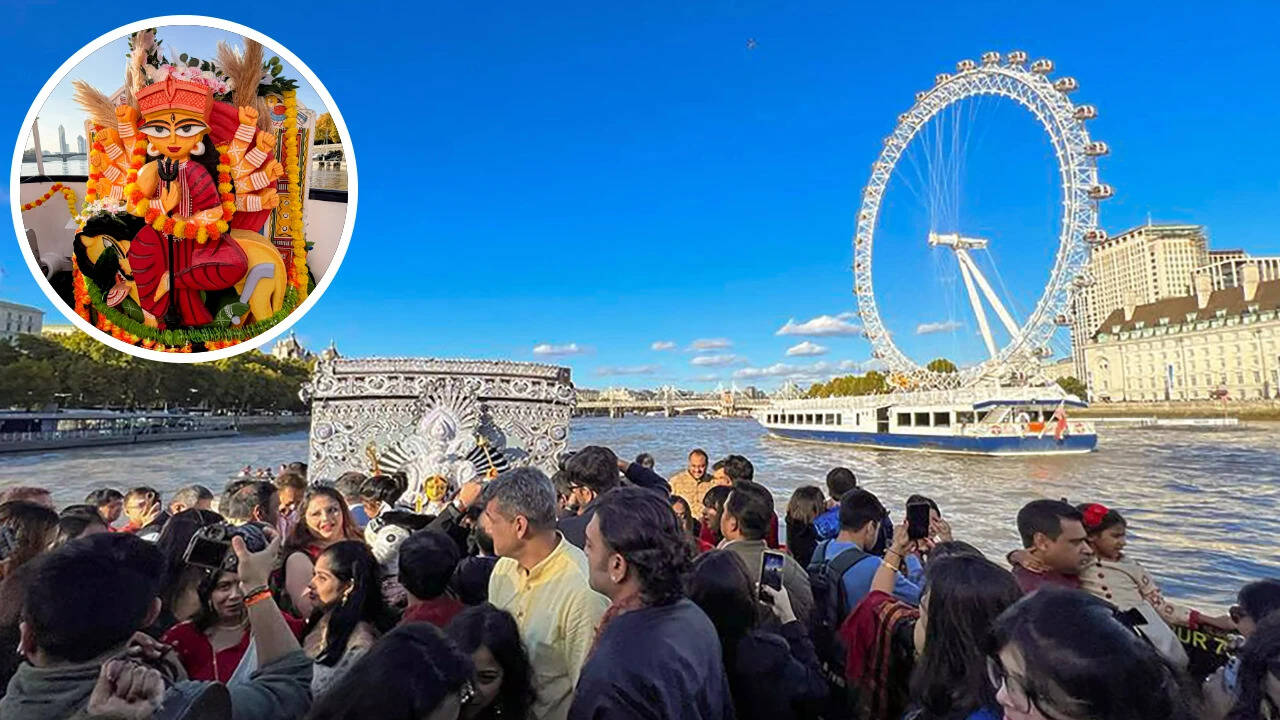
Listen.
Not to the hiss of a double-decker bus braking wet rubber against asphalt, nor to the metallic clack of Oyster cards tapping through a commuter barrier at Canary Wharf, but to a dry, wooden thunder rolling off a tidal river that smells of river mud, diesel, and rain-soaked brick.
Stand near the embankment on an autumn afternoon when clouds sit low over East London, and you might hear something that has no business belonging to a chilly grey estuary. A heavy, double-headed drum slung across a shoulder. Two thin sticks striking taut hide in a syncopated gallop that speeds up, tightens, and seems to pull your sternum forward toward the water.
Dhak.
For generations of British Bengalis, celebrating Durga Puja in the United Kingdom meant gathering inside hired community halls, school gymnasiums, or temporary marquees erected on damp playing fields. Those spaces were warm, crowded, and fiercely loved. People stood shoulder-to-shoulder over plates of khichuri and labra, catching up with cousins they only saw once a year, passing babies from lap to lap while children spun around folding chairs. Yet there was always a quiet friction baked into the walls of a rented hall. The walls were drywall. The carpets smelled faintly of floor cleaner and old gymnasium sweat. Outside waited a city that rarely paused for five days of autumn worship, and a river—the great, winding artery that has carried sailors, merchants, and migrants into London for centuries—remained mostly a backdrop viewed through train windows or tourist postcards.
Taking Durga Puja onto the Thames changes the geometry of belonging.
It is easy to read a headline about British Bengalis bringing Durga Puja to London’s river and picture a neat cultural showcase: colorful saris against historic stone, music drifting past riverside pubs, another vibrant festival added to the capital’s calendar. A standard news report stops right there. It records who organized the boat or the riverside gathering, notes the date, mentions the music, and moves on to the next story.
That misses everything that actually happens inside a chest when a drumbeat hits open water.
To understand why a river procession or riverside gathering matters so deeply to families living thousands of miles from the Padma or the Hooghly, you have to look at what migration quietly erodes. It rarely breaks people all at once in a single dramatic moment. Instead, it wears down the small, automatic rhythms of life. In Kolkata, Dhaka, or rural Bengal, autumn arrives with a shift in light and air that tells your body what season it is before you even check a calendar. Even if you have spent thirty winters scraping frost off a windshield in Ilford or barking your shins on a cramped flat in Tower Hamlets, a part of your memory stays tethered to monsoon-washed grass, marigold garlands, and the crispness of sharat skies.
When you raise children in another country, you carry a constant, low-grade worry that those threads will fray. You watch your teenage son or daughter switch effortlessly between London slang and polite English, their Bengali accented or hesitant, their sense of home shaped by school bells, tube strikes, and football scores rather than ancestral riverbanks. You want them to feel rooted without feeling foreign. You want them to stand tall in the city where they were born while knowing the weight of the stories that made them possible.
Let us step into a hypothetical scenario to feel how that quiet ache plays out across three generations of one family. This story is invented to illustrate real emotional dynamics shared by many British Bengali households, though the feelings themselves are grounded in lived observation rather than fiction.
Picture Rina, a woman in her late forties who came to London as a young child and now works as a hospital pharmacist in East London. Beside her stands her father, Subir, retired from decades of shift work and wearing a slightly stiff wool cardigan against the river breeze. A few paces ahead walks Rina’s sixteen-year-old daughter, Tania, hood pulled up, earbuds hanging around her neck, scrolling her phone with the guarded posture of a teenager who has been dragged to too many "cultural things" on weekends.
For Subir, the river has always held a complicated history. Like countless South Asian immigrants who arrived in Britain during the post-war decades and later years, he knows what it feels like to be tolerated in the margins while building someone else’s city. He has spent half a century translating himself—softening vowels, swallowing frustration, keeping his head down so his children could have room to breathe. When he looks out over the Thames, he sees old imperial power and modern glass towers, a current that moves indifferent to individual lives.
For Rina, the tension is different. She lives between two obligations: caring for aging parents whose world is shrinking, and raising a daughter whose world is wide open but sometimes untethered. She loves her heritage fiercely, yet she sometimes wonders whether ritual without living context becomes a museum piece—something you visit once a year, take photos of, and pack away until next October.
And Tania? Tania does not want to feel like an outsider at school, nor does she want to feel like a performance at home. To her, tradition can sometimes feel like a set of unspoken rules about how to dress, whom to respect, and which languages count as "proper."
Then the dhak starts up near the water.
Not recorded through a tinny Bluetooth speaker. Live. Wood, skin, and human wrist.
You do not just hear a dhak with your ears; you feel it in your ribs and your heels. The rhythm has an urgent, celebratory lift—dhina-ta-ta, dhina-ta-ta—that seems to invite movement even when your knees ache or your pride tells you to stay cool. Subir’s shoulders drop an inch, the stiff guard he wears in public softening as a memory of childhood courtyards flashes behind his eyes. Rina watches her father’s face change and feels a sudden tightness in her throat, that familiar lump that comes when grief and joy share the same breath.
And Tania? She lowers her phone. She does not suddenly transform into a character from a period drama, nor does every single doubt evaporate in ten seconds. Real life is messier than that. She might still feel self-conscious at first. Yet when the beat rolls across the open water—uncontained by drywall, loud enough to meet the wind coming off the estuary—the sound does not feel small or tucked away in a basement. It feels big. Public. Alive.
That shift from tucked-away to out-in-the-open is the real story beneath Durga Puja on the Thames.
Why the Setting Changes the Stakes
Culture is often treated as if it were purely portable, like luggage you can toss into the boot of a car and unpack anywhere. Consider that a useful metaphor, but an incomplete one. Luggage holds objects; living culture needs air, space, and friction to stay supple.
In Bengal, Durga Puja is bound up with water. It begins with honoring rivers and sacred streams, celebrates the goddess returning home to her parents’ house for a brief, joyful visit, and culminates in visarjan—the farewell immersion into river or pond water that carries both sorrow at her departure and hope for her return the following year. Water is not a decorative detail in that story. Water is the threshold between arrival and farewell, between holding on and letting go.
In London, practicing that relationship with water has historically been complicated. Environmental rules, safety regulations, tidal currents, and urban permitting exist for good reason along a busy working river. A major tidal waterway is not a quiet village pond; barges, ferries, and swift tides demand strict planning and care. Yet for decades, the distance between the celebration and the river meant that one of the emotional pillars of the festival had to be adapted into symbolic gestures inside indoor halls.
Bringing Durga Puja onto or beside the Thames bridges that gap in a way no rented hall ever could. Even when a gathering is a riverside procession, a boat charter, or a celebration along the embankment, placing the rhythm of the dhak beside moving water restores a primal connection. The river becomes a witness rather than a border.
I have stood in crowded community halls in Britain where the air grew thick with incense, warm food, and laughter, and I have felt how fiercely people guard their joy there. There is an unmistakable warmth in those rooms—a sense of adda, that unhurried, animated conversation where politics, cinema, family gossip, and philosophy collide over endless cups of tea. Anyone who has spent time in a Bengali household knows that conversation itself is a form of affection. We argue passionately, interrupt constantly, and care deeply enough to stay up arguing until midnight.
Yet indoor spaces also have limits. When a community celebrates exclusively behind closed doors, it can accidentally reinforce a quiet separation: we are in here, and London is out there.
Stepping toward the river flips that dynamic. The city’s skyline—glass office blocks, historic bridges, cranes, joggers, tourists with cameras—sits right across the frame. Nobody has to pretend they are in South Asia. Everyone knows they are in London. That honesty is what gives the moment its charge. It says: you do not have to erase where you came from to belong to the place you are standing.
Ritual, Memory, and the Weight of Farewell
To understand why these moments hit so hard emotionally, it helps to look at how humans process change.
Psychologists and historians often note that rituals give shape to feelings that are otherwise too large or ambiguous to hold. Grief, gratitude, homesickness, hope—these emotions rarely arrive neatly labeled. A festival creates a container for them. Over five days, people dress up, cook elaborate meals, sing, dance, pray, and gather in crowds. The noise and color do not deny hardship; they create a temporary sanctuary where joy is collective rather than private.
For diasporic communities, that sanctuary carries extra weight.
When you live far from your homeland, every visit back feels compressed, and every goodbye stings a little sharper. Parents grow older between trips. Neighborhoods change. Childhood friends marry, move, or drift into busy adult lives. There is a subtle, ongoing mourning for things that are still there yet no longer quite yours in the same way.
At the same time, there is a fierce refusal to let joy become sorrowful. Durga Puja is famous for its paradox: Asho ma—come, Mother—welcoming the goddess with drums and ululations, followed days later by the bittersweet ache of seeing her off, knowing she will return next year. That rhythm of arrival and departure mirrors the immigrant experience with uncanny precision. Arriving in a new country brings hope and hustle; saying goodbye to parts of the past brings ache; returning each autumn to the same songs and beats brings renewal.
When the dhak echoes near the Thames, that paradox is right there in the air. The water moves past; it never stops in one spot. You cannot hold river water in your fist. And yet, year after year, the river is still there, carrying new tides.
Let’s be honest about what can feel confusing or intimidating to someone watching from the outside—or even to a younger British Bengali who hasn’t grown up steeped in every custom. Durga Puja is rich, layered, and sometimes overwhelming if nobody explains what is happening. You see intricate clay sculptures, vibrant red-and-white alta or sindoor motifs, brass lamps, conch shells, trays of offerings, and groups of people swaying in rhythmic dance (dhunuchi naach) as incense rises and drums pound faster.
If you do not know the story, it can look like pure spectacle. If you only hear the loud drums, you might miss the quiet devotion underneath.
Here is an intuitive way to think about it: treat the festival like a symphony rather than a single note. The dhak is the percussion that drives the pulse, the conch shell is the piercing call that wakes the room, the lamps and flowers are color and scent, and the shared meals and laughter are the harmony that holds the room together. You do not need to understand music theory to feel a symphony move through you. You just need to stay long enough to let the layers settle.
What Happens When Tradition Meets Modern London
Bringing a centuries-old tradition onto a modern global river also invites practical questions. How do organizers balance reverence with safety? How do communities keep events welcoming to neighbors who have never attended a Puja before? How do young people find their own voice inside an ancient framework?
These are not small questions, and pretending they solve themselves would be dishonest. Organizing large cultural gatherings in a major city requires permits, stewards, clear communication, accessibility for elders, and respect for shared public spaces. Sometimes weather cooperates with crisp autumn sun; other times a sudden London squall sweeps sideways off the water and tests everyone’s patience.
When organizers get it right, though, something remarkable happens on the embankment or deck.
Elders who rarely leave their local streets get to feel the wind off the river and hear traditional rhythms played with full-throated pride. Middle-aged parents get a rare afternoon where they are not just managing schedules and bills, but standing beside their children in shared celebration. Young adults—artists, DJs, writers, engineers, students—get to see their heritage not as something fragile and dusty, but as raw material they can carry forward in their own way.
Even a passerby walking along the river path—someone who came out for a quiet Sunday stroll with a coffee—gets a glimpse of a living London that refuses to fit into a single cliché. London has always been shaped by movement along its waters. Long before sleek commuter boats and riverside apartments, people from across the world arrived here carrying spices, textiles, languages, melodies, and memories.
The dhak is just one more voice joining a very old conversation beside the tide.
The Sound That Stays After the Boat Turns
Think about what lingers when the music stops.
The sticks finally come to rest against the taut leather. The last echo of the dhak thins out over the grey-green swell of the Thames. Seagulls wheel overhead, crying out in their sharp, familiar way. A commuter boat cuts a clean white wake through the current, heading upriver toward the city’s stone arches and glass towers.
If you were standing there—whether you grew up knowing every beat of the autumn drums, or you arrived curious and slightly unsure of where to stand—you walk away with something subtle that wasn’t there an hour before. Not a neat checklist of facts. Not a tidy summary.
Just the memory of wooden thunder rolling across cold water, and the quiet certainty that a people who can carry that rhythm across oceans and winters are still writing their story in broad daylight.