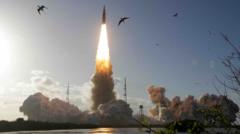
The success of Artemis II depends not on the spectacle of a rocket launch, but on the management of life-support tolerances and the structural integrity of the heat shield during a high-velocity ballistic reentry. While public discourse focuses on the return of humans to the vicinity of the Moon, the mission’s true value lies in its role as a high-stakes stress test for the Space Launch System (SLS) and the Orion spacecraft’s Environmental Control and Life Support System (ECLSS). This mission represents the transition from theoretical modeling to empirical validation within a deep-space environment that cannot be fully replicated in Low Earth Orbit (LEO).
The Propulsion Architecture of the SLS
The Space Launch System (SLS) Block 1 configuration utilizes a liquid oxygen and liquid hydrogen core stage supported by two five-segment solid rocket boosters. This architecture is designed to generate 8.8 million pounds of thrust, providing the necessary velocity to escape Earth's gravity well while carrying the heavy mass of a crew-rated capsule and its service module.
The propulsion strategy is defined by the requirement for a specific impulse ($I_{sp}$) that balances raw thrust with fuel efficiency. The RS-25 engines, repurposed and upgraded from the Space Shuttle program, provide a high $I_{sp}$ of approximately 452 seconds in a vacuum. This efficiency is critical during the eight-minute climb to orbit, where the vehicle must shed mass rapidly to maintain its acceleration profile.
The Trajectory Logic of a Free Return
Artemis II does not enter lunar orbit. Instead, it utilizes a "Hybrid Free Return Trajectory." The mission profile involves two distinct phases:
- High Earth Orbit (HEO): After an initial burn to reach a temporary parking orbit, the Interim Cryogenic Propulsion Stage (ICPS) performs a second burn to raise the apogee to approximately 74,000 kilometers. This 24-hour orbit allows the crew to test the spacecraft's systems while remaining close enough to Earth to abort and return within a single day if the ECLSS fails.
- Trans-Lunar Injection (TLI): Once system integrity is verified, the spacecraft executes a burn that sends it toward the Moon. The physics of this maneuver rely on the Moon’s gravity to "whip" the capsule around the far side and slingshot it back toward Earth without requiring a large engine burn for the return trip.
This trajectory serves as a safety mechanism. By using a free-return path, the mission minimizes the "criticality 1" risks associated with a primary engine failure during a lunar insertion burn.
The ECLSS Bottleneck
Maintaining a habitable environment for four astronauts for ten days in deep space is a logistical challenge that grows exponentially with mission duration. The Orion ECLSS must manage three primary variables to prevent physiological failure:
- Atmospheric Pressure and Composition: The system must maintain a 101.3 kPa (14.7 psi) nitrox mix while scrubbing carbon dioxide. Unlike the International Space Station, which uses bulky regenerative systems, Orion utilizes Amine swing-beds for $CO_2$ removal to save mass.
- Thermal Regulation: Deep space presents a thermal delta of hundreds of degrees. Orion uses a redundant fluid loop system (active thermal control) to move heat from the electronics and the crew to external radiators.
- Radiation Mitigation: Artemis II will pass through the Van Allen radiation belts and move beyond the protection of Earth’s magnetosphere. The spacecraft is shielded, but the crew must also utilize "shelter-in-place" protocols using on-board mass (water and equipment) during Solar Particle Events (SPEs).
The performance of these systems during the HEO phase determines whether the mission proceeds to the Moon. Any deviation in the partial pressure of oxygen or an undetected leak in the cooling loops necessitates an immediate reentry.
Structural Integrity and Reentry Dynamics
The most significant technical hurdle for Artemis II is the reentry phase. Returning from the Moon involves velocities of approximately 11,000 meters per second (roughly 24,500 mph), compared to the 7,800 meters per second of a return from LEO.
The kinetic energy that must be dissipated as heat increases with the square of the velocity ($KE = \frac{1}{2}mv^2$). Consequently, a lunar return subjects the heat shield to temperatures near 2,760°C—about half the temperature of the sun's surface.
The Avcoat Ablation Variable
The Orion heat shield uses Avcoat, an ablative material designed to wear away as it burns, carrying heat away from the structure. During the uncrewed Artemis I mission, the heat shield exhibited "char loss" or spalling that differed from pre-flight predictions. Pieces of the ablative material liberated differently than expected.
For Artemis II, the engineering focus is on the boundary layer transition—the point where the airflow over the capsule changes from laminar to turbulent. If this transition occurs too early or unevenly due to the surface roughness of the charred Avcoat, it creates localized "hot spots" that could compromise the underlying titanium structure. The success of the mission hinges on whether the modified Avcoat application and the skip-entry maneuver—where the capsule "bounces" off the atmosphere to bleed off speed—behave according to the revised thermal models.
The Human Factor as a System Constraint
Transitioning from a machine-only payload to a crewed mission introduces "biological noise" into the spacecraft's telemetry. Humans are heat-generating, moisture-producing, and oxygen-consuming variables that fluctuate based on activity levels.
The crew of Artemis II—Wiseman, Glover, Koch, and Hansen—are not merely passengers but are integrated components of the spacecraft's fail-safe architecture. Their primary function is to validate manual handling qualities, specifically during the proximity operations trial. After separating from the ICPS, the crew will use the stage as a target to test Orion’s manual piloting and docking sensors. This is a prerequisite for Artemis III, which will require a complex docking maneuver with a lunar lander.
Economic and Strategic Interdependencies
The Artemis II mission is the linchpin of the "Lunar Gateway" economy. The program operates on a fixed-cost vs. cost-plus contract hybrid, where NASA owns the SLS but relies on private contractors for the European Service Module (ESA) and future landing systems (SpaceX/Blue Origin).
The mission's success or failure dictates the investment velocity of the secondary lunar market. A failure in the Orion heat shield or the SLS core stage would likely lead to a multi-year grounding of the program, shifting the strategic advantage toward the Chinese Lunar Exploration Program (CLEP). Conversely, a successful mission validates the SLS Block 1 architecture, allowing for the transition to the more powerful Block 1B, which utilizes the Exploration Upper Stage (EUS) to increase payload capacity to the Moon by 40%.
Communication Latency and Deep Space Networking
Standard satellite communications rely on the TDRS (Tracking and Data Relay Satellite) network. For Artemis II, as the spacecraft moves beyond 400,000 kilometers from Earth, the mission shifts to the Deep Space Network (DSN). This creates a communication latency of approximately 1.3 seconds each way.
While 1.3 seconds seems negligible, it prevents real-time "joysticking" from mission control. The spacecraft's onboard computers must handle flight-critical maneuvers autonomously, with the crew acting as the secondary layer of redundancy. The data rates also drop significantly at lunar distances, requiring the crew to prioritize telemetry over high-definition video during critical phases like the TLI burn or the lunar flyby.
Validating the Artemis II Operational Model
The mission is an exercise in risk management where the goal is to find the "unknown unknowns" in the spacecraft's design. The hardware has been tested in vacuum chambers and vibration labs, but the combined stressors of a ten-day mission—vibration, radiation, thermal cycling, and human metabolic load—cannot be fully simulated.
The primary metric of success for Artemis II is the volume of high-fidelity data recovered from the 1,000+ sensors onboard. This data will be used to calibrate the models for Artemis III, which will involve the significantly higher risk of a lunar descent and ascent.
The strategic play for the Artemis program now moves from the engineering of individual components to the integration of the whole. If the Orion heat shield maintains its structural margin and the ECLSS manages the crew's metabolic load within the predicted 5% variance, the path to a permanent human presence on the Moon is clear. If the spalling issues seen in Artemis I recur or if the thermal loops show signs of degradation, the program must pivot toward a fundamental redesign of the Service Module or the reentry profile, delaying lunar landing goals into the 2030s.