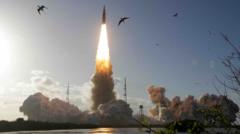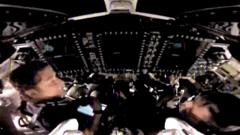
The grainiest video feed in human history just dropped, and the world is expected to swoon. We are watching four people float in a tin can, waving at a camera with the forced enthusiasm of a hostage video, and calling it "progress." If you find yourself misty-eyed over the first live view of the Artemis II crew, you’ve been sold a narrative that prioritizes nostalgia over engineering reality.
NASA is running a victory lap for a mission that, by any objective technical standard, is sixty years late and billions of dollars over budget. We aren't watching the dawn of a new era. We are watching a high-definition remake of a 1960s classic, produced with 2026 tax dollars and zero structural innovation.
The High Cost of Sentimentalism
The "lazy consensus" surrounding Artemis II is that this mission is a "bold step toward Mars." It isn't. It is a politically motivated trajectory designed to prove that the Space Launch System (SLS) can actually fire without blowing up its own launchpad.
Let’s talk about the math they don't put in the press kits. The SLS costs roughly $2 billion per launch. That isn’t the development cost; that is the price of the hardware that gets dropped into the ocean every single time the engines ignite. For that price, we are getting a "Free Return Trajectory."
In orbital mechanics, a free return is the "safety scissors" of spaceflight. You kick the craft hard enough to loop around the moon, and gravity pulls you back to Earth without you needing to do much of anything. It’s a glorified slingshot. We did this with Apollo 13 in 1970 because we had to. Doing it in 2026 is an admission that we are still terrified of deep space maneuverability.
The Orion Capsule Is a Step Backward
The media treats the Orion capsule like a luxury spacecraft. In reality, it’s a cramped, overweight legacy system. While private industry is iterating on reusable stainless steel hulls and rapid-turnaround heat shields, Orion remains a "one-and-done" relic.
I’ve spent years watching aerospace giants burn through "Cost-Plus" contracts where inefficiency is literally a profit center. When you get paid more for taking longer, you don't build the best ship; you build the most expensive one.
- Weight Penalty: Orion is massive, yet its habitable volume is roughly $9m^3$. Compare that to the internal volume of modern commercial designs which offer triple the space for a fraction of the mass-to-orbit cost.
- The Heat Shield Issue: We are still using ablative shields that char and degrade. We are literally burning money on entry.
- Life Support: The tech inside that "live view" isn't a leap forward. It’s an incremental polish on systems that haven't fundamentally changed since the Space Shuttle era.
The "People Also Ask" Delusion
When people ask, "Why are we going back to the moon?" the standard answer is "To stay."
Brutal honesty: We aren't staying. There is no infrastructure. There is no Gateway. There is no lunar base. Artemis II is a flyby. It is the celestial equivalent of driving past a fancy restaurant, looking through the window, and claiming you've had a five-course meal.
If we wanted to "stay," we would be launching fuel depots. We would be perfecting automated lunar landing systems before risking human life on a PR stunt. Instead, we are sending a crew to take selfies in lunar orbit because the public's attention span won't support a twenty-year infrastructure build-out without a "hero shot."
The Staccato Reality of Space 2.0
Launch.
Discard.
Wait three years.
Repeat.
This is the cadence of a dying program. Real progress looks like the frantic, messy, explosive iteration we see in South Texas. Real progress is failing fast and moving on. Artemis is "Too Big to Fail," which in government-speak means "Too Expensive to Succeed."
We are cheering for a crew that is essentially sitting in a ballistically guided coffin. If anything goes wrong with the Service Module provided by ESA, there is no backup. There is no rescue. We have placed four brilliant humans on a single-point-of-failure mission to justify a rocket that should have been canceled a decade ago.
The Nuance of the Lunar Flyby
The counter-argument usually goes: "But we need to test the integration of the crew with the systems."
No. We need to automate the systems so the crew doesn't have to "integrate" with them. The obsession with "piloting" a spacecraft in 2026 is an ego-driven holdover from the Chuck Yeager days. A modern spacecraft should be as autonomous as a vacuum cleaner. If a human needs to toggle a switch to keep the CO2 scrubbers running, the engineers have failed.
The Artemis II crew are passengers. Highly trained, incredibly brave passengers, but passengers nonetheless. To call them "explorers" during this specific mission is a stretch. They are testers of a legacy architecture.
Why You Should Be Skeptical of the "Live Feed"
The video quality might be better, but the transparency is worse. Notice what they don't show you in these live views:
- The Radiation Levels: Artemis II will take the crew outside the protection of the Van Allen belts. We still haven't solved long-term deep space radiation shielding. We are just hoping the sun doesn't have a tantrum during the ten-day mission.
- The Cost-Per-Pixel: Calculate the cost of that video stream. It is the most expensive entertainment in human history.
- The Opportunity Cost: Every billion spent on the SLS/Orion stack is a billion not spent on nuclear thermal propulsion or lunar manufacturing.
Stop Asking if We Can Go
Ask why we are going like this.
The status quo says we need a giant, expendable rocket because that’s how we did it in 1969. The contrarian truth is that the moon is only accessible if we stop trying to throw giant rocks at it from Earth. We need orbital assembly. We need refueling. We need to stop treating astronauts like mascots for a bloated procurement system.
If you want to be inspired, don't look at the waving astronauts. Look at the balance sheet. Look at the lack of a lander for Artemis III. Look at the fact that we are sending humans around the moon without a way to actually touch it.
Artemis II isn't a mission. It's a trailer for a movie that hasn't been filmed yet and might never be finished.
Stop settling for the "live view" and start demanding the landing.
The moon isn't a destination for a flyby; it’s a resource. Until we treat it like one, these missions are just very expensive orbital parades.
Put down the flag and pick up a calculator.