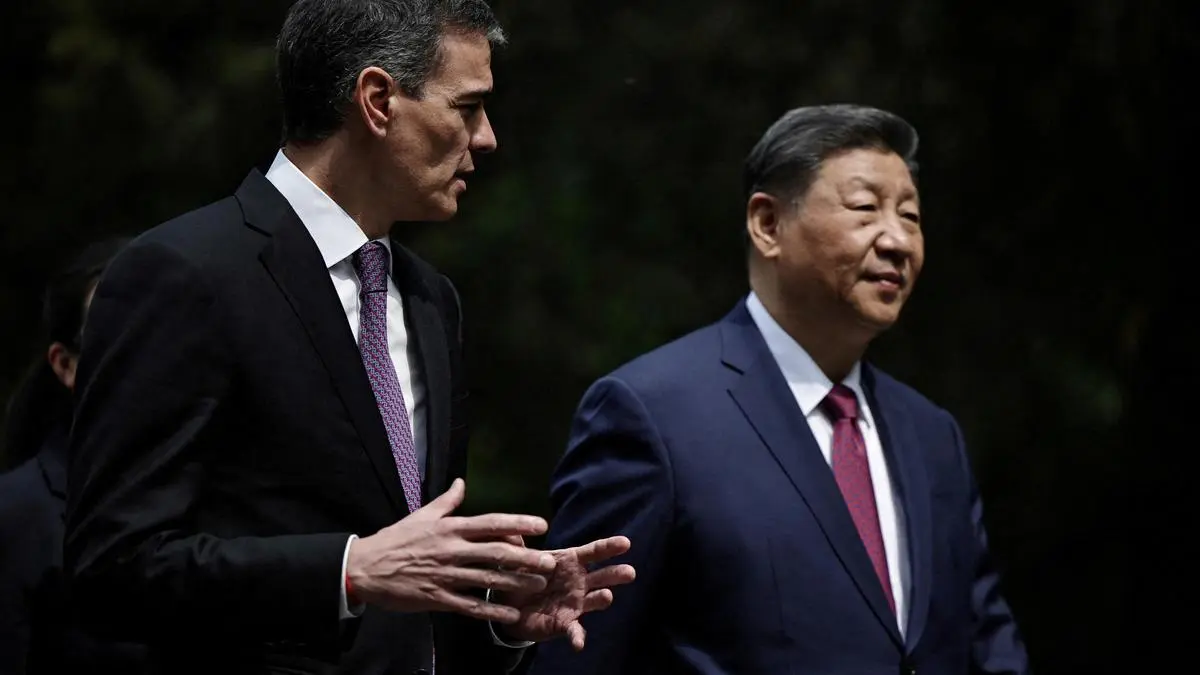
The rules of the game just changed. Sitting in the Great Hall of the People in Beijing, Chinese President Xi Jinping didn't mince words during his meeting with Spanish Prime Minister Pedro Sánchez on April 14, 2026. He described a world where the international order isn't just shaking—it's "crumbling into disarray."
You don't hear that kind of bluntness from the top of the CCP every day. Usually, it's all "win-win cooperation" and "shared futures." But the 2026 Iran war has pushed things past a breaking point. While a fragile two-week ceasefire was recently brokered, the damage to the old way of doing things is already done. Xi isn't just commenting on the weather; he’s signaling that the era of Western-led stability is officially over. Meanwhile, you can find similar events here: Why Russia is Escalating Attacks on the Izmail Port and Global Shipping.
The war that broke the system
The conflict that ignited in late February 2026, when U.S. and Israeli forces launched strikes against Iranian infrastructure, has turned the Middle East into a testing ground for a new brand of chaos. Xi’s "crumbling" comment is a direct hit on the U.S. strategy of unilateral intervention. From Beijing’s perspective, the "law of the jungle" has returned, and the old guard in Washington is the one holding the machete.
China has a massive stake here. It imports roughly 13% of its oil from Iran. It signed a 400-billion-dollar partnership with Tehran back in 2021. Yet, notice what China didn't do. It didn't send troops. It didn't fire missiles. Instead, it played the long game. While the U.S. spent billions on munitions, Beijing used its seat at the UN and its back-channel influence to position itself as the "only stabilizer." To explore the bigger picture, we recommend the excellent analysis by Al Jazeera.
Why the Iran war changed the math
The Strait of Hormuz is the world's most important energy artery. When the blockade started, the global economy felt the squeeze instantly. Beijing didn't blink. It leveraged its relationship with Pakistan to help bridge the gap for a ceasefire, effectively outmaneuvering traditional Western diplomacy. By doing this, Xi proved a point: you don't need a carrier strike group to be the most influential person in the room.
Spain as the bridge to a skeptical Europe
It’s no accident that Xi chose a meeting with Pedro Sánchez to drop these truth bombs. Spain has gone rogue by European standards. Sánchez called the U.S.-Israeli strikes "illegal" and shut down Spanish airspace to U.S. warplanes. That’s a massive fracture in the NATO wall.
Xi is smelling blood in the water. He's pushing for a "genuine multilateralism" which is basically code for "a world where the U.S. doesn't get to make all the rules." By cozying up to Sánchez—who’s now visited Beijing four times in three years—Xi is trying to peel European nations away from the "containment" logic of the Trump administration. He’s telling Europe: "The old order is failing you. Join us in building something else."
The reality of the crumbling order
Don't mistake this for a total collapse into anarchy. It's a shift in who holds the remote control. China’s strategy is built on three pillars that the Iran war has highlighted:
- Economic Interdependence over Alliances: China doesn't want to be your "ally" in the way America does. It wants to be your bank, your builder, and your biggest customer. It’s harder to go to war with someone who owns your ports and built your 5G network.
- The Global Security Initiative: Xi is pitching this as an alternative to NATO-style security. It prioritizes "non-interference," which sounds great to regimes that don't want the West lecturing them on human rights.
- Selective Engagement: Beijing stays out of the actual fighting. It lets other powers exhaust their treasuries and political capital in regional wars while it collects the pieces afterward.
The chips on the table
There’s a darker side to this "stability." Intelligence reports have been swirling about China preparing to ship advanced air defense systems and MANPADs to Iran. While Beijing denies it, the message is clear: if the U.S. continues to push, China will provide the tools to push back.
This isn't about saving the Iranian regime. It’s about ensuring that no single power—especially the U.S.—can dictate terms in the Persian Gulf. Xi knows that a weakened Iran is a dependent Iran. And a dependent Iran is a perfect tool for securing China’s energy future.
What you should watch next
If you're trying to figure out where the world is headed, don't look at the battlefields. Look at the diplomatic cables.
- Watch the Strait of Hormuz: If the ceasefire holds, China wins. If it breaks and the U.S. tries to force it open with more strikes, we’re looking at a global recession.
- European Alignment: See if other EU nations follow Spain’s lead in distancing themselves from U.S. military policy. If France or Germany starts sounding like Sánchez, the Western alliance is effectively dead.
- The Weaponry Flow: Keep an eye on reports of Chinese dual-use tech entering the region. That’s the real indicator of how much "disarray" Xi is willing to tolerate.
The "crumbling" order Xi mentioned isn't a prediction; it’s an observation of a process that’s already well underway. The 2026 Iran war didn't start the fire, but it certainly finished off the foundation of the old world. You’re living in the transition phase now.
If you're an investor or a policy watcher, stop waiting for things to "go back to normal." Normal is gone. The play now is to figure out who’s going to build the next set of rules—and right now, Xi Jinping is holding the blueprint. Get familiar with the Global Security Initiative and start looking at trade data instead of troop movements. That’s where the real power is shifting.