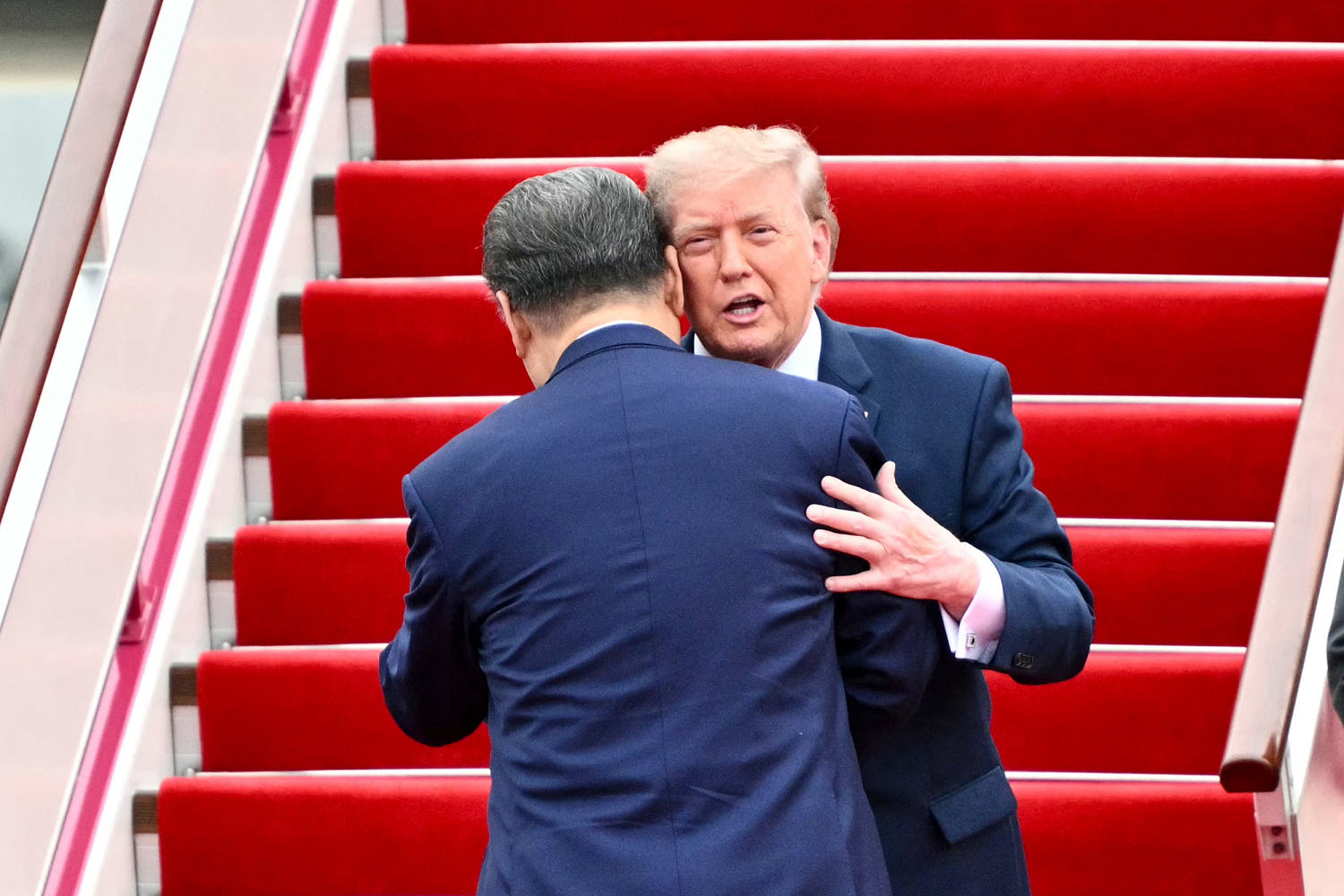
When Chinese President Xi Jinping steps onto an airport tarmac to personally greet a visiting foreign leader, it is never a casual scheduling quirk. Protocol in Beijing is calibrated down to the centimeter. By breaking with decades of standard diplomatic practice to welcome Donald Trump directly at the aircraft steps—just days ahead of scheduled talks with Russian President Vladimir Putin—Xi sent an unmistakable signal to Washington, Moscow, and every capital watching the shifting geometry of global power. The gesture was a calculated display of personal respect designed to flatter an American leader who prizes bilateral pageantry, while simultaneously establishing diplomatic supremacy before Russia entered the room.
Standard diplomatic choreography in Beijing dictates that visiting heads of state, including American presidents, are met at the airport by a senior foreign ministry official or a state councilor. The formal welcome with the Chinese president occurs later, safely inside the Great Hall of the People, flanked by honor guards and carefully managed press pools. Deviating from that script requires explicit authorization from the very top of the Chinese Communist Party.
The Architecture of Beijing Protocol
To understand the weight of a tarmac greeting, you have to understand how Beijing weaponizes etiquette. In Chinese statecraft, hospitality is never merely polite; it is a ledger of leverage. Every banquet menu, motorcade route, and seating arrangement communicates precisely where a foreign leader sits in Beijing's hierarchy of priorities.
When Barack Obama arrived in Hangzhou for the 2016 G20 summit, a dispute over the rolling staircase forced him to exit through the belly of Air Force One, a moment widely interpreted by seasoned diplomatic observers as an intentional slight. Conversely, during Trump's 2017 state visit, Xi granted him an unprecedented private tour and dinner inside the Forbidden City, the first time a foreign leader had dined there since the founding of the People's Republic in 1949.
That historical precedent matters. Beijing's analysts have spent years studying Trump's political psychology. They know that traditional multilateral pressure—joint communiqués from Brussels or coordinated tariffs from G7 finance ministers—often hardens his resolve. Direct, high-status personal engagement does the opposite. By stepping onto the tarmac himself, Xi bypassed the bureaucratic friction of the State Department and the National Security Council, speaking directly to Trump's preference for leader-to-leader dealmaking.
The Triangular Trap Involving Moscow
The timing of the arrival elevates this from a bilateral curiosity to a major geopolitical maneuver. Hosting an American president immediately prior to consultations with Vladimir Putin places Beijing squarely at the center of a modern strategic triangle, echoing—yet inverting—the Cold War diplomacy of the 1970s.
In 1972, Richard Nixon and Henry Kissinger exploited the Sino-Soviet split to pull China closer to the United States, isolating Moscow. Today, the alignment looks entirely different, yet the underlying mechanics of triangular diplomacy remain intact. The party that maintains working relations with both rivals holds the decisive advantage.
Consider the position Vladimir Putin occupies in this equation. Since the invasion of Ukraine and the subsequent wave of Western sanctions, Russia's economic dependence on China has grown substantially. Beijing buys discounted Russian crude, supplies critical dual-use industrial components, and provides a diplomatic shield at the United Nations Security Council. Officially, Xi and Putin celebrate a partnership with no limits. Privately, power dynamics are rarely so egalitarian.
By rolling out the red carpet for Trump first, Xi subtly reminded Putin that China is not locked into an exclusive anti-Western bloc. Beijing retains the option—and the diplomatic stature—to engage directly with Washington on the biggest global issues, from trade imbalances to European security. It forces Moscow to wonder what concessions or understandings might have been discussed behind closed doors before Russian officials even landed in Beijing.
What Moscow Actually Wants
Russia's primary objective in any trilateral shadow play is preventing a grand bargain between Washington and Beijing that leaves Moscow isolated. The Kremlin fears a scenario where China trades reduced support for the Russian defense industrial base in exchange for American tariff relief or technological access.
What Washington Actually Wants
The Trump administration approaches Beijing through a transactional lens focused heavily on trade deficits, manufacturing repatriation, and bilateral reciprocity. At the same time, Washington seeks Chinese pressure on Moscow to bring the conflict in Ukraine to a negotiated settlement on terms acceptable to the United States.
What Beijing Actually Wants
China's leadership wants breathing room. Facing domestic economic headwinds—including a prolonged real estate slump, local government debt, and demographic contraction—Xi needs stability in external relations. He wants to prevent a full-scale trade war with the United States while keeping Russia stable enough to remain a useful counterweight to Western alliances, without letting Moscow drag China into secondary sanctions.
Decoding the Domestic Audience in China
Foreign observers often make the mistake of analyzing Beijing's diplomatic theater solely through the lens of international relations. In reality, the primary audience for Xi Jinping is almost always domestic.
State media outlets like Xinhua and China Central Television carefully curate every frame of a presidential greeting. When millions of Chinese citizens watch Xi stand on the tarmac welcoming the President of the United States, the visual narrative reinforces a specific message: China is no longer a rising power seeking validation from the West. Instead, global leaders come to Beijing to pay court, and Xi dictates the terms of engagement with supreme confidence.
This imagery serves a practical political purpose at home. Amid sluggish consumer confidence and youth unemployment, projecting unassailable international prestige helps insulate the leadership from domestic criticism. A leader who can summon both the American president and the Russian president to Beijing within the same week appears indispensable on the world stage.
Yet this strategy carries inherent risks for Beijing. If the high-profile summitry fails to yield tangible relief on tariffs or export controls, hardline nationalist voices within China's online sphere and policy circles may question the utility of granting such extraordinary protocol honors to an American administration known for aggressive trade postures.
The Illusion of Personal Chemistry
Decades of covering international summits teach a hard lesson: personal warmth on the tarmac rarely survives the cold realities of structural competition. We have seen this movie before across multiple administrations.
George W. Bush famously looked into Vladimir Putin's eyes and claimed to get a sense of his soul, only to watch relations deteriorate over NATO expansion and missile defense. Barack Obama and Xi Jinping took a relaxed, shirt-sleeved stroll at Sunnylands in 2013, promising a new model of major-power relations, shortly before China began rapidly militarizing artificial islands in the South China Sea. Even during Trump's first term, the warm glow of the Forbidden City banquet evaporated within months as the two nations plunged into a multi-year tariff war.
The fundamental drivers of friction between the United States and China are structural, not personal. They involve deep disagreements over industrial subsidies, intellectual property protections, currency valuation, dominance in artificial intelligence and semiconductors, and the geopolitical status of Taiwan and the South China Sea. A handshake at the bottom of an airplane staircase does not rewrite the supply chain for advanced microchips, nor does it alter the patrol routes of naval destroyers in the Taiwan Strait.
To understand how these dynamics collide in practice, consider a hypothetical example of a trade negotiation following such a summit. Imagine Washington demands that Beijing drastically curtail state subsidies for electric vehicle manufacturing and purchase tens of billions of dollars in American agricultural goods. Beijing agrees to the agricultural purchases—an easy, reversible win that plays well in American farm states—while offering vague, unenforceable commitments on industrial policy. Six months later, when the structural subsidies remain intact, tariffs return, and the tarmac diplomacy is revealed as an intermission rather than a resolution.
The Leverage Trap for Washington
For the American delegation, accepting grand ceremonial gestures requires strict discipline. Protocol upgrades are inexpensive for an authoritarian state to dispense; they cost zero yuan and require no legislative approval. Concrete policy concessions, by contrast, carry steep economic and political prices.
The danger for any American president stepping into Beijing's carefully choreographed embrace is mistaking atmosphere for substance. When a host government goes to extraordinary lengths to honor a guest, it creates a subtle psychological obligation to reciprocate—perhaps by softening rhetoric on human rights, delaying planned sanctions, or moderating demands on market access.
Experienced negotiators recognize this dynamic immediately. They separate the theater from the text. They accept the tarmac greeting, smile for the cameras, and then walk into the negotiating room demanding verifiable, enforceable mechanisms rather than warm assurances.
The Unspoken Message to American Allies
Beyond Moscow and Beijing, capitals from Tokyo to Brussels watch these bilateral spectacles with quiet anxiety. Traditional American allies rely on predictability and consultation. When Washington engages in high-stakes, personalized diplomacy with Beijing—especially on a timeline that overlaps with Russian consultations—allies worry about being sidelined.
In Tokyo, Taipei, and Seoul, policymakers scrutinize every word spoken during such visits for signs that Washington might treat regional security commitments as bargaining chips in a broader trade deal. In European capitals, leaders wonder whether bilateral discussions between Trump and Xi regarding the war in Ukraine could bypass European security interests entirely.
Beijing understands this dynamic intimately. Part of the strategic value of elevating Trump's arrival is to sow subtle doubt among America's partners about Washington's commitment to multilateral coordination. If allies believe the United States is cutting solo deals behind closed doors, the cohesion of Western export controls and diplomatic coalitions begins to fray.
Reading the Signals Behind the Handshake
Diplomatic theater is a language of precision, and every deviation from the script carries intent. Xi Jinping walked onto that tarmac because the geopolitical environment demanded a bold, unmistakable gesture that could accomplish three objectives at once: flatter an unpredictable American counterpart, remind Vladimir Putin of Beijing's strategic autonomy, and project supreme authority to a domestic audience navigating economic uncertainty.
The cameras captured a moment of historic hospitality, complete with firm handshakes and coordinated smiles. Yet beneath the surface of that choreographed welcome, the underlying rivalries over trade, technology, and global influence remain completely untouched, waiting inside the negotiating room where protocol ends and power politics begins.