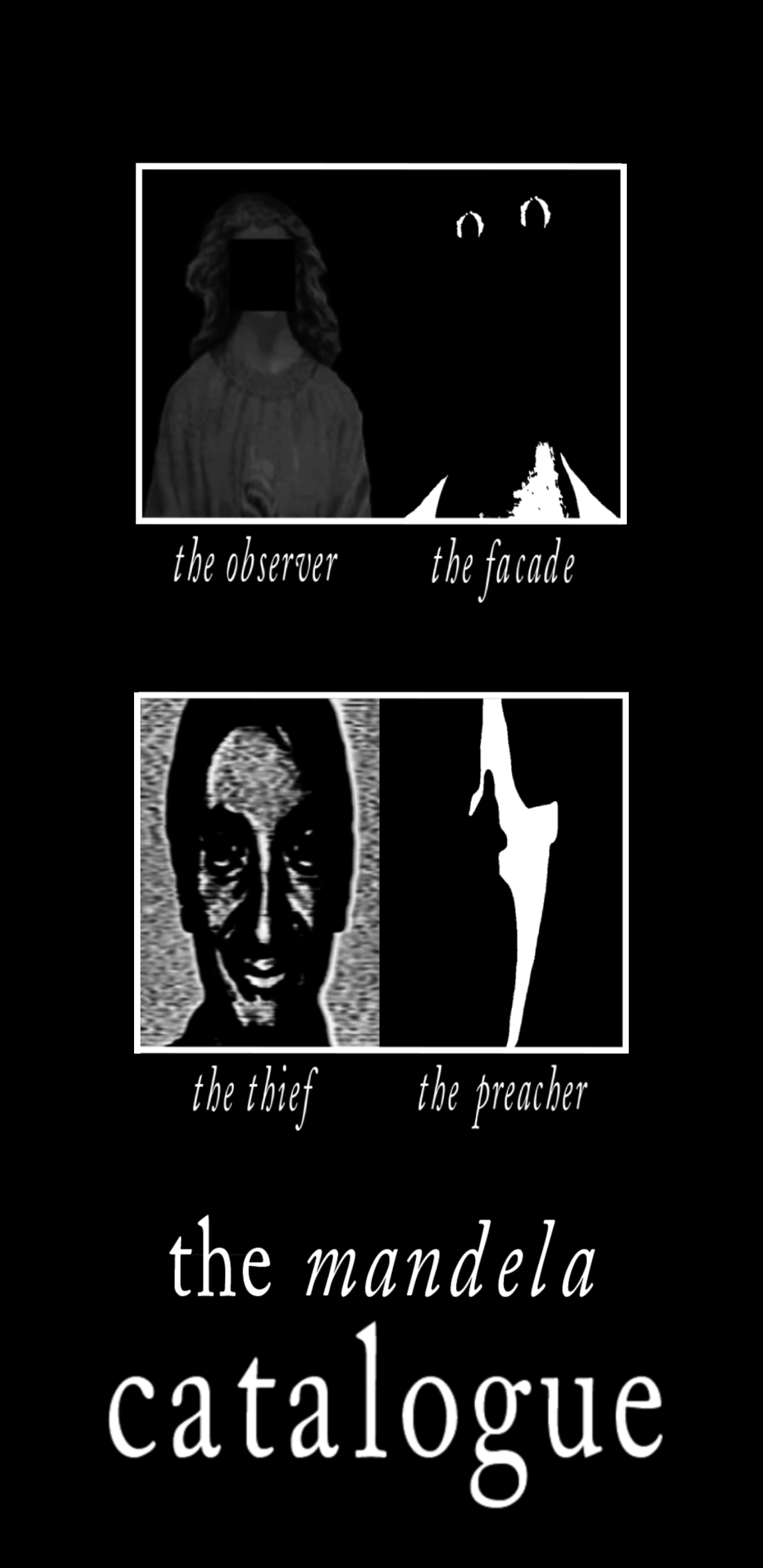
You’re scrolling through YouTube late at night. The lighting in your room is just a bit too dim. Suddenly, a distorted face flashes on the screen, accompanied by a chilling realization: that thing in the corner of the room might not be your coat rack. If you've spent any time in the "analog horror" rabbit hole, you know exactly what I'm talking about. Specifically, that haunting phrase—no i'm not a human mandela catalogue—which has become a shorthand for one of the most effective psychological horror tropes in modern digital media.
It’s weird.
Alex Kister, the creator of The Mandela Catalogue, tapped into something primal. He didn't just make a scary video series; he defined a new era of internet dread. The "No, I'm not a human" sentiment isn't just a line of dialogue. It’s the core of the Alternates. These are entities that look like us, talk like us, but possess a fundamental wrongness that triggers our "uncanny valley" response so hard it feels like a physical punch to the gut.
The Philosophy of the Alternate
The Mandela Catalogue works because it uses our own biology against us. Most horror relies on monsters that look like monsters. Think Xenomorphs or Jason Voorhees. But the "no i'm not a human" aspect of the Mandela Catalogue flips that. The monster is your mom. It’s your best friend. It’s the person staring back at you in the mirror who blinks just a millisecond after you do.
Kister’s work centers on the concept of "Biological Distortions" and "Flawed Imitations." According to the lore established in the series—starting with the "Overthrone" video—these Alternates are metaphysical entities that replace humans. They don't just kill you; they delete your existence and take your place.
It's existential. Truly.
When people search for no i'm not a human mandela catalogue, they’re usually looking for the specific scene involving the "intruder" or the psychological breakdown of characters like Mark Heathcliff. Mark’s story is basically a masterclass in isolated dread. He's trapped in a room, listening to something outside that sounds human but clearly isn't. It’s the verbal denial of humanity that sticks. When an entity mimics a human voice to say it isn't one, the irony creates a specific type of cognitive dissonance.
Why the Analog Aesthetic Matters
Why does 4:3 aspect ratio and VHS grain make things scarier?
Honestly, it’s because it feels realer than 4K. High-definition video leaves nothing to the imagination. You see every pixel of the CGI monster. But in the low-fidelity world of the Mandela Catalogue, your brain fills in the gaps. That smudge of gray on a CRT screen? Your mind turns it into a smiling face with elongated limbs.
Alex Kister used this to hide the limitations of a low-budget production, but it accidentally became the series' greatest strength. The "no i'm not a human" vibe is amplified by the fact that the footage looks like something you’d find in your basement on a dusty tape from 1992. It feels like forbidden knowledge. Like a government warning you weren't supposed to see.
The series leans heavily on "M.A.D." or Metaphysical Awareness Disorder. This is a fictional condition in the lore where victims are driven to suicide by "verbal information" that is "not desired to be known." Think about that. The monster kills you just by telling you something. It tells you that it isn't human, and that reality is so fundamentally broken that your brain just... quits.
Misconceptions About the Series
A lot of people think the Mandela Catalogue is just about jumpscares. It's not. If you watch the "Vol. 1" restored edition or the later, more complex entries like "Vol. 4," you'll see it's actually a deeply religious horror. It subverts Christian iconography. The "Angel" Gabriel in the series isn't a protector. He’s the first Alternate.
"I am your true savior," he says. But the visuals tell a different story.
The phrase no i'm not a human mandela catalogue often gets confused with other analog horror series like The Walten Files or Gemini Home Entertainment. While those are great, they focus on different fears. The Walten Files is about spirits trapped in machines (fnaf-esque but darker). Gemini Home Entertainment is about a cosmic invasion. Mandela is specifically about the loss of self.
It's about the fear that you are replaceable.
The Impact on the Horror Genre
Since Kister’s first video dropped in 2021, we’ve seen an explosion of "mimic" horror. TikTok is full of "don't look at your reflection" trends. Short films on YouTube are obsessed with the idea of something being "wrong" with a person’s face.
The psychological weight of an entity admitting, "I'm not human," while standing in a human kitchen, wearing human clothes, is a trope that isn't going away. It strikes at the heart of our social contracts. We trust people because they look like us. If that trust is broken, society collapses.
In the series, the Department of Temporal Phenomena (DTP) issues warnings telling people to follow the "T.H.I.N.K." principle.
- Tell others about your situation.
- Hinder the Alternate's movement.
- Identify the class of Alternate.
- Neutralize the threat (if possible).
- Know your place.
But here’s the kicker: the "K" in T.H.I.N.K. was eventually revealed to be "Kill yourself." The government in the series basically gave up. That’s the level of hopelessness we’re dealing with here.
Examining the "Type" System
If you’re diving deep into the lore, you have to understand the different types of Alternates. This isn't just random monsters; there’s a hierarchy.
Type 1 is the "Doppelgänger." This is the most common one. It looks exactly like you. This is where the no i'm not a human mandela catalogue meme-speak often originates. Imagine seeing yourself standing in the hallway. You know you’re you, so what is that?
Type 2 is the "Tulpa" or "Invisible" Alternate. These are way more psychological. They exist in your peripheral vision. You feel them, but you can’t see them. This is the stuff of nightmares for anyone who has ever felt like they were being watched in an empty house.
Type 3 is the "Flawed Impostor." These are the ones that are terrifying to look at. They tried to copy a human, but they messed up the proportions. Maybe the neck is three feet long. Maybe the mouth is where the eyes should be. They are the physical embodiment of the phrase "not human."
How to Engage with the Lore Today
If you’re new to this, don't just watch the highlights. You have to watch the videos in order. Start with "Overthrone." Move to "The Mandela Catalogue Vol. 1."
Pay attention to the audio. Kister uses high-frequency tones and distorted speech-to-text voices to create an atmosphere of constant anxiety. It’s effective because it mimics the "EAS" (Emergency Alert System) sounds that we are conditioned to find alarming.
The community around the series is also huge. On platforms like Reddit and Discord, fans dissect every frame. They found hidden links to unlisted videos. They decoded Caesar ciphers. It’s an ARG (Alternate Reality Game) as much as it is a series.
Actionable Steps for Fans and Creators
If you’re a creator looking to capture this vibe, or a fan trying to understand why it works, look at these specific elements:
- Liminal Spaces: Use environments that feel familiar but empty. Empty hallways, abandoned offices, quiet suburbs at 3 AM.
- Sound Design over Visuals: The scariest part of the Mandela Catalogue isn't what you see; it's the distorted breathing or the robotic voice saying something horrific.
- Subverting Norms: Take something comforting—like a bedtime story or a religious text—and twist it.
- The Reveal: The most powerful moment is always the admission of the monster's nature. That "No, I'm not a human" moment should be the climax, not the start.
The Mandela Catalogue changed horror because it realized that we aren't afraid of the dark. We're afraid of what's in the dark that looks exactly like our brother. It’s a cold, clinical look at the end of the world, not through a bang, but through a series of subtle, terrifying replacements.
If you want to experience the peak of this, go back and watch the "Interlude" video. It bridges the gap between the early lo-fi stuff and the more cinematic later volumes. It shows the evolution of a creator who understood that horror is best served with a side of existential crisis.
The series is currently ongoing, with fans perpetually waiting for the next "Volume." Every time a new video drops, the internet breaks for a few days as people try to figure out if the characters we're watching are actually the characters we think they are.
It’s a rabbit hole with no bottom. And that’s exactly why we love it.
To get the full experience, set your monitor to a lower brightness, put on some good headphones, and watch the "Restored Edition" of Volume 1. It’s the definitive way to see the "no i'm not a human mandela catalogue" elements in their original, terrifying context. Just make sure your doors are locked first. Or don't. It probably won't matter if there's an Alternate already inside.
Stay curious about the lore, but don't let the Metaphysical Awareness Disorder get to you. Keep an eye on Alex Kister’s official YouTube channel for the latest updates on Volume 5 and beyond. Follow the community-led wikis to catch up on the hidden lore bits you definitely missed on your first watch, like the significance of the "3-3-3" numbers or the true identity of the man in the television.