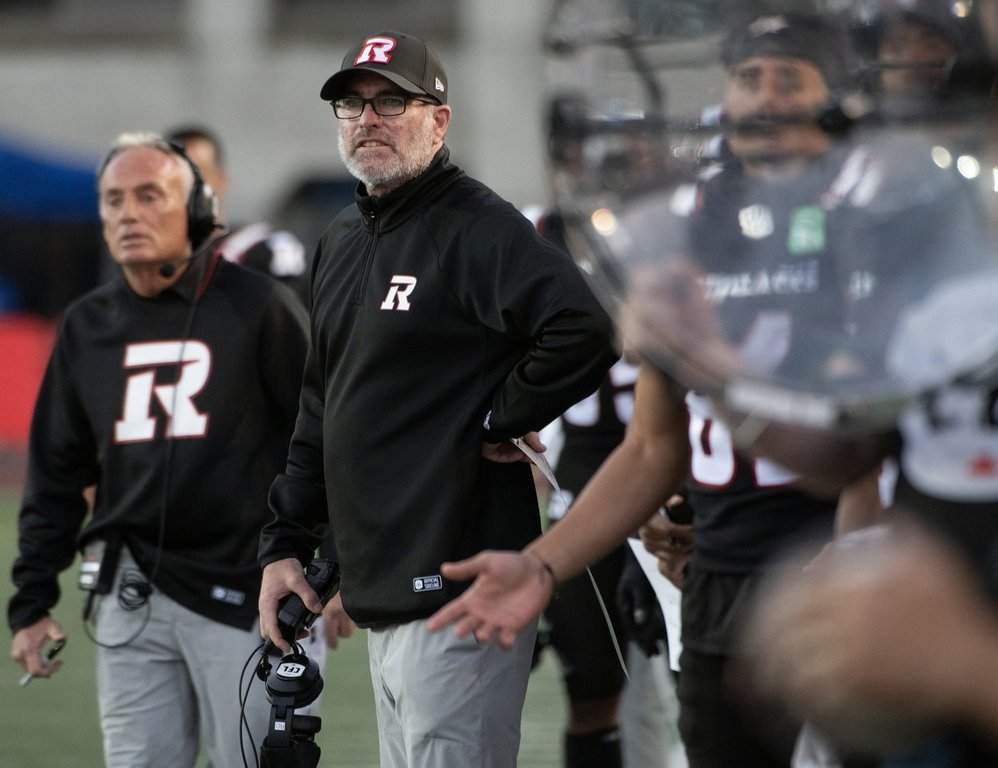
The air inside a professional football facility in June smells of two things: fresh-cut grass and stale anxiety. It is a sterile environment wrapped in a high-stakes bubble, where men in their twenties and thirties chase a leather ball while men in their forties and fifties pace the sidelines, trying to outrun their own obsolescence.
Ryan Dinwiddie knows this smell intimately.
For years, his name was synonymous with the Toronto Argonauts. He was the wunderkind coach who took the reins and delivered a Grey Cup, a man whose offensive mind was parsed like modern poetry by commentators across Canada. He had security. He had a legacy.
Then came the shift. The quiet announcement that Dinwiddie was migrating to the Ottawa Redblacks marked more than a change in postal codes. It represented a fundamental reinvention of a man who had already conquered the mountain, only to realize he missed the climb.
Football coaches are a strange breed. They trade sleep for film study. They trade family dinners for red-zone packages. When a coach of Dinwiddie’s caliber moves to a franchise that has spent recent seasons searching for an identity, it is never just about a contract. It is a reclamation project.
The Ghost of Lansdowne Park
To understand why this move matters, you have to understand Ottawa.
Football in the nation's capital is a romance wrapped in heartbreak. The city has seen franchises rise, crumble, change names, and vanish into the ether, only to be resurrected under the Redblacks banner. The fans at TD Place are loud, loyal, and possess a long memory. They remember the championship glory of 2016, but they also remember the lean, frustrating winters that followed.
When a team struggles, the stadium feels larger than it is. The empty seats look like open wounds.
Dinwiddie steps into this environment not as a savior, but as an architect. The Ottawa front office did not bring him in to tweak the playbook; they brought him in to rewrite the culture. That process is painful. It requires stripping away the bad habits that accumulate during losing seasons—the subtle acceptance of mediocrity, the slight hesitation before a snap, the collective sigh when an opponent scores first.
Consider a hypothetical player. Let’s call him Marcus. Marcus is a veteran defensive back who has survived three coaching changes in Ottawa. He has seen the speeches. He has worn the different variations of the jersey. When a new coach walks through the door boasting a championship resume, Marcus does not applaud. He watches. He looks to see if the new boss is going to yell, or if he is going to teach.
Dinwiddie’s reputation precedes him as a teacher. In Toronto, his offenses were masterclasses in spacing and timing. He did not rely on trick plays; he relied on execution so precise it bordered on mechanical. But replicating that in Ottawa means convincing players like Marcus that the sacrifices required to reach that level are worth the phantom pain of tomorrow's practice.
The Anatomy of the Pivot
The Canadian Football League is a distinct beast. The field is too wide. The timing rules are designed to induce cardiac arrest in defensive coordinators. A lead is never safe, and a three-point deficit with twenty seconds left feels like an eternity.
In this environment, an offensive coach cannot afford to be a purist. He must be a pragmatist.
Dinwiddie’s arrival in Ottawa alters the mathematical geometry of the East Division. For the past few seasons, Toronto held the keys to the kingdom, largely because Dinwiddie’s system maximized quarterback efficiency while keeping defenses guessing. By crossing the provincial border, he changes the calculus. He brings the blueprint of the enemy into the home locker room.
But blueprints are just paper. The actual construction happens in the dirt.
During the first week of training camp, observers noted a distinct shift in the tempo of Ottawa's practices. The casual observer might just see guys running around in shorts. Look closer. The change is in the details. It is the position of a receiver’s hands on a blocking assignment. It is the exact angle of a quarterback’s drop-back.
Dinwiddie is obsessive about these details because he knows that games in October are won by the muscle memory developed in June. He is trying to build a collective instinct. When the stadium is shaking and the season is on the line, a player cannot be thinking about where his feet go. The feet must know on their own.
The Human Cost of High Expectations
We like to view sports as a meritocracy of physical talent, but the reality is far more fragile. It is a psychological tightrope.
When a franchise hires a coach of this stature, the pressure does not just land on the whistle-blower. It cascades down to the youngest guy on the practice roster. The kid from a small American college who scraped his way onto the plane to Canada suddenly realizes the margin for error just vanished.
Under previous regimes, maybe a dropped pass in a scrimmage was met with a shrug and a "we'll get 'em next time." Under Dinwiddie, that same dropped pass is a film-room case study in lack of focus.
This intensity can break a locker room if it isn't managed correctly. If a coach is viewed as a tyrant, the players will play hard enough to avoid getting cut, but they won't play hard enough to win a championship. They won't dive for the ball on third-and-inches when their ribs are cracked.
The true test of Dinwiddie’s new phase in Ottawa will not be measured in total passing yards or first downs. It will be measured in the eyes of his players when they lose their first difficult game. That is when the narrative of a season is written. Do they turn on each other, or do they look at the man in the headset and believe him when he says they are close?
Reclaiming the Red and Black
There is an old saying in football that you never want to be the guy who replaces a legend; you want to be the guy who replaces the guy who replaced the legend.
Ottawa has cycled through the replacements. The fans are tired of transitions. They are tired of "building years." They want relevance, and they want it immediately.
Dinwiddie’s move is a gamble for everyone involved. For the Redblacks, they have invested heavily in a philosophy that requires total buy-in. For Dinwiddie, he has risked a pristine reputation to prove that his success in Toronto was not an accident of circumstance, but a product of his specific DNA.
As the sun sets over the Rideau Canal, casting long shadows across the turf at TD Place, the whistles fall silent. The players limp toward the training room. The coaches gather in dark rooms to watch the digital tape of a Tuesday afternoon practice, hunting for the single flaw that could ruin a Saturday night.
The new era in Ottawa has no guarantees. The East Division is a gauntlet, and the ghosts of past failures still linger in the rafters of the stadium. But for the first time in a long time, there is a sense of deliberate direction in the capital. A man who knows how to win is standing at the chalkboard, and he is holding the eraser.