The ink on a diplomatic communique is always cold, but the pens are held by hands that sweat.
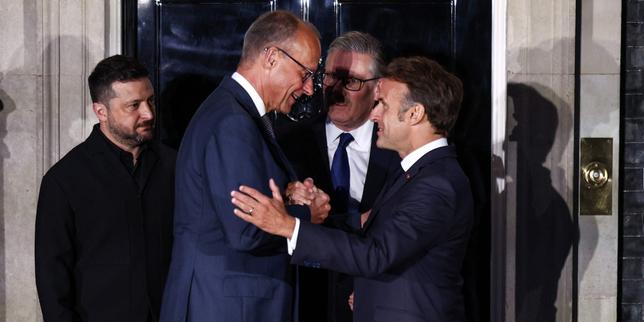
In the grand, vaulted halls of European power—the Élysée Palace, the Federal Chancellery in Berlin, the quiet corridors of Downing Street—the air conditioning is impeccable. It silences the humidity of a changing season. Yet, inside those rooms, the atmosphere carries a crushing weight. When news broke that France, Germany, and the United Kingdom had officially thrown their diplomatic weight behind Volodymyr Zelensky’s proposal for direct talks between Kyiv and Moscow, the public received a headline. A standard, dry, twelve-word bulletin.
But headlines are just the skin of history. Beneath them lies the pulse.
To understand what just happened, look away from the podiums. Consider instead a hypothetical desk in a nondescript office in eastern Ukraine. Let us call the man sitting there Anton. He is not a politician. He is a local civil coordinator, the kind of person who manages water distribution schedules and counts remaining blankets. For Anton, and for millions like him, the dry phrase "direct dialogue" is not a political strategy. It is the difference between a roof and a crater. It is the difference between waiting for a son to call and waiting for a chaplain to knock on the door.
For years, the geopolitical machinery has operated at a distance. Statements were funneled through intermediaries, parsed by analysts, and delivered via sterile press releases. It was a conflict mediated by geometry—tables so long the participants needed earpieces just to hear each other's breathing.
Then came the shift.
The Ukrainian presidency proposed something deceptively simple yet immensely dangerous: direct conversation. No buffers. No shields. Just the raw, unvarnished confrontation of two sides staring into the abyss of their own shared geography.
When Paris, Berlin, and London nodded in unison, the tectonic plates of European security shifted a millimeter. A millimeter is everything.
Skeptics will say this is merely theater. They will argue that words are cheap when artillery is expensive. But they forget how wars actually end. They do not end when the last bullet is fired; they end when someone, exhausted and broken, decides that sitting across from an enemy is marginally more tolerable than digging another trench.
The Western endorsement is a calculated gamble. By backing a direct channel, the European trio is signaling a profound weariness with the status quo. It is an admission that the existing architecture of global diplomacy—the summits, the resolutions, the multilateral committees—has become a carousel that spins without moving forward.
Think of it as a structural collapse in slow motion. When a building threatens to fall, engineers eventually stop trying to reinforce the outer walls from afar. They have to walk inside the structure, right up to the cracked load-bearing pillar, and face the dust.
This decision is fraught with terrifying ambiguity. What does a direct dialogue even look like when the ground beneath the negotiators' feet is still shaking? Trust is not a factor here; trust was buried long ago. This is about survivalist pragmatism. It is the realization that even the most bitter enemies must eventually negotiate the terms of their co-existence on a finite planet.
The risk is immense. A failed direct summit does not leave you back at zero. It drops you into the negative. If the two leaders sit in a room and walk out without a word, the silence that follows will be louder than any missile strike. It tells the world that diplomacy has exhausted its vocabulary.
But consider what happens next if they do not try.
The alternative is a perpetual engine of attrition. A world where headlines become background noise, where the names of devastated towns blur together, and where the human cost is converted into a series of neat, digestible graphs for evening news broadcasts.
We often treat international relations like a game of chess, admiring the clever positioning of knights and bishops. We look at France's strategic autonomy, Germany's economic recalculations, and Britain's defense commitments as mere pieces on a board. But chess pieces do not bleed. They do not have families waiting in unheated basements, checking their phones for a signal that never comes.
The three Western powers did not just sign a statement of support. They signed an acknowledgment of reality. They accepted that the path to any semblance of stability cannot be paved by proxy or navigated by committee. It requires the brutal, uncomfortable intimacy of direct confrontation at a table.
The diplomatic wires have gone quiet for the night. The press briefings are over, the cameras packed away into black canvas bags. In Paris, Berlin, and London, the lights in the ministry windows are turning off one by one.
Far to the east, Anton turns off his desk lamp too. He steps outside into the cool air, listening to the distance. For the first time in a long time, the future is not dictated solely by the trajectory of incoming steel. It hangs, fragile and trembling, on the terrible potential of a human voice.