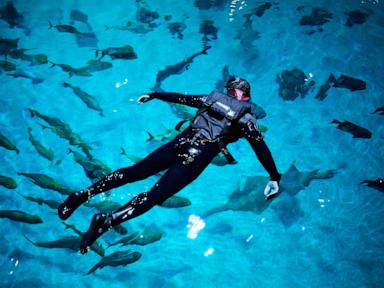
In the basement of the world’s largest indoor aquatic habitats, the air smells of salt and industrial filtration. For a combat veteran carrying the invisible fractures of a decade of deployment, this environment offers something the sterile walls of a VA clinic cannot: neutral buoyancy. The recent initiatives bringing wounded service members into the tanks at the Georgia Aquarium to swim with whale sharks are not merely feel-good photo opportunities. They represent a desperate pivot in American rehabilitative medicine. Traditional talk therapy and pharmaceutical interventions are flagging under the sheer volume of post-9/11 trauma cases, forcing providers to look toward high-impact sensory immersion as a bridge back to civilian functionality.
The Physics of Displacement
Water is a brutal truth-teller. When a veteran with a spinal cord injury or a double amputation enters a 6.3-million-gallon tank, the primary force they contend with is no longer gravity, but displacement. In a terrestrial environment, every movement is a negotiation with pain. The prosthetic chafes. The scar tissue pulls. But in the water, the load on the musculoskeletal system vanishes. This isn't just about comfort; it is about neurological recalibration. If you enjoyed this post, you should read: this related article.
When the body is suspended, the brain receives a different set of signals from the vestibular system. For a soldier who has spent years on high alert, hyper-vigilance is a hardwired survival mechanism. The sensory deprivation—or rather, the sensory shift—of being underwater forces the nervous system to downshift from a sympathetic state (fight or flight) to a parasympathetic state (rest and digest). You cannot be hyper-vigilant when you are focused on the rhythmic, slow-motion pulse of a whale shark’s tail.
The whale shark itself acts as a massive, living anchor for the wandering mind. These animals move with a deliberate, prehistoric indifference. They are uninterested in the veteran’s trauma, their rank, or their physical limitations. To a man or woman who feels defined by their "brokenness," the total apathy of a 20-ton fish is remarkably liberating. It is a rare moment where they are not a patient or a hero. They are just another organism in the current. For another look on this story, refer to the latest update from Mayo Clinic.
Beyond the Spectacle of Therapy
Critics often point to the high cost and logistical complexity of these programs as a barrier to scalable healthcare. It is an expensive way to find peace. However, this view ignores the astronomical long-term costs of failed traditional treatments. If a single immersion session can break a cycle of opioid dependency or prevent a veteran from slipping into the dark statistics of the suicide crisis, the return on investment is immediate.
We are seeing a shift toward "adventure-based healing" because the clinical model is exhausted. The sterile white room with two chairs and a box of tissues has its limits. For many, that setting feels like an interrogation. Contrast that with the Georgia Aquarium’s Ocean Voyager exhibit. The sheer scale of the environment provides a sense of "awe," a psychological state that researchers are beginning to realize is vital for emotional regulation.
The Mechanics of Awe
Awe is more than just a big feeling. It is a cognitive process that happens when we encounter something so vast it requires us to update our mental maps of the world. For a veteran whose world has shrunk to the size of their bedroom or the local pharmacy, the vastness of the tank expands their horizons. It forces a "small self" perspective. In the presence of a whale shark, your problems are not necessarily gone, but they are suddenly, mercifully, smaller.
The Hidden Logistics of Aquatic Re-entry
It isn't as simple as handing a veteran a snorkel and pushing them into the water. The behind-the-scenes effort required to facilitate these swims is an overlooked feat of engineering and empathy. Dive masters at these facilities often have to work around complex physical constraints—oxygen tanks that need to be waterproofed, specialized buoyancy compensators for those missing limbs, and a constant watch for signs of panic or flashbacks.
The water provides a safe container for physical exertion. A veteran might find they can move a limb in the water that feels locked on land. This success creates a "win" in the brain, a small victory over the body that can be carried back to the surface. It is a form of physical therapy that masquerades as an excursion.
The Problem with Short Term Relief
The elephant—or the shark—in the room is the "vacation effect." What happens when the wetsuit comes off? The criticism that these programs offer only fleeting relief is valid but misses the point of a catalyst. The swim is not the cure; it is the spark. It proves to the veteran that they are still capable of feeling something other than dread or numbness.
The real work happens in the weeks following the event. Successful programs integrate these swims into a broader continuum of care. Without the follow-up, the experience risks becoming a haunting memory of a peace that cannot be sustained. We see the most success when the "awe" experienced in the tank is used as a reference point in future counseling sessions, a mental anchor for the veteran to return to when the noise of the world becomes deafening.
The Industrialization of Healing
There is a growing industry surrounding veteran wellness, and with it comes a level of scrutiny. We must ask if these programs are designed for the veteran or for the donor. High-gloss videos of wounded warriors swimming with majestic sea life make for excellent fundraising material. While the publicity brings in the necessary capital to run these expensive operations, the integrity of the clinical outcome must remain the priority.
The Georgia Aquarium has managed this balance by partnering with established military support organizations that vet participants and provide the necessary pre- and post-swim support. This isn't a tourist attraction for the broken; it is a specialized intervention. The distinction is critical. If we treat these experiences as mere entertainment, we devalue the profound physiological shifts occurring in the water.
A New Metric for Recovery
The military-medical complex is obsessed with metrics. How many pills? How many hours of talk? How many points on a PTSD scale? These are necessary but insufficient. We need to start measuring the return of curiosity and the reduction of social isolation.
When a veteran shares the story of their swim, they are engaging in a positive narrative of their own life. They are no longer the person who was blown up in Kandahar; they are the person who swam with a giant of the deep. That shift in identity is where the true healing resides. It is the movement from "victim" to "adventurer."
The water doesn't wash away the past. It just makes the present light enough to carry. As more facilities look toward these high-immersion models, the focus must stay on the brutal reality of the veteran experience. It is a long, difficult road back from the edge of the world. Sometimes, the only way to find your footing is to stop standing on your own two feet and let the ocean take the weight.
You cannot fix a broken soul with a dive mask, but you can give it a place to breathe. The data suggests that for a significant portion of our returning force, this breath is the first one they’ve taken in years that didn't feel like a struggle. That alone justifies the effort. The next challenge is making sure the silence of the deep remains accessible once they are back on the noisy, crowded streets of the home front.