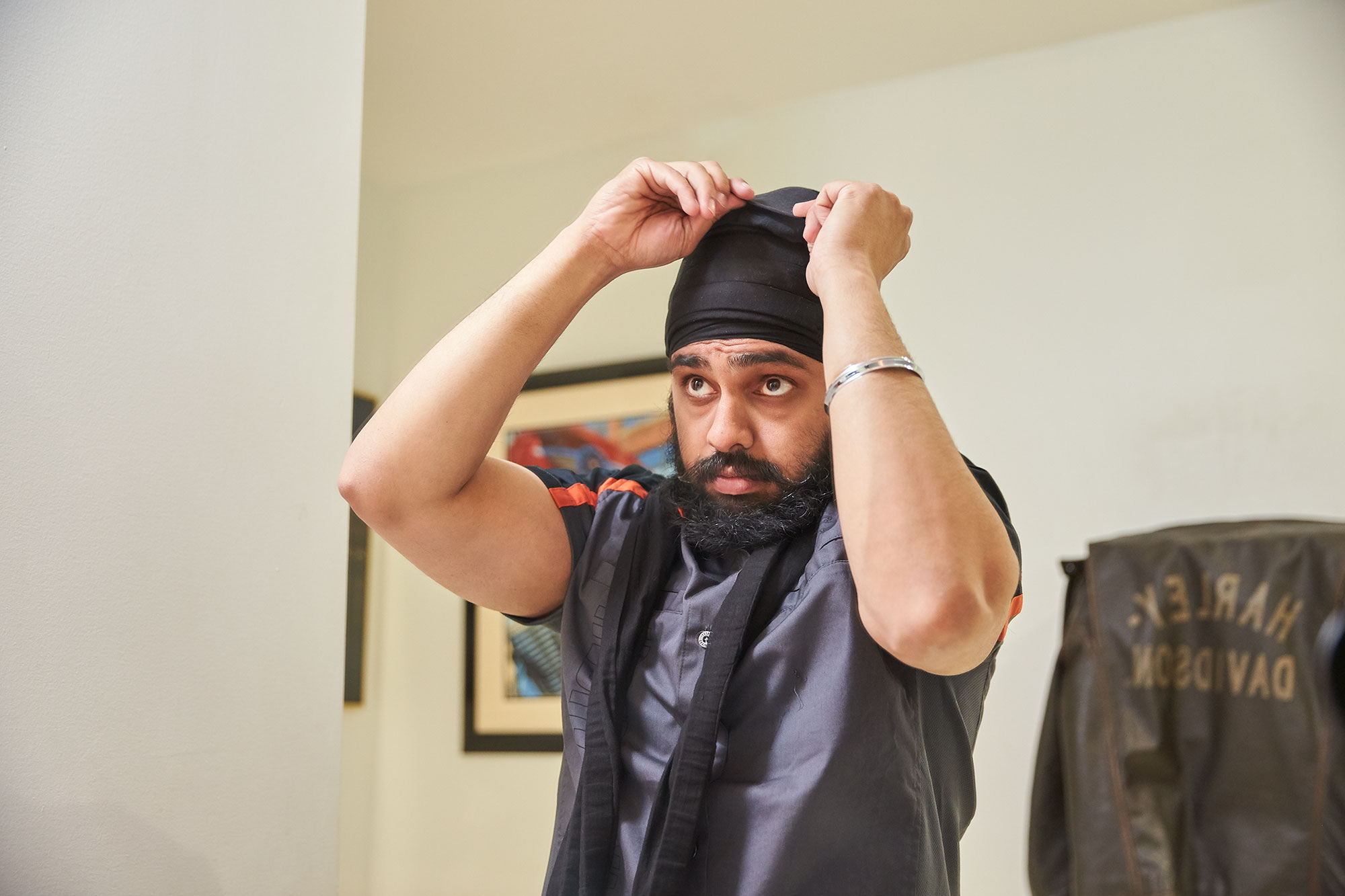
The salt spray doesn’t care about your religion. When you are standing on the deck of a vessel in the North Atlantic, the wind is a physical hand trying to shove you overboard, and the machinery below deck hums with a mechanical indifference to human culture. For decades, the maritime world operated under a singular, rigid logic: to keep a ship running, you must look a certain way. You must be clean-shaven. You must fit into the uniform.
Until Karambir Singh decided that the uniform had to change to fit the man. If you liked this piece, you might want to look at: this related article.
For years, the Canadian Marine Careers Expo and various naval sectors operated under a standard that felt like a brick wall to observant Sikh men. The requirement was simple on paper but soul-crushing in practice. To serve as a marine engineer, you needed to be able to don a gas mask or a breathing apparatus with a perfect seal. In the eyes of safety regulators, a beard was not a symbol of faith; it was a structural flaw.
Karambir Singh grew up with the scent of engine oil and the steady rhythm of the sea in his periphery. He didn't want to just work; he wanted to solve the puzzles of heat, pressure, and steel that keep a massive vessel alive. But he also carried the 5Ks of his faith. His turban was his crown. His beard was his identity. To choose the sea was, historically, to abandon the self. For another perspective on this development, see the latest update from Reuters.
The Engineering of Identity
Marine engineering is a brutal discipline. You are responsible for the heart of the ship. If a pipe bursts or a fire breaks out in the engine room, you are the first line of defense. Safety isn't a suggestion; it’s a religion of its own. This is where the conflict lived. The "clean-shave" policy wasn't born out of malice, but out of a narrow definition of safety that failed to innovate.
Consider the physics of a respirator. The mask must suction to the skin to prevent toxic fumes from entering the lungs. For decades, the industry collective shrugged and said, "It can't be done with a beard." They saw a beard as an insurmountable gap in the seal. They didn't see it as a design challenge.
Singh’s journey wasn't just about getting a job. It was a multi-year masterclass in persistence. He wasn't just asking for an exception; he was proving a point of engineering. Modern technology had evolved, but the policy had stayed stagnant, anchored in the mid-20th century. By working with the Canadian Coast Guard and various regulatory bodies, the conversation shifted from "You can't" to "How can we?"
The solution wasn't a miracle. It was a technical adjustment. By utilizing specific types of under-mask coverings and high-tension respirators, the "impossible" seal became a reality. It turns out that when you stop looking for reasons to exclude people, the solutions reveal themselves rather quickly.
The First Watch
When Karambir Singh finally stepped onto the deck as Canada’s first bearded Sikh Marine engineer, the air felt different. It wasn't just the victory of one man. It was the cracking of a glass ceiling that was actually made of rusted iron.
Imagine the silence of the engine room before the shift starts. The smell of diesel is thick. The heat is a constant, heavy blanket. Singh enters, his turban wrapped tightly, his beard groomed and ready for the mask if the alarm ever sounds. He isn't a "diversity hire." He is the man who knows how to fix the turbine when it screams. He is the one who understands the delicate balance of the cooling system.
The stakes were invisible but massive. If he failed, the door would slam shut for every young Sikh boy in Vancouver, Brampton, or Halifax who looked at the ocean and dreamed of the engine room. If he succeeded, the definition of a "Canadian Sailor" would expand forever.
He chose the harder path. It is easy to shave. It is easy to blend in. It is incredibly difficult to stand your ground and demand that a centuries-old institution acknowledge your right to exist as your whole self.
Breaking the Iron Seal
This policy change ripples far beyond the individual. It challenges the very idea of what "professionalism" looks like in a high-stakes environment. We have been conditioned to believe that a uniform means uniformity—that to be reliable, we must be identical.
But the sea is unpredictable. Engineering is about creative problem-solving under pressure. Why would we want a fleet of identical minds when we could have a fleet of people who have already proven they can overcome systemic obstacles just to get into the room?
The technical reality is that the "beard problem" was always a mask for a lack of imagination. When the Canadian government and the maritime industry finally moved to accommodate Singh, they didn't just help a Sikh man; they modernized their entire approach to safety and equipment. They acknowledged that the human element is more valuable than the rigid adherence to an outdated manual.
The Sound of the Engine
There is a specific kind of peace that comes when a ship reaches cruising speed. The vibrations settle into a hum that you feel in your teeth. In that moment, your religion, your hair, and your background fade into the background. All that matters is the pressure gauge and the temperature of the oil.
Karambir Singh stands at the center of that hum. He is no longer a headline or a policy debate. He is an engineer.
But every time he catches his reflection in a polished steel bulkhead, he sees a man who refused to leave half of himself on the shore. He represents a new era of the Canadian workforce—one where the "standard" is finally being rewritten to include the people who actually live in the country.
The invisible stakes were never just about a beard. They were about whether we value a person’s skill enough to respect their soul. As the ship cuts through the dark water of the Pacific, the white foam trailing behind, the message is clear. The old ways are sinking. A new kind of sailor is at the helm.
The engine keeps turning. The seal holds. The man remains whole.