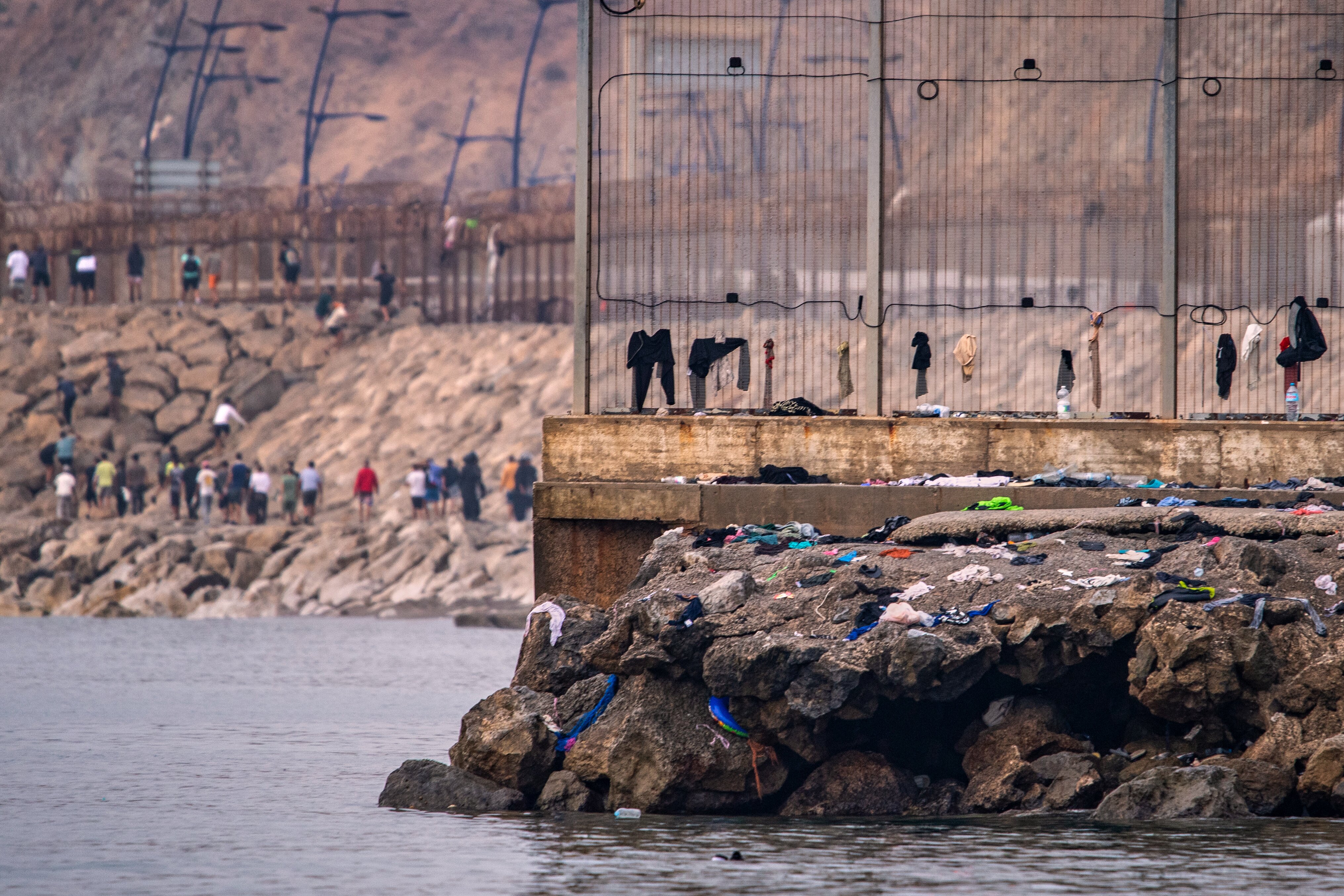
The sea does not care about borders. It never has. It laps against the golden shores of the Mediterranean, carrying the scent of salt, fish, and old dreams, indifferent to the lines drawn on parchment maps by men in distant capitals. But on the razor-wire fences of Ceuta and Melilla, the sea meets a very different kind of reality. It meets steel. It meets concrete. It meets a sixty-seven.
That is the number that echoes through the morning briefings and the dry wire reports. Sixty-seven. A tally. A statistic. A quiet punctuation mark at the end of a sentence that nobody wants to finish reading. Learn more on a similar subject: this related article.
To understand what happened when tens of thousands of people crossed back into Morocco from Spanish soil, you have to strip away the politics. You have to forget the press conferences, the nervous diplomatic cables, and the flashing red lights of police cruisers. You have to stand where the dust meets the asphalt.
I remember the heat. It is a heavy, pressing thing that settles behind your eyes and refuses to leave. When you stand near the border crossing, the air vibrates with a low, constant hum—the sound of idling engines, shouting voices, and the collective heartbeat of thousands of people caught in the liminal space between rejection and survival. Additional analysis by NPR highlights comparable perspectives on this issue.
Consider what happens when a gate closes.
For months, the pressure had been building. Imagine holding your breath underwater. At first, there is quiet concentration. Then, a rising panic. Your chest burns. The world narrows to a single, desperate need for air. That was the state of affairs along the southern edge of Europe. Tens of thousands had pushed northward, drawn by the fragile, glowing promise of a better life, only to find themselves trapped in a labyrinth of administrative dead ends and fortified barriers.
Then came the pivot. The decision to return. Not because they wanted to, but because the alternative—remaining in the shadows of a fortress that viewed them as a threat—became heavier than the grief of going back.
The mass movement back into Morocco was not a gentle retreat. It was an exodus born of exhaustion.
Imagine a mother carrying a toddler across uneven terrain, her shoes worn thin, the dust caked into the sweat on her forehead. She is not thinking about geopolitics. She is thinking about water. She is thinking about whether the next town has a clinic, whether her child's cough will worsen in the night, whether the money she borrowed to make this journey will ever be repaid.
When the mass crossings back began, the sheer volume of humanity overwhelmed the infrastructure. Chaos ensued. Panic rushed through the narrow corridors like a sudden flood. People tripped. People fell. People were crushed by the sheer weight of a desperate crowd moving as a single, terrified organism.
Sixty-seven lives ended in the crush.
Sixty-seven futures, erased in the blink of an eye. Sixty-seven stories cut short simply because they tried to cross a line that humans invented and nature ignores.
It is easy to look at migration as a crisis of numbers. Governments do this instinctively. They count entries. They count deportations. They count the dead as collateral damage in a grander game of border security. But numbers are a sedative. They numb the mind to the reality of individual suffering. They turn a human tragedy into a spreadsheet error.
Let us be honest about the mechanics of despair.
When borders harden, they do not stop movement; they only make it more dangerous. They turn desperation into an industry. Smugglers thrive in the shadows cast by high walls. Desperate people take greater risks because the legal pathways are narrower than the eye of a needle. The border crisis in Spain is not an anomaly. It is a symptom of a deeper, global fracture. It is what happens when extreme wealth sits within arm's reach of extreme poverty, separated only by a fence and a police baton.
We watched the footage replay on loop. Grainy helicopter shots showing dark clusters of humanity moving against the pale dust. Pundits debated the legal frameworks. Officials pointed fingers across the Mediterranean, each side blaming the other for the breakdown in order.
And all the while, the families of the sixty-seven sat in quiet rooms, thousands of miles away, receiving phone calls that changed their lineages forever.
There is a profound loneliness in being caught between two worlds. To Morocco, many of these travelers felt like ghosts who had already left. To Spain, they were intruders who had no right to stay. They belonged to no one, and therefore, everyone felt justified in managing them with detachment.
We must confront the uncomfortable truth behind these events. Fortress mentalities do not solve humanitarian realities. They merely displace them. Every time a wall goes higher, the methods used to scale it become more perilous. Every time a door closes tighter, the push to break it open grows more violent.
Consider the rhythm of the tide. It comes in, washing the shore clean, and then it pulls back, dragging the sand into the deep.
The people who crossed back into Morocco were part of that pull. They were retreating from a wall that refused to yield. But the reasons they left their homes in the first place have not vanished. The drought in the fields, the lack of work, the quiet desperation of waking up every day with no horizon—these things remain. They are packed in the bags of those who returned, heavier than any stone.
History has a cruel way of repeating its worst chapters because we refuse to listen to the language of human pain. We prefer the clean vocabulary of policy. We prefer to speak of migration flows and security protocols as if we are discussing weather patterns or shipping lanes.
The wind blows. The fence stands. The people bleed.
Until we learn to look at the border not as a line to be defended, but as a wound that needs healing, the numbers will only grow. Sixty-seven is not just a statistic from a single weekend of chaos. It is a warning. It is the cost of our collective failure to imagine a world where human dignity matters more than geographic convenience.
The sun sets over the Strait of Gibraltar, painting the water in shades of bruised purple and gold. Across the water, the lights of Europe twinkle, bright and indifferent. In the quiet dust of the borderlands, the footprints of the tens of thousands are slowly swept away by the wind, leaving behind only the silence of what used to be.