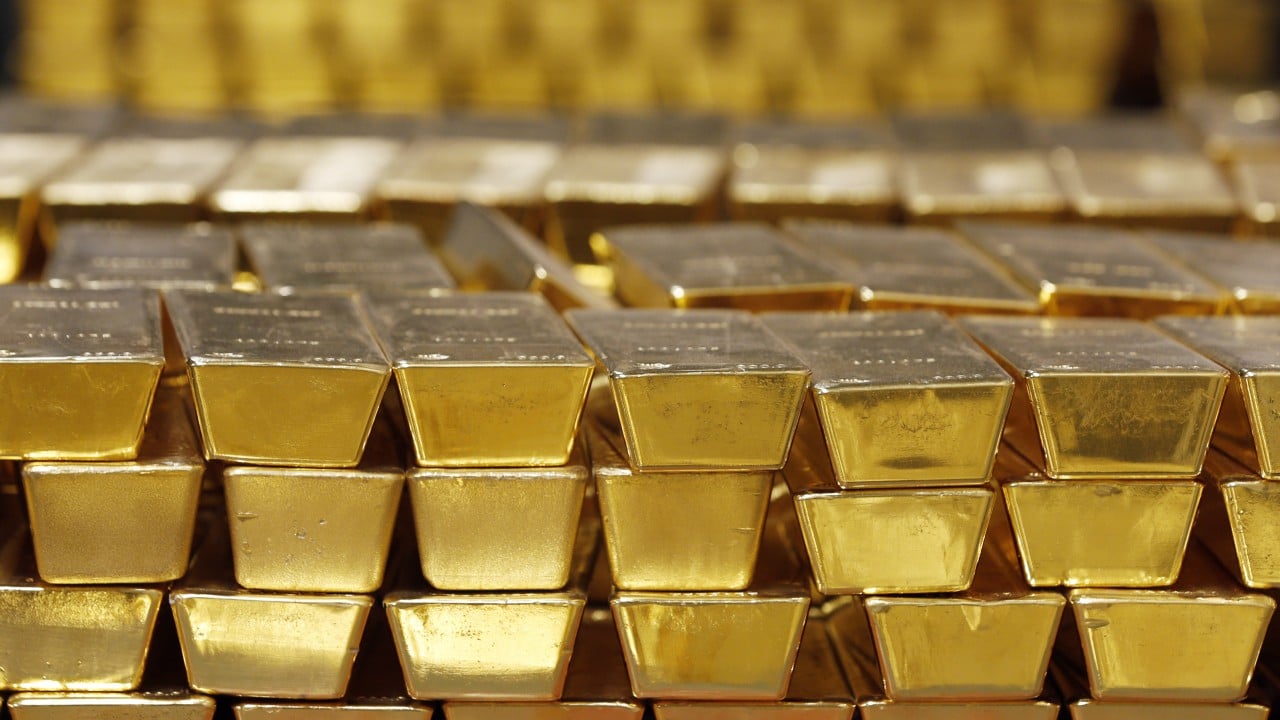
Heavy steel does not care about empires. It cares only about weight, friction, and the quiet pressure of air sealed tight behind rubber gaskets.
Imagine standing four stories underground beneath the humid, orchid-scented heat of Southeast Asia. The air here smells of cool concrete and absolute stillness. Outside, the container ships crawl across the Malacca Strait like a string of lit-up beetles, carrying everything from microchips to sneakers. But inside this room, beneath layers of biometric locks and armed guards who rarely speak, something heavier rests.
Gold.
Millions of ounces of it, stacked in unpolished, matte-yellow bricks that absorb light rather than reflect it.
For decades, the world’s wealth found its traditional sanctuary in Zurich, London, or the fortress of New York’s Federal Reserve. If you were a sovereign central bank looking for a safe place to stash your ultimate emergency insurance, you sent your bars across the Atlantic or parked them near the Thames. Geography was destiny. Trust was an address in Manhattan or an old stone building in the Swiss Alps.
Then the ground shifted.
Not physically—though the physical earth of Singapore is an engineering miracle reclaimed from the sea—but geopolitically.
Consider what happens when the rules of international finance stop feeling permanent. A central bank in a developing nation watches frozen assets make headlines halfway across the world. Suddenly, a vault five thousand miles away in a country with a different legal system, a different currency, and a different geopolitical alignment starts to look less like a convenience and more like a vulnerability.
Enter Singapore.
To understand why this tiny island nation—an urban redoubt roughly the size of a single sprawling metropolitan county—is suddenly storing tonnage for foreign central banks, you have to look past the spreadsheets. You have to look at predictability.
In a chaotic world, predictability is the most valuable commodity on earth.
Singapore built its entire modern identity on a singular, almost obsessive premise: things must work. The trains run on a second-by-second heartbeat. The water is recycled and purified until it tastes like mountain spring water, harvested from urban rooftops. The legal contracts are enforced with a cold, incorruptible precision that makes international corporate lawyers sleep soundly at night.
So, when the Monetary Authority of Singapore quietly opened the doors of its high-security vaults to foreign central bank gold, it wasn’t just offering a closet with a heavy door. It was offering a psychological anchor.
Let us walk through a hypothetical scenario to see how this actually works.
Imagine you are the chief risk officer for a central bank in a rapidly growing region. Your nation exports technology and natural resources. You have accumulated billions in foreign reserves, and a portion of that must be held in gold—the ancient, dead metal that requires no electricity, carries no counterparty risk, and retains its purchasing power when paper currencies falter.
Where do you put it?
Send it to New York? Shipping costs are astronomical, and political winds shift every four years. Send it to Europe? Old Europe is weary, bogged down by regulatory sluggishness and energy crises.
Instead, you look south. You look at a neutral, meticulously ordered city-state where the government views economic stability as an existential religion. You load unmarked, armored trucks under the glare of tropical suns, transfer the cargo onto private cargo jets with armed escorts, and fly it across oceans to a subterranean labyrinth where humidity is controlled down to the decimal point and guards rotate their shifts with the choreography of watchmakers.
When that gold arrives, it is weighed, assayed, and cataloged. Every bar is scanned. Every serial number is entered into a ledger that tolerates zero errors.
And then, nothing happens.
That is the beauty of a vault. Success is measured by total, uninterrupted boredom.
Yet, beneath this boredom lies a fierce, silent race for financial dominance.
For years, London has been the undisputed clearinghouse for global bullion. When gold changes hands globally, it usually does so on paper inside the London Bullion Market Association. But paper is fragile. In times of stress, nations want to touch the metal. They want it physically close to the trade routes they actually use.
Asia is where the growth is. Asia is where the manufacturing heartbeat of the planet pumps day and night. It makes an intuitive, logistical kind of sense that the metal backing the future of global trade should reside where the trade is happening.
Singapore understood this chess move long before anyone else.
They didn't stumble into this role. Back in 2012, the government removed the seven percent Goods and Services Tax on investment-grade precious metals. It was a bold stroke of policy that instantly signaled to the global financial elite: Bring your wealth here. We are open for business.
The bullion dealers arrived next. Then the refiners. Then the high-security logistics firms with their armored fleets. Slowly, organically, a subterranean ecosystem formed.
Now, with foreign central banks stepping forward to deposit their sovereign wealth into Singapore’s vaults, the transformation is complete. The island has evolved from a regional trading post into a planetary safe room.
There is a profound irony in all of this.
We live in an era of pure abstraction. Trillions of dollars flash across fiber-optic cables beneath the ocean floor every single millisecond. Wealth is often nothing more than a green number blinking on an OLED screen, backed by algorithms and institutional faith.
Yet, when the digital world wobbles—when inflation spikes, when sanctions fly, when trust frays at the edges—humanity crawls backward down the ladder of evolution. We seek out the heaviest, most stubborn element we can find. We dig deep into the earth, pour concrete, lock the doors, and leave the gold alone in the dark.
Singapore has built the ultimate dark room.
And as the rest of the world navigates a century of unpredictable tides, the quiet weight beneath the island’s pavement grows heavier by the day.