The air in Washington during a crisis doesn't just feel heavy. It feels static. It is the kind of atmospheric pressure that makes the back of your neck ache, a reminder that while the rest of the world watches the evening news, a handful of people in windowless rooms are trying to keep the sky from falling.
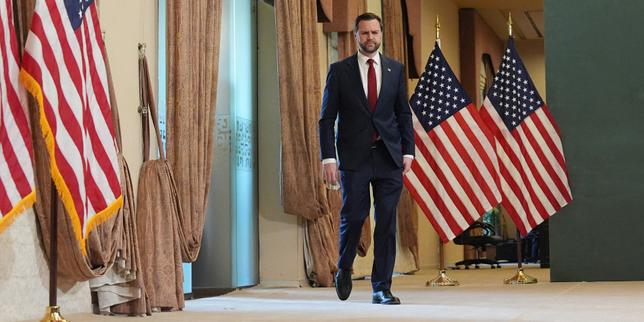
J.D. Vance sat in the middle of that static this week. He was supposed to be on a plane. The itinerary was set: a high-stakes diplomatic mission to Pakistan, a journey meant to solidify ties and project a sense of steady American presence in a region that often feels like it is vibrating on a different, more dangerous frequency. But the plane stayed on the tarmac. The engines remained silent.
Behind the scenes, the White House shifted its weight. The "additional meetings" cited by officials aren't just entries on a digital calendar. They are the physical manifestation of a world on fire. When the Middle East erupts, the ripples don't stop at the Mediterranean. They wash up against the pillars of Pennsylvania Avenue, forcing every other priority into the shadows.
Imagine a map spread across a mahogany table. It isn't just a map of geography; it is a map of consequence. To the west, the Middle East is a bloom of red and orange—escalation, retaliation, the terrifying math of "what comes next." To the east, Pakistan represents a different kind of fragility, a nuclear-armed state navigating its own internal storms. Vance was caught in the tension between these two points. To leave for Islamabad while Washington debated the next move in the Middle East would be like walking out of a house fire to go mow the lawn. It just doesn't happen.
The delay is a tell.
It reveals the true hierarchy of panic in the West Wing. While the public is often told that the government can "walk and chew gum at the same time," the reality is much more singular. When the red phone rings, everything else goes on hold. The "additional meetings" J.D. Vance attended were likely less about Pakistan and more about the gravity of the Middle East conflict pulling every available resource into its orbit.
There is a specific kind of exhaustion that settles on a politician's face when they are tethered to a crisis they didn't start but must somehow help manage. You can see it in the way a suit starts to rumple by 3:00 PM. You can hear it in the clipped, dry tones of White House spokespeople. They aren't just conveying information; they are guarding it. They are making sure the world knows that the Vice President-elect is here, in the room, part of the machinery, even if that means a diplomatic slight to a partner across the globe.
Consider the optics from Islamabad. A foreign dignitary cancels or delays. In the world of diplomacy, timing is the only currency that matters. A delay isn't just a scheduling conflict; it is a statement of priority. It tells Pakistan—and the world—that the fire in the Middle East is currently the only thing the fire department is focused on.
But why does this matter to the person sitting at home, thousands of miles from a drone strike or a diplomatic summit?
It matters because these delays represent the moment reality breaks the script. We like to believe our leaders have a master plan, a sequence of events choreographed months in advance. We find comfort in the schedule. But the schedule is a lie we tell ourselves to feel safe. The truth is found in the "additional meetings." The truth is in the silent engines of a grounded plane. It is the acknowledgment that we are reactive creatures, forever trying to catch up to a history that moves faster than we can think.
The Middle East has a way of swallowing every other conversation. It is an ancient, recurring ghost that haunts the halls of American power. Every time a leader tries to "pivot" or look toward a new horizon—be it Asia, the economy, or domestic reform—the ghost pulls them back by the collar. Vance’s delayed departure is just the latest verse in a very old song.
Inside those rooms in Washington, the talk isn't about grand ideologies. It is about logistics. It is about how many carrier groups are in range. It is about which lines of communication are still open and which have gone cold. It is about the terrifying realization that a single miscalculation in a desert halfway across the globe can rewrite the fate of an administration in an afternoon.
There is a hypothetical staffer in these scenarios. Let’s call her Sarah. Sarah hasn't slept in thirty-six hours. Her job is to manage the briefing books for the Pakistan trip. She has spent weeks memorizing the names of provincial governors and trade statistics. Now, she watches as those books are pushed to the corner of the desk to make room for satellite imagery of missile sites. Her work hasn't become irrelevant, but it has become secondary.
That shift from primary to secondary is where the real drama of government happens. It is the quiet, heartbreaking realization that the "important" work you were doing is now "extra" because the world decided to break in a different direction.
We often speak of power as something proactive—the ability to make things happen. But in the corridors of D.C. this week, power looked like the ability to stop. The ability to pause a trip, to keep a plane on the ground, and to force a man like J.D. Vance to sit in one more meeting, listening to one more update on a conflict that seems to have no bottom.
The plane will eventually take off. The meetings will end. Vance will eventually land in Pakistan and shake the hands he was supposed to shake days ago. He will smile for the cameras and speak of "enduring partnerships" and "mutual interests."
But the delay remains. It sits there like a scar on the timeline. It is a reminder that no matter how much we plan, we are always at the mercy of the next phone call. The static in Washington hasn't cleared yet. It has just become the new background noise, a low hum that accompanies every decision, every movement, and every heartbeat of a nation trying to navigate a world that refuses to stay still.
The engines are cold. The doors are shut. Somewhere in a room without windows, the conversation continues. History isn't made by the trips we take. It is made by the ones we are forced to postpone.