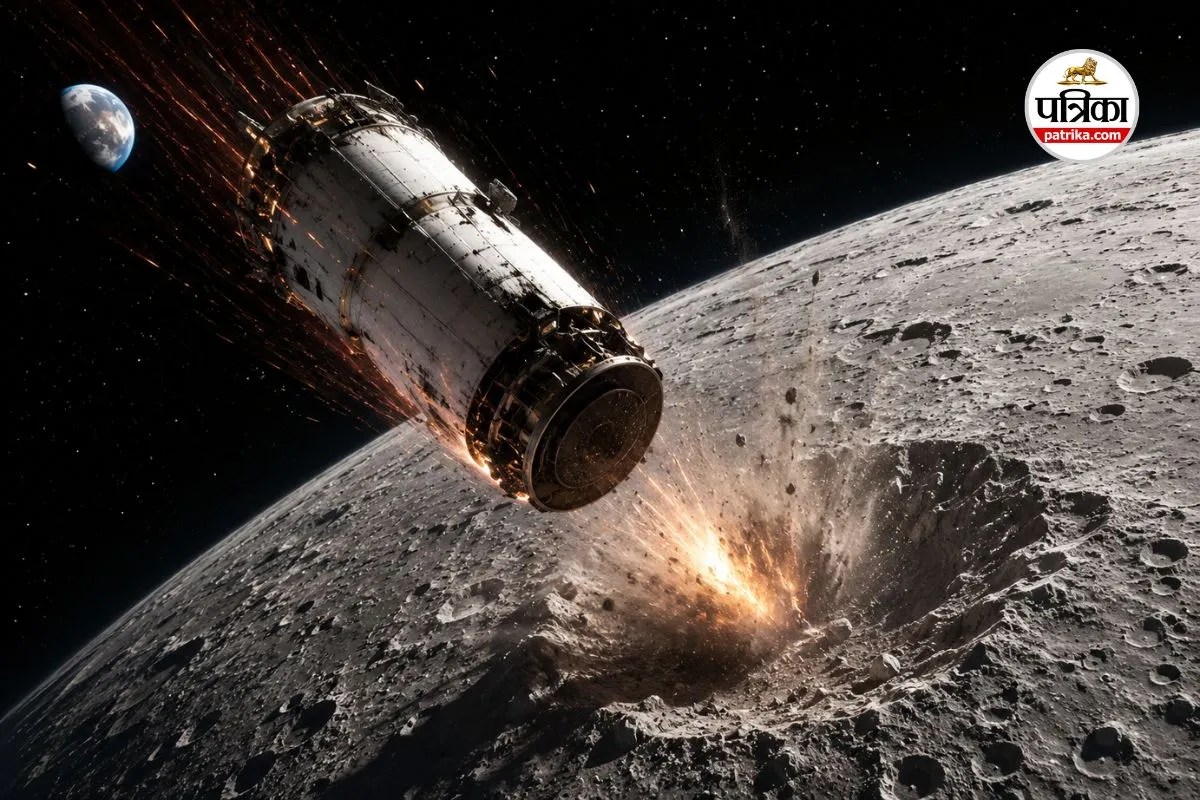
An eight-thousand-pound piece of metal just slammed into the lunar surface at 5,400 miles per hour.
The object was the upper stage of a SpaceX Falcon 9 rocket launched back in January 2025 to send lunar landers on their way. After running out of fuel and lingering in deep space for more than a year and a half, a chaotic mix of solar activity and gravitational pulls pushed it onto a direct collision course with the Moon. It hit near the Einstein and Bell craters, packing the destructive punch of roughly three tons of TNT.
People love to panic about space junk. They picture a sky raining debris or an imminent threat to Earth. But NASA made it clear right away that this crash posed zero danger to our planet.
So why care? Because accidental impacts like this give scientists a rare, unscripted laboratory to study how high-speed debris reshapes the lunar landscape.
What Actually Happened Up There
Deep space missions require a massive amount of energy. When SpaceX launched those landers in January 2025, the mission was complex. Firefly Aerospace’s Blue Ghost-1 made a successful landing, while Japan’s ispace Hakuto-R unfortunately crash-landed. Meanwhile, the massive 45-foot-long second-stage rocket body was left behind in an uncontrolled orbit.
SpaceX officials noted they followed standard disposal protocols for the launch. But standard rules don't always account for the unpredictable shove of solar radiation pressure and Earth-Moon gravity over eighteen months. Independent astronomers first spotted the trajectory earlier this year, and NASA’s Center for Near Earth Object Studies eventually confirmed the math. There was no fuel left to steer it away. Gravity took the wheel.
The impact itself happened in the dead of night at around 2:35 a.m. Eastern time. Because it hit the sunlit side of the Moon, observers couldn't see a bright flash with the naked eye or even through standard amateur telescopes. Spectroscopy told the real story instead. Researchers using the Very Large Telescope in Chile spotted a distinct plume of sodium and lithium gas kicked up by the violent contact.
Why Planetary Scientists Are Excited
Accidental moon crashes are uncommon, but intentional ones have happened before. Back in 2009, NASA intentionally smashed a rocket stage into the lunar south pole to hunt for water ice. It worked, proving that water ice exists in shadowed craters.
This unintended SpaceX impact offers a similar scientific bonus:
- Fresh Craters: Scientists expect the strike to carve out a crater roughly 60 to 90 feet wide and over 10 feet deep.
- Subsurface Material: The collision throws up dust and rock that haven't been exposed to direct sunlight for eons.
- Impact Physics: Researchers will use before-and-after imagery from the Lunar Reconnaissance Orbiter to see how ejecta plumes behave in a vacuum.
Understanding how high-velocity objects interact with lunar soil helps researchers refine models for future exploration. As space agencies gear up to establish permanent bases on the Moon, knowing how dust behaves during disturbances is critical data for keeping equipment and astronauts safe.
The Real Problem With Space Junk
We have a congestion issue building up around our nearest celestial neighbor. Estimates suggest there are now roughly 3,000 human-made objects associated with the Moon, totaling around 190 tonnes of hardware.
Most of it sits harmlessly in various orbits, but events like this highlight a casual attitude toward high-energy mission disposal. SpaceX and NASA are currently reviewing what future disposal paths should look like for deep-space launches that venture past standard Earth orbit. As commercial spaceflight ramps up, leaving multi-ton rocket bodies to drift aimlessly simply won't cut it anymore.
The dust has settled near the Einstein crater. The data is streaming back to ground stations. Now it is up to aerospace engineers to change how they clean up after themselves before the neighborhood gets too crowded.