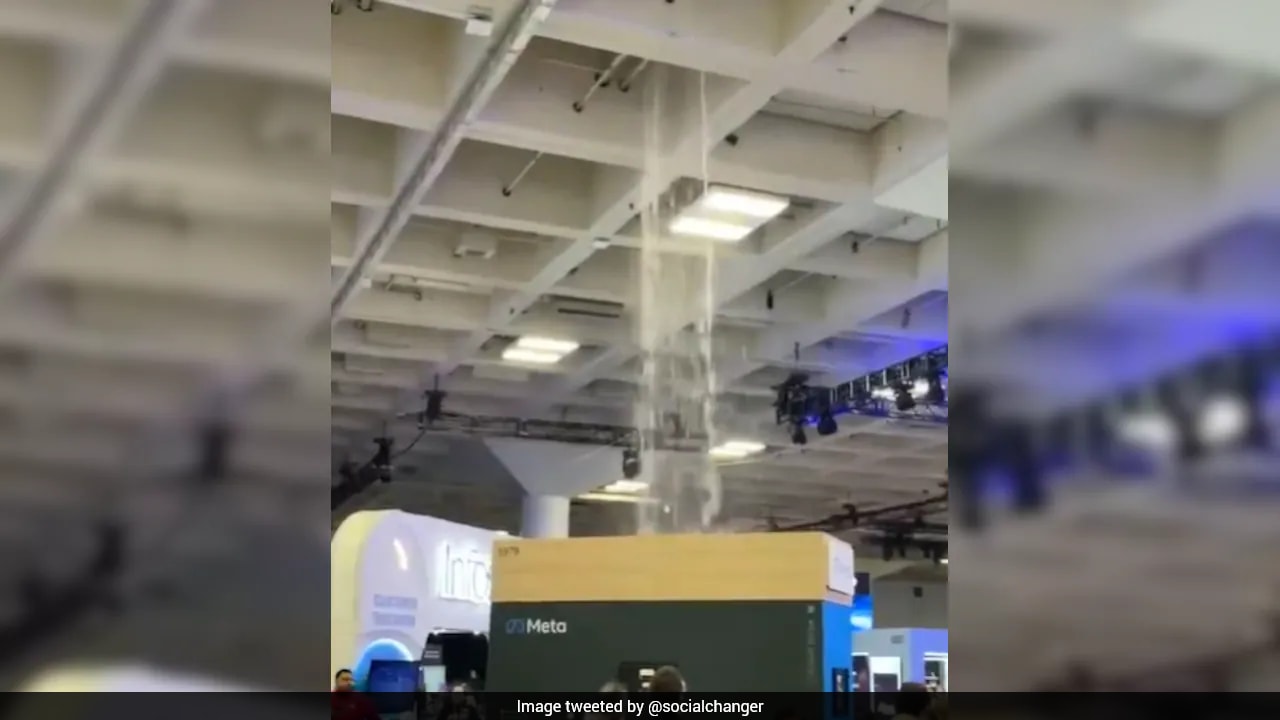
Heavy rain overwhelmed the roof drainage system at San Francisco's Moscone Center during the Microsoft Ignite conference, sending water pouring through the ceiling directly onto Meta's exhibition booth. While social media treated the incident as an ironic metaphor for hardware vulnerabilities in the artificial intelligence era, the real story lies in aging municipal convention infrastructure colliding with billion-dollar enterprise tech spectacles. Attendees watched facility crews scramble with plastic sheeting and trash cans to protect high-end server demonstrations and virtual reality hardware from dirty runoff. Nobody was injured, yet the incident exposed a glaring physical vulnerability beneath the polished veneer of Silicon Valley's biggest annual marketing blitz.
Water does not care about market capitalization. You can spend tens of millions of dollars designing an exhibition floor that looks like a futuristic command center, complete with custom lighting rigs, bespoke carpeting, and liquid-cooled AI server racks, only to have the entire operation undone by a clogged roof drain and an atmospheric river rolling off the Pacific Ocean.
For veterans of the enterprise tech circuit, the sight of buckets catching rainwater inside a major convention hall induces a familiar, weary sigh. We spend forty-eight weeks a year writing about distributed cloud architectures, zero-trust security models, and redundant data centers engineered to withstand regional power grid failures. Then everyone flies to San Francisco for a week, packs into a subterranean concrete cavern, and discovers that the single point of failure for the entire show floor is a thirty-year-old flashing joint above Hall D.
The Anatomy of a Convention Center Failure
To understand how rainwater ends up cascading onto a major sponsor's booth at a flagship technology conference, you have to look at the physical geometry of modern exhibition halls. Convention centers like Moscone are architectural anomalies. They require massive, uninterrupted spans of column-free floor space so event organizers can build multi-story booths and hang heavy rigging from the ceiling trusses.
Achieving those wide spans requires flat or low-slope roof assemblies covering hundreds of thousands of square feet. Unlike a pitched residential roof that sheds water immediately via gravity, a massive flat roof acts like a shallow retention pond during intense downpours. Engineers design these roofs with slight tapers that direct water toward internal roof drains, which then funnel the runoff down through giant vertical pipes hidden inside the structural columns of the building.
That system works fine during a standard drizzle. It fails catastrophically when two things happen simultaneously.
First, San Francisco is prone to sudden, high-volume rain events—often driven by atmospheric rivers—that dump several inches of water in a matter of hours. Second, flat roofs collect debris. Wind blows leaves, plastic wrappers, and urban grit onto the roof surface over months of dry weather. When the first heavy storm of the season hits, that accumulated debris washes straight toward the drain strainers, forming a dense mat that blocks water from entering the pipes.
Once a drain clogs, water pools. The weight of standing water causes the roof deck to deflect slightly downward, creating a deeper bowl that attracts even more water—a phenomenon structural engineers call ponding instability. Eventually, the water level rises above the height of the roof membrane seams, HVAC curbs, or skylight flashings. Gravity takes over, and water finds the path of least resistance straight through the ceiling deck and onto whatever happens to be sitting underneath.
In this case, what happened to be sitting underneath was Meta.
Why Meta's Booth Took the Brunt
The optics of water raining down on Meta's exhibition space during a Microsoft conference provided instant fuel for industry cynics. Meta and Microsoft have spent the last few years locked in a complex dance of public partnership and fierce underlying competition. Meta shows up at Ignite primarily to showcase its open-weights Llama models running on Microsoft Azure infrastructure, positioning itself as the enterprise-friendly alternative to closed AI ecosystems.
Booth placement on a show floor of that scale is never accidental. Sponsors pay staggering sums—often well into seven figures for top-tier diamond or platinum packages—for prime real estate near main traffic arteries, keynote entrances, or central hubs. Those prime spots also happen to sit directly beneath the highest concentration of ceiling utility grids, catwalks, and HVAC penetrations.
Every time a facility crew cuts a hole in a roof deck to run a chilled-water pipe, an electrical conduit, or an exhaust duct, they create a potential leak point. Over decades of renovations, seismic retrofits, and roof replacements, a convention center ceiling becomes a patchwork quilt of membranes, sealants, and mechanical curbs.
When the storm hit San Francisco, the water didn't just drip politely in an empty aisle. It poured through compromised flashing near an overhead utility run, landing right in the middle of a high-profile corporate showcase. Booth staffers had to immediately power down demonstration units, throw plastic tarps over exposed electronics, and cede their prime networking space to janitorial crews armed with mops and industrial wet-vacs.
Think about the absurdity of the contrast. On the screens inside the booth, engineers were demonstrating neural networks capable of processing trillions of parameters across globally distributed data centers. Meanwhile, three feet away, a minimum-wage facility worker was taping a clear garbage bag to a ceiling truss to divert rainwater into a rolling yellow mop bucket.
The Hidden Economics of Show Floor Disasters
Most casual observers look at a leaky roof at a tech conference and laugh at the irony. Event producers, insurance underwriters, and corporate marketing directors look at it and calculate liability.
When a corporate giant buys floor space at an event like Microsoft Ignite, they sign an exhibitor contract packed with dense indemnification clauses. Standard venue contracts almost universally absolve the convention center operator and the event organizer of responsibility for "acts of God" or weather-related building failures, unless gross negligence can be proven.
Consider a hypothetical example of how this plays out behind closed doors after the rain stops. Suppose a major sponsor brings half a million dollars worth of prototype server hardware and custom-built interactive displays to a trade show. A roof leak ruins two custom OLED panels and shorts out a pre-production compute node. The sponsor's legal team immediately demands compensation from the event organizer. The event organizer points to the venue management company. The venue management company points to the city agency that owns the building, citing an unprecedented weather event.
Meanwhile, the sponsor's marketing team has lost six hours of prime floor time during the busiest day of the conference. You cannot file an insurance claim for missed enterprise sales leads or the intangible embarrassment of having your booth cordoned off with wet-floor signs while thousands of developers walk past filming on their phones.
To prevent total mutiny among top sponsors, event organizers usually handle these crises through quiet commercial make-goods rather than litigation. That means offering discounted floor space for next year's conference, complimentary executive briefing rooms, or bonus digital sponsorship placements. The public sees a funny viral video; behind the curtain, account executives spend weeks smoothing over frayed relationships with furious corporate clients.
San Francisco's Infrastructure Reality Check
You cannot separate the Moscone Center leak from the broader conversation surrounding San Francisco as a host city for mega-conferences. For years, the city's convention bureau has fought an uphill battle to keep marquee tech events anchored in downtown San Francisco.
During the early 2020s, several major conferences threatened to leave—or actually did leave—citing high union labor costs, exorbitant hotel rates, and visible street-level challenges in the surrounding SoMa district. Microsoft Ignite itself had moved away from traditional physical footprints before returning to San Francisco with massive fanfare, billed as a triumphant homecoming for the city's tech sector.
San Francisco poured hundreds of millions of dollars into expanding and modernizing Moscone Center in the late 2010s, creating sleek subterranean halls and airy glass lobbies. Yet infrastructure maintenance is a relentless, unglamorous grind. Buildings located near the bay face constant assault from salt air, fog, and extreme seasonal shifts between bone-dry summers and violent winter storms.
When a newly renovated, flagship municipal facility springs a major leak during one of the most heavily publicized tech events of the year, it undermines the core pitch city officials make to global event organizers. Tech companies justify the astronomical cost of exhibiting in San Francisco by telling themselves they are paying for world-class venues and unmatched proximity to the industry's talent pool. Seeing buckets on the floor shatters that illusion instantly.
The Fragility of the Physical Cloud
There is a deeper lesson embedded in this minor soggy catastrophe, one that extends far beyond convention center maintenance schedules. The modern technology industry has spent two decades cultivating a vocabulary designed to make computing feel ethereal, weightless, and invincible.
We call it the cloud. We talk about serverless architectures, virtualized environments, and frictionless deployment. The entire aesthetic of modern tech marketing—from keynote slide decks to trade show booths—is built around clean lines, glowing glass, and the subtle implication that software has somehow transcended the messy limitations of the physical world.
It hasn't.
Every single AI model running in Azure, every Llama instance powering an enterprise chatbot, and every virtual reality environment Meta builds relies entirely on brute-force physical infrastructure. It runs on copper wiring, silicon wafers, concrete foundations, diesel backup generators, and millions of gallons of cooling water. It sits inside buildings that have roofs, pipes, and drains.
Tech executives love to talk about digital resilience while routinely underestimating mundane physical risks. We have seen major cloud regions go offline because a construction worker accidentally severed a fiber-optic bundle with a backhoe. We have seen data centers throttle compute capacity because an unexpected heatwave overwhelmed their chillers. And at Microsoft Ignite, we watched a flagship AI showcase get defeated by clogged roof gutters.
What Event Organizers Actually Do When the Ceiling Fails
When water starts pouring onto an active show floor, the response follows a rigid, unglamorous triage protocol that rarely makes it into press releases.
- Immediate Electrical Isolation: The first priority is preventing electrocution or electrical fires. Trade show floors are spiderwebs of high-voltage power cables hidden beneath carpet padding. Floor managers immediately cut power to affected floor boxes, plunging the surrounding booths into darkness.
- Containment Over Repair: You cannot patch a flat roof membrane during a torrential downpour while standing on a wet, slippery surface in high winds. Facility crews focus entirely on interior water diversion. They hang giant plastic funnels—known in the trade as roof leak diverters—from the ceiling trusses, attaching garden hoses to the bottom to channel water into wheeled trash barrels.
- Perimeter Control: Security guards set up stanchions and caution tape to keep attendees away from slick concrete and polished linoleum floors, where a single slip-and-fall lawsuit can cost more than repairing the roof.
- Sponsor Relocation: If a leak renders a booth completely unusable, event directors scramble to carve out temporary demo space in media lounges, vacant meeting rooms, or unoccupied corners of the hall so the sponsor can salvage scheduled customer meetings.
Notice what is missing from that list. There is no rapid-response engineering team fixing the root cause in real time. Once the water breaks through the vapor barrier, the building is simply bleeding until the storm passes.
The Inevitable Repeat
The water eventually stopped dripping at Moscone Center. Facility crews hauled away the barrels, dried out the concrete, peeled back the soaked carpet tiles, and replaced the damaged ceiling panels before the next morning's keynote sessions began. Meta's staff wiped down their hardware, booted up their demos, and went right back to pitching enterprise AI to passing developers.
To the average attendee walking the floor the next day, it looked as though nothing had happened. The lights were bright, the coffee was hot, and the keynote speakers were back on stage promising a future of infinite, uninterrupted digital transformation.
Up above the lighting rigs, hidden in the dark steel trusses thirty feet over their heads, the plastic sheeting and zip ties were still hanging from the rafters, waiting for the next storm to roll in off the Pacific.


