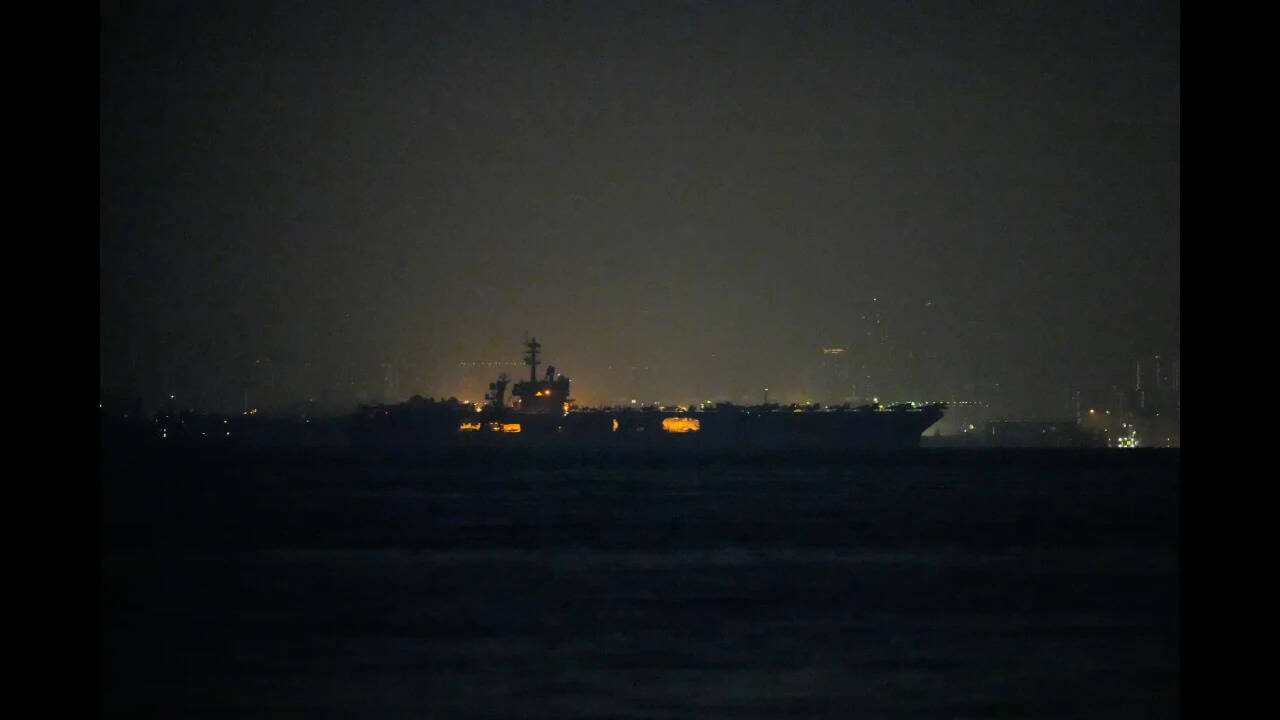
Every headline this week reads like a script written by a bored Pentagon press secretary who hasn't seen the sun since the Obama administration. The consensus from the mainstream security apparatus insists that recent American airstrikes against Iranian-backed proxies represent a dangerous escalation, a major tactical shift, and a decisive turning point in Middle Eastern stability.
They are wrong. They are missing the entire architecture of the modern regional theater because admitting the truth requires burning down decades of bureaucratic self-justification. You might also find this similar article interesting: Pattaya Under Pressure When the Carrier Arrives.
These strikes are not a sign of strength or strategic reinvention. They are expensive, theatrical punctuation marks in a managed stalemate. Washington drops multi-million-dollar precision munitions on empty warehouses, Tehran issues a ritualistic denunciation through state media, proxy militias launch a symbolic swarm of cheap drones that get swatted down by a destroyer, and both capitals return to their respective cocktail parties.
I have watched defense contractors carve up federal budgets over operational theater for twenty years. I have sat in closed-door risk assessments where analysts openly admit that kinetic action against regional proxies accomplishes exactly zero long-term deterrence. Yet, the machine keeps spinning. Why? Because a permanent low-grade conflict keeps defense budgets fat, career paths lubricated, and policymakers looking decisive on the evening news without ever having to answer for a real strategy. As reported in recent articles by BBC News, the implications are worth noting.
The Fallacy of Tactical Retaliation
The lazy narrative treats each exchange of fire as a discrete chess move. If the proxy hits our base, we hit their supply depot. Equal and opposite reaction. Newtonian physics applied to foreign policy.
This model ignores the fundamental asymmetry of the conflict. The United States measures success in tactical efficiency: did the missile hit the coordinates? Did we minimize civilian casualties? Did we project resolve? Tehran measures success in strategic endurance: are American forces bleeding capital and political will? Are regional integration deals stalled? Is the domestic U.S. electorate growing exhausted by endless foreign entanglements?
By that scorecard, every time Washington takes the bait and responds with kinetic force, Iran wins a quiet victory. They are spending pennies on crude asymmetric capabilities while forcing the world's most expensive military machine to burn through finite stockpiles of interceptors and precision-guided munitions.
Imagine a poker player who insists on matching every bluff with a massive all-in shove, completely ignoring the fact that his opponent is playing with house money and bleeding him dry through the rake. That is U.S. Middle East policy in a nutshell.
The Myth of Deterrence
For decades, the security establishment has peddled the belief that you can bomb an ideological network into submission. We did it in Lebanon. We did it in Iraq. We are trying to do it now through proxy outposts in Syria, Iraq, and Yemen.
Deterrence only works against actors who have valuable infrastructure they are afraid to lose. When your entire operational model is decentralized, cell-based, and heavily subsidized by a state sponsor operating behind a nuclear threshold, traditional deterrence is a phantom. You cannot deter a network that views structural damage as a recruitment asset.
Every time a facility is hit, the proxy groups paint new murals, spin up new Telegram channels, and recruit fifty more disaffected youths who view the American flag as the ultimate symbol of stagnation. The strikes do not cripple the network; they fertilize it.
The Nuclear Elephant in the Room
The media loves to hyperventilate about regional proxies because talking about the actual core issue requires intellectual courage. The regional proxy war is a smoke screen for the reality of Iran's nuclear program.
While cable news anchors hyperventilate over a warehouse in Deir ez-Zor, Tehran continues to expand its advanced centrifuge cascades and accumulate near-weapons-grade uranium. They do not care about the tactical setbacks in the desert. Those are disposable pawns. Their strategic horizon is fixed entirely on crossing the nuclear threshold. Once that occurs, every single kinetic strike launched over the past decade will look like a pathetic exercise in rearranging deck chairs on a sinking carrier.
The defense establishment focuses on proxies because they know how to bomb proxies. They do not know how to handle a nuclear-armed adversary without risking a catastrophic regional war or accepting a paradigm shift in global power distribution. So they stick to what is comfortable: expensive, repetitive, ultimately meaningless cycles of proportional retaliation.
What Real Strategy Would Look Like
If Washington were serious about altering the regional dynamic, it would immediately abandon the addiction to tactical whack-a-mole. Real strategy requires economic strangulation combined with absolute regional containment, backed by quiet, devastating cyber operations that target critical infrastructure rather than concrete bunkers. It requires building actual, functioning security architectures with regional partners who share the burden, rather than expecting the U.S. taxpayer to finance infinite desert patrols.
Instead, we get more theater. More announcements of major strikes. More declarations of unshakeable resolve from podiums inside the Beltway.
The next time you read about a decisive American response to Iranian aggression, look past the tonnage of the ordnance and ask yourself a simple question: did this action change Tehran's long-term calculus by even a single millimeter?
The answer is no. And until Washington admits that its current playbook is designed to perpetuate the conflict rather than solve it, the desert theater will continue its endless, bloody loop. Stop watching the explosions. Watch the enrichment charts instead.