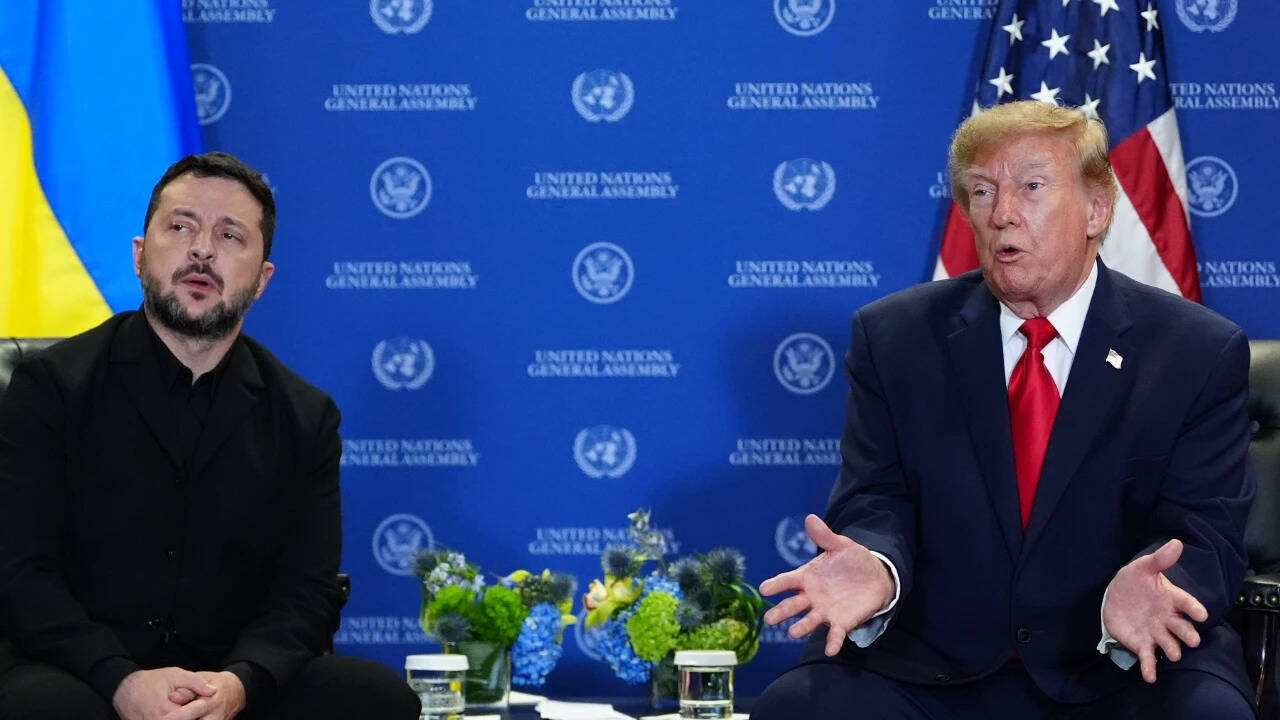
The headline runs on a continuous loop across every cable network and policy blog. Washington is threatening to pull the plug. Weapons shipments frozen. Intelligence feeds dark. All because Ukrainian drones hit Russian refineries, sending crude prices ticking upward ahead of an election cycle where inflation remains the political third rail.
The lazy consensus in every major newsroom is that the White House
Washington is Playing Monopoly While the Kremlin is Playing Chess In related updates, take a look at: Inside Daniel Kinahans High Stakes Court Battle and Bail Fight.
news, business
The conventional wisdom coming out of Washington is that withholding intelligence and munitions will finally force Kyiv to play nice and stop targeting Russian energy infrastructure. This is diplomatic malpractice disguised as strategy. The Washington Post has analyzed this critical subject in great detail.
For months, the mainstream press has peddled a lazy narrative: that striking Russian oil refineries and export terminals is a reckless escalation that risks global supply chains and invites uncontrollable retaliation. The policy establishment treats energy infrastructure as a sacred cow, assuming that the economic shockwaves of a constrained Russian oil supply outweigh the strategic necessity of degrading Moscow's war machine.
This is backward. It completely misreads the mechanics of modern commodity markets and the core drivers of attrition warfare.
The Flawed Logic of Energy De-escalation
Let us look at the underlying mechanics. When analysts argue that hitting refineries causes destabilizing price spikes, they ignore how localized and adaptable contemporary energy flows have become. Russia has spent the better part of two years rerouting its hydrocarbons to alternative buyers in Asia. Its primary revenue streams are no longer tethered exclusively to Western maritime insurance or European pipelines.
More importantly, treating energy nodes as off-limits creates a bizarre asymmetry. Moscow is permitted to systematically level civilian power grids, heating plants, and grain silos across Ukraine, yet Kyiv is expected to fight with one hand tied behind its back to appease Western anxieties about inflation ahead of an election cycle.
Threatening to cut off supplies over refinery strikes assumes that Ukraine is a client state with no agency of its own, entirely dependent on Western permission to survive. That dynamic might look clean on a whiteboard in the State Department, but on the ground in Donbas and Kyiv, it ignores the existential stakes. If a country is fighting for physical survival, self-preservation dictates that you dismantle the economic engine funding your destruction, regardless of what discomfort it causes petrol prices in Western capitals.
The Real Cost of Coercive Diplomacy
I have watched bureaucrats try to micro-manage high-stakes conflicts from conference rooms, assuming that aid can be turned on and off like a garden hose to dictate battlefield tactics. It never works.
When you withhold critical hardware and intelligence because your ally refuses to follow your tactical playbook, you do not achieve compliance. You achieve resentment and operational paralysis. You signal to the adversary that your resolve is brittle and that divisions within the coalition can be exploited.
The fear of high oil prices has paralyzed Western decision-making. But let us be entirely honest about the alternative. If Russia retains its export revenue unchecked, the war simply grinds on indefinitely, draining Western stockpiles through a slow bleed rather than a decisive outcome. Starving the Russian federal budget of petrodollars is the only mechanism capable of altering Moscow's long-term calculus. By demanding that Kyiv spare these facilities, Washington is inadvertently subsidizing the very war it claims it wants to end.
Rewriting the Playbook
The right question is never how to keep energy markets stable while a sovereign nation is being dismantled. The right question is how to maximize pressure on the aggressor's balance sheet before winter sets in again.
If Western policymakers spent half as much energy helping Ukraine scale domestic long-range strike capabilities as they do drafting stern diplomatic reprimands, the strategic landscape would look entirely different. Coercion only works when you offer a superior alternative. Telling a nation under bombardment to stop hitting the refineries that fund the missiles falling on its hospitals is not strategy. It is cowardice wrapped in diplomatic language.
Stop trying to manage a war you refuse to let your partners win.