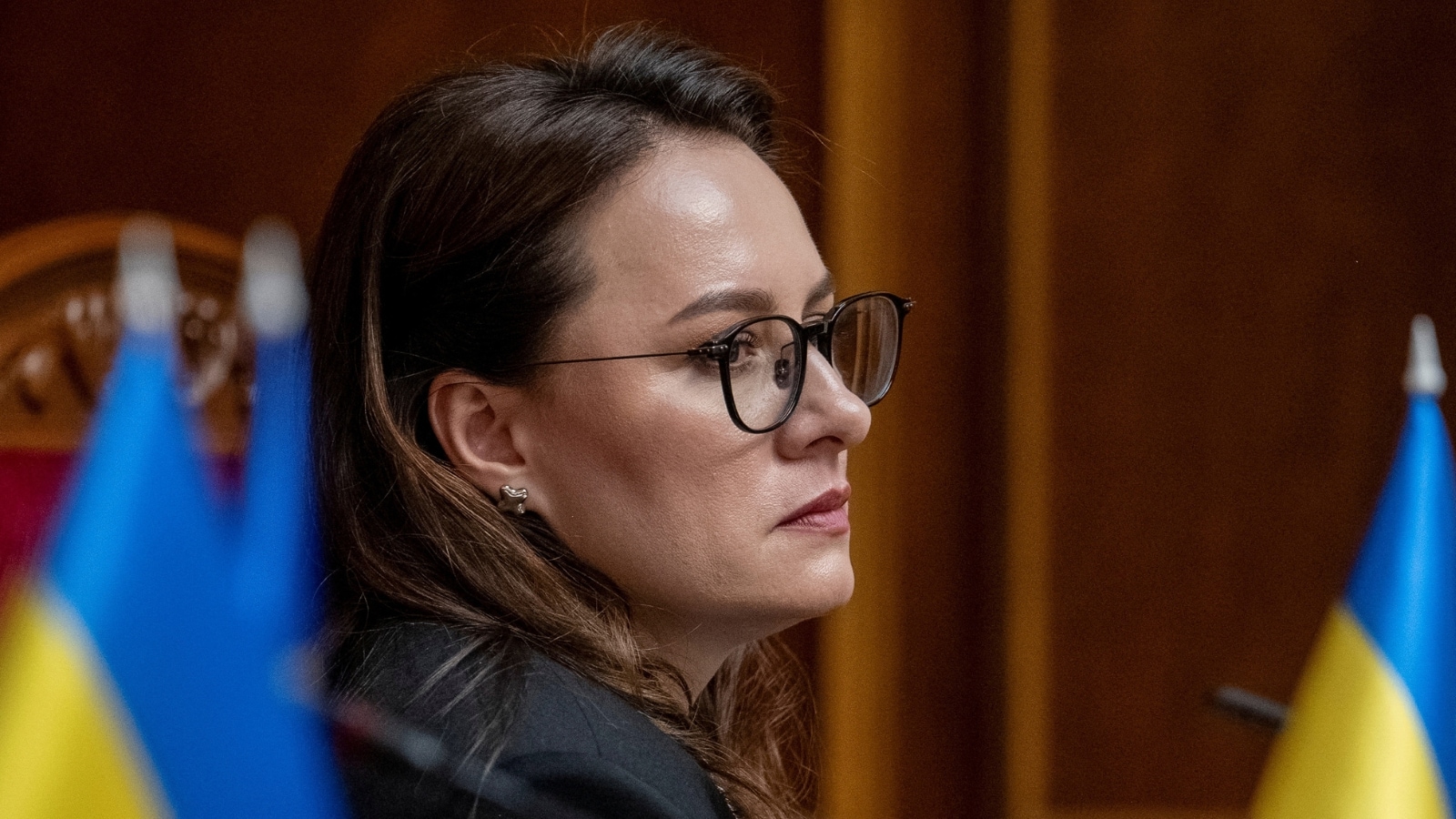
The resignation of Prime Minister Yulia Svyrydenko on July 14, 2026, and the subsequent automatic dissolution of her cabinet, exposes the structural friction of a highly centralized presidential system operating under indefinite martial law. While external commentators frequently interpret these executive-level rotations as signs of democratic renewal or course correction, a rigorous analysis of Ukraine’s executive dynamics suggests otherwise. Rather than addressing systemic vulnerabilities in wartime administration, the frequent replacement of prime ministers serves as a mechanism to absorb political friction, distribute accountability, and project momentum when democratic avenues—such as national elections—are constitutionally paused.
To understand the core drivers behind Svyrydenko’s departure after just under a year in office, one must move past the simplistic political theater and examine the rigid structural constraints that dictate the lifespan of a wartime prime minister in Kyiv. Under the current governance architecture, the office of the prime minister is caught in an institutional vise: tasked with managing an battered domestic economy and complex donor relations, yet deprived of the autonomous executive authority needed to implement long-term structural reforms without direct clearance from the Office of the President.
The Strategic Function of Cabinet Dissolution Under Martial Law
With national elections prohibited during wartime, the executive branch lacks the traditional feedback loops of democratic accountability. In this environment, cabinet reshuffles function as the primary valve for releasing political pressure. When public dissatisfaction rises due to infrastructure failures, economic stagnation, or systemic corruption, the prime minister acts as a constitutional shield for the presidency.
The operational lifespan of a wartime cabinet in Ukraine can be mapped using a structural cycle:
[Phase 1: Appointment & External Trust Building]
       │
       ▼
[Phase 2: Management of Systemic Shock (Winter/Energy/Mobilization)]
       │
       ▼
[Phase 3: Accumulation of Public & Donor Friction]
       │
       ▼
[Phase 4: Sacrificial Reshuffle & Reset of the Clock]
Svyrydenko's tenure followed this cycle precisely. Appointed in July 2025 after playing a lead role in securing a critical mineral agreement with the United States, her initial objective was to formalize economic ties that bound Western material interests to Ukraine’s security. However, as the cabinet confronted the realities of a brutal winter marked by severe power and heat shortages, the limits of technocratic management became apparent.
By dismissing the prime minister, the administration resets the clock on public expectations. It signals to domestic constituencies and international donors that a "new political strategy" is underway, without requiring a fundamental reallocation of decision-making power away from the centralized core at Bankova.
The Three Structural Constraints of the Wartime Cabinet
An objective assessment of Svyrydenko’s term reveals that her government was bound by three structural bottlenecks that no executive rotation can easily resolve.
1. The Energy and Infrastructure Vulnerability Trap
The primary domestic metric of success for any Ukrainian prime minister during this war is infrastructure resilience. Svyrydenko's government was forced to manage an energy network under continuous, systematic bombardment.
- The Accountability Gap: While the central government manages macroeconomic stability, the physical defense and restoration of municipal infrastructure rely on a decentralized network of local authorities. When winter outages sparked nationwide frustration, the presidency shifted blame downward, targeting local officials such as Kyiv Mayor Vitali Klitschko. Yet, the prime minister remains the public face of the state's economic coordination, bearing the reputational cost of systemic energy deficits.
- The Resource Mismatch: The cost of defending and rebuilding transmission lines and generation capacity vastly exceeds the domestic revenue-generation capacity of the Ukrainian state. Because the state budget is heavily subsidized by foreign aid, any delay in donor disbursements directly impacts the speed of grid stabilization.
2. The Anti-Corruption and Donor Leverage Dilemma
A key point of friction that accelerated the cabinet’s dismissal was a series of high-level corruption scandals. Although Svyrydenko herself was not implicated, her administration was accused by opposition lawmakers of failing to execute deep institutional cleanups.
This dynamic exposes a fundamental tension in wartime governance. International donors, including the European Union and the International Monetary Fund (IMF), have conditioned their financial support on strict anti-corruption benchmarks. In 2026, this pressure culminated in the opening of the first EU accession negotiation cluster and the securing of a 90-billion-euro loan package.
To maintain this vital lifeline, the Prime Minister must satisfy Western demands for institutional transparency. However, executing thorough anti-corruption investigations often disrupts internal political alliances that are vital for maintaining domestic stability and war-mobilization efforts. The Prime Minister is therefore caught between two opposing forces: donor demands for immediate, structural sanitization and the internal political necessity of maintaining elite cohesion.
3. The Limits of Executive Centralization
Svyrydenko’s appointment in 2025 was widely viewed by domestic analysts as an extension of the influence of Andriy Yermak, the head of the Presidential Office. This relationship highlights a broader administrative reality: the centers of actual executive authority in wartime Ukraine do not align with the formal constitutional hierarchy.
Constitutional power is concentrated within the presidential administration, leaving the cabinet of ministers to function primarily as an executing body rather than a policymaking entity. This arrangement was highly effective during the initial phase of the full-scale invasion, when rapid, top-down command structures were necessary to prevent state collapse.
In a protracted war, this high level of centralization creates operational bottlenecks. Professional civil servants and ministers are hesitant to make critical decisions without explicit approval from the presidential office, slowing down administrative reaction times. When ministers are viewed as political instruments rather than independent actors, institutional continuity suffers. The constant recycling of personnel—such as former Prime Minister Denys Shmyhal stepping down to become defense minister and then energy minister—demonstrates a preference for political reliability over specialized expertise, which ultimately limits the growth of a professional managerial class.
The Strategic Path for the Next Administration
As parliament prepares to vote on a successor, with Serhii Koretskyi, the current CEO of state energy firm Naftogaz, emerged as a leading candidate, the strategic priorities for the incoming cabinet are clear. To break the cycle of short-lived, reactive cabinets, the new administration must shift from a posture of crisis management to one of institutional institutionalization.
First, the incoming prime minister must negotiate a clear delegation of authority from the Office of the President. Without the autonomy to make rapid fiscal and administrative decisions, the next cabinet will face the same bottlenecks that paralyzed its predecessor ahead of the coming winter.
Second, the government must prioritize the physical decentralization of the energy sector. Replacing large, vulnerable thermal power plants with a distributed network of smaller, gas-turbine generation units is a technical and security necessity. Koretskyi’s potential appointment suggests an understanding of this reality, given his background in state-owned energy infrastructure.
Third, the administration must depoliticize its anti-corruption efforts. Rather than reacting to scandals after they occur to appease donors, the cabinet needs to strengthen independent investigative bodies like the National Anti-Corruption Bureau (NABU) and ensure they are insulated from political interference.
Ultimately, the true measure of the next government's success will not be the elegance of its reform presentations or the frequency of its international conferences. It will be whether the new prime minister can secure the institutional independence required to govern effectively, or whether they will simply become the next political shock absorber in an increasingly centralized state.