Static.
Before the glow of the plasma screen, before the algorithmic hum of the modern feed, there was only the hiss of vacuum tubes and the amber dial of a radio receiver. Families gathered in the flickering shadow of living rooms not to stream, not to scroll, but to listen. They tuned in by the millions. They listened to a man in a black cassock who spoke with the cadence of a poet and the piercing clarity of a courtroom prosecutor.
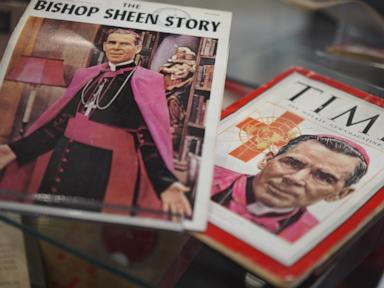
His name was Fulton J. Sheen.
Decades have passed since his voice faded from the airwaves, yet the echo of that voice still reverberates through the American spiritual consciousness. Now, that echo is drawing toward a quiet, monumental destination: beatification in St. Louis. For those who study the strange, winding pathways of history, this is not merely a bureaucratic milestone within the Vatican. It is a cultural reckoning. It asks a restless generation what happens when a public figure speaks with conviction rather than calculation.
Imagine sitting in a cramped Brooklyn apartment in 1952. The coal stove is ticking. Outside, the winter wind rattles the double-hung windows. Inside, the television set—a heavy, mahogany-cased monolith—takes three full minutes for the tubes to warm up. When the picture finally blooms into grainy black and white, there is a man pacing a stage. He holds no notes. He has no teleprompter. He simply looks directly into the glass eye of the camera, smiles a slightly disarming smile, and says, "Welcome."
That man was Fulton Sheen, holding an audience of thirty million viewers hostage every single week. Protestants, Catholics, Jews, and the fiercely secular tuned in to Life Is Worth Living. He competed against Milton Berle, television’s reigning monarch of comedy, and routinely matched him in the ratings. Berle famously joked, "My show has a bigger cast, but Sheen has God on his side."
Behind the polished television persona, however, lay a relentless ascetic. Sheen rose at dawn, spent hours prostrate in prayer on hardwood floors, and gave away nearly every penny of the astronomical royalties and speaking fees he earned. He drove himself to exhaustion. He viewed his media platform not as an empire to be built, but as a battlefield for human souls.
To understand why his impending beatification matters—why thousands will flood the streets of St. Louis to witness a ceremony rooted in ancient tradition—we have to look at the modern landscape of public discourse. Today, we are drowning in noise. Everyone has a megaphone, but few have a message. Communication has become transactional, clipped down to fifteen-second clips and performative outrage.
Sheen operated differently. He possessed an uncanny ability to translate profound theological mysteries into the everyday language of the working class. He spoke about anxiety before psychiatry had a vocabulary for it. He warned about the spiritual vacuum of hyper-materialism long before consumer capitalism consumed our identities.
Consider a hypothetical afternoon in Peoria, Illinois, where Sheen was born in 1895 as Peter Fulton Sheen. A small boy, frail and perpetually sick, sits on the porch watching the freight trains rumble past. He does not know he will one day stand before popes, presidents, and millions of unseen faces. He only knows the ache of ordinary life. That grounded Midwestern upbringing never left him. Even when he wore the crimson robes of an archbishop, walking the marble corridors of Rome, he retained the pragmatic directness of a farm boy from the Illinois cornfields.
Beatification is the final procedural ridge before canonization, the formal declaration by the Catholic Church that a deceased person lived a life of heroic virtue and is now in heaven, capable of interceding for those who pray. To reach this point requires more than fond memories or historical nostalgia. It requires a miracle.
The Church does not rush this process. The Vatican’s Congregation for the Causes of Saints operates with an almost excruciating meticulousness. Every sermon, every letter, every casual remark written or spoken by the candidate is scrutinized by skeptical theologians known historically as advocatus diaboli—the devil's advocates. They dig for flaws. They look for hypocrisy, pride, or cruelty.
For Fulton Sheen, the journey has been uniquely turbulent. Bureaucratic delays, jurisdictional disputes, and the complex politics of ecclesiastical memory have repeatedly threatened to stall his cause. For years, his remains sat in St. Patrick’s Cathedral in New York, while his native diocese in Peoria fought a protracted legal battle to bring him home. It was a messy, very human conflict over the bones of a holy man.
Yet, the momentum could not be stopped. The groundswell of devotion came not from corporate PR campaigns, but from ordinary people. Nurses who prayed to him during grueling night shifts. Addicts who found sobriety through his writings. Priests who looked to his fierce intellectual integrity as an anchor in stormy times.
When the news broke that St. Louis would host the beatification, a quiet tremor went through the community of those who still value the old virtues of discipline, eloquence, and sacrifice. St. Louis holds a special resonance in the geography of American Catholicism, bridging the industrial Midwest with the sprawling American South. It is a fitting crossroads for a man who spent his life trying to bridge the gap between heaven and earth.
What does it actually mean for a twentieth-century television pioneer to be declared blessed in the twenty-first century?
It forces us to confront an uncomfortable truth. We live in an era that worships authenticity, yet we have engineered a society where nearly every interaction is curated, filtered, and monetized. Fulton Sheen was theatrical, yes. He used sweeping hand gestures and dramatic pauses. But his performance served a reality outside of himself. He did not ask his audience to look at him; he asked them to look past him, toward an infinite horizon.
He once wrote that every heart has a vacuum that only the infinite can fill. In an age of relentless scrolling, endless optimization, and hollow digital connectivity, that diagnosis feels more urgent than ever. We have filled our lives with screens, yet we are lonelier than our grandparents were when they huddled around those glowing glass tubes in 1952.
The ceremony in St. Louis will feature ancient hymns, Latin chants, and bishops in heavy vestments. Cameras will stream it live to smartphones across the globe. The irony would not be lost on Sheen, who embraced the media technologies of his day with open arms, viewing television as a modern pulpit waiting to be claimed.
As the incense rises beneath the grand arches of the cathedral, the crowd will quiet. A decree will be read. A new title will be bestowed.
But the true significance of the day does not lie in the Vatican decrees or the press releases. It lives in the quiet realization that integrity still matters. It lives in the memory of a lone man standing before a camera, pointing into the dark, and whispering across the decades that your life has a purpose you did not invent and cannot destroy.
The static clears. The voice remains.


