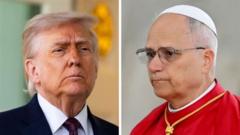
The long-simmering friction between the White House and the Holy See has finally boiled over into a public, scorched-earth confrontation that defies traditional diplomatic protocol. Donald Trump’s recent tirades against Pope Leo XIV—the first American-born pontiff—mark a definitive rupture in the historically cautious relationship between U.S. presidents and the Vatican. By labeling the Pope "terrible on foreign policy" and "weak on crime" following the Church’s condemnation of the U.S.-Israeli military campaign in Iran, Trump has moved beyond mere policy disagreement. He is now actively challenging the Pope’s legitimacy and moral authority in a gamble to retain his grip on the Catholic voting bloc.
This is not a simple misunderstanding. It is a calculated collision between two men who believe they hold an exclusive mandate to lead.
The Myth of the American Pope
When Leo XIV was elected in May 2025, many in the Trump administration viewed it as a strategic win. The assumption was that an American pontiff would inherently understand the nuances of "America First" nationalism. That was a catastrophic misreading of the institution. The Vatican operates on a timeline of centuries, not election cycles. Leo XIV’s background in the American Midwest did not make him an ally of Washington; it made him uniquely equipped to dismantle the specific brand of Christian nationalism that Trump has cultivated.
The current rift centers on the moral legitimacy of the conflict in Iran. While the administration frames the war as a necessary defense of Western civilization, the Pope has characterized it as an "atrocious" display of power. Trump’s reaction—claiming the Church only installed an American Pope to "deal" with him—suggests a deep-seated frustration that he cannot co-opt the Papacy into his political narrative.
Blasphemy as a Political Tool
Perhaps the most jarring escalation occurred on Truth Social, where Trump posted an AI-generated image depicting himself in a Christ-like role. The imagery, showing the President in robes laying hands on the sick, appeared less than an hour after he attacked the Pope. To a secular audience, this might seem like standard social media bluster. To the Vatican and serious theologians, it is viewed as "stark heresy."
Prominent Catholic figures, including Bishop Robert Barron and Cardinal Joseph Tobin, have broken their usual silence to condemn the post. They see it as a "messianic complex" that threatens the fundamental separation between the sacred and the profane. Trump’s subsequent defense—that the image represented him as a "doctor" rather than a deity—has done little to soothe the anger of the clergy. By positioning himself as a spiritual alternative to the Pope, Trump is forcing American Catholics to choose between their partisan identity and their religious hierarchy.
The Fracturing of the Catholic Vote
For decades, the Republican party has relied on a "fusionist" strategy, bringing together fiscal conservatives and religious voters on issues like abortion. But the 2026 landscape is different. Leo XIV is not Pope Francis; he has been described as bringing "doctrinal clarity" that appeals to conservatives. Yet, his unwavering stance on the "inhuman treatment" of migrants and the "idolatry of power" creates a paradox for the Catholic right.
- The Nationalist Faction: These voters prioritize border security and economic protectionism, often viewing the Vatican's globalist perspective as out of touch with American reality.
- The Traditionalist Faction: These voters are deeply loyal to the Papacy but are increasingly alienated by Trump’s use of sacred imagery for political theater.
- The Moderate Middle: These are the voters Elise Ann Allen, a papal biographer, warns could be "further alienated" by outbursts that target the person of the Pope rather than just his policies.
A New Era of Secular Defiance
The Pope’s response to these attacks has been uncharacteristically blunt. "I have no fear of the Trump administration," he told reporters. This lack of deference is the real story. In the past, the Vatican might have worked through backchannels or issued vaguely worded statements via the Secretariat of State. Leo XIV is choosing to engage directly in the public square.
This standoff reveals a broader truth about modern power. The Trump administration is betting that personal brand loyalty is stronger than institutional religious loyalty. They are testing whether the "moral voice" of the Church still carries weight in a polarized digital age where an AI-generated image can travel further than a Papal Encyclical.
The White House’s insistence that the Pope should "focus on being a Great Pope, not a Politician" ignores the history of the office. The Papacy has been a political actor since the fall of Rome. What has changed is the refusal of the secular leader to pretend otherwise. By treating the Pope as just another "liberal" rival, Trump has stripped away the last vestiges of the "sacred" in American political discourse.
The Strategy of Discreditation
By suggesting the Pope was "illegitimately elected," Trump is applying the same playbook used against his domestic political opponents. If the arbiter of morality can be framed as a partisan hack, then their moral judgments no longer have to be reckoned with. This tactic effectively shields the administration's base from the ethical critiques coming from Rome.
However, this strategy carries a long-term risk. The Catholic Church remains one of the few truly global institutions with the infrastructure to provide a counter-narrative to state-led information. If the President continues to alienate the leadership of the 1.3 billion-strong Church, he may find himself isolated on the world stage, with even traditional allies like Italian Premier Giorgia Meloni forced to pick sides.
The friction is no longer about immigration or climate change; it is about who has the final say on the "moral dimensions of global affairs." Trump wants that authority to reside in the Oval Office. Leo XIV insists it belongs to the Gospel. There is no middle ground in this conflict, and the abruptness of the President's attacks suggests he knows the clock is ticking on his ability to define the terms of the debate.
Stop looking for a diplomatic "off-ramp." Both sides have decided that the only way forward is through.