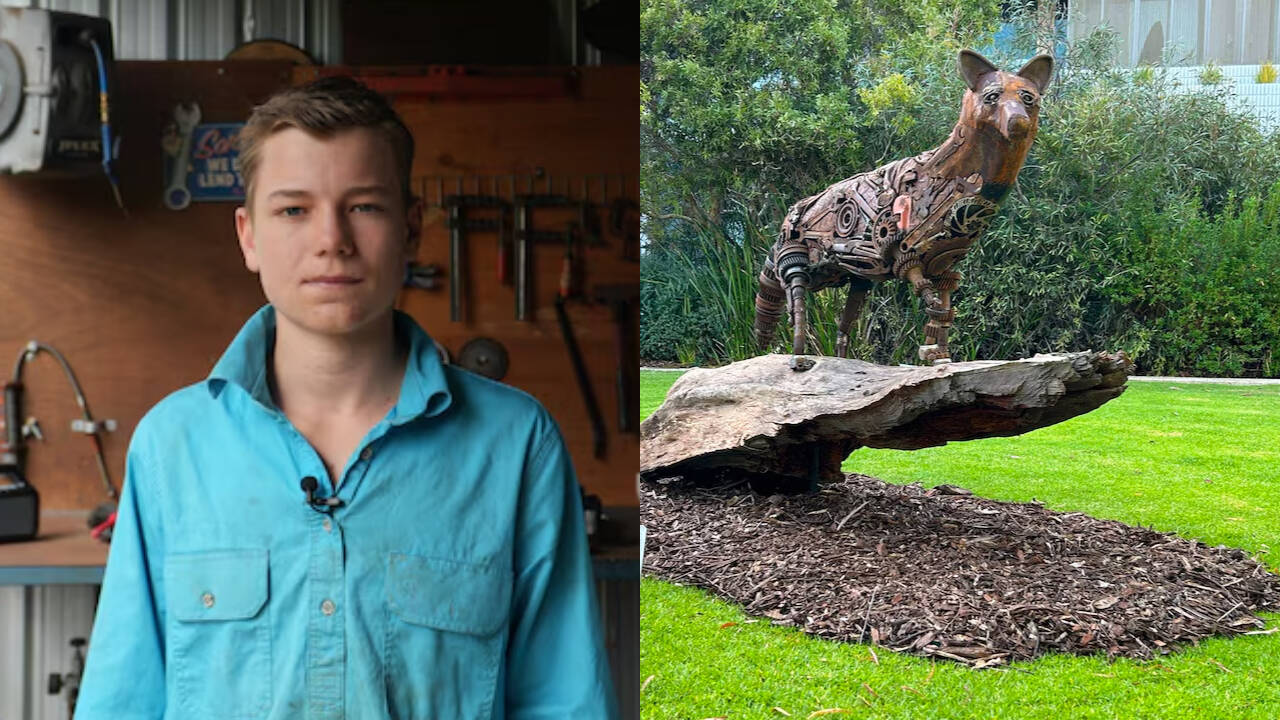
Every few months, the internet finds a teenager welding spark plugs into a velociraptor and loses its collective mind. The headlines write themselves: Fourteen-year-old prodigy turns trash into eight-thousand-dollar masterpieces. The narrative is engineered for maximum algorithmic dopamine. It strokes our collective desire for meritocracy, proving that raw, unpolished youth can bypass the gatekeepers and strike gold with a MIG welder and a pile of rusted mufflers.
It is a comforting fairy tale. And it is entirely destroying how we understand value in the arts.
When media outlets slap an eight-thousand-dollar price tag on a kid's scrap metal sculpture, they are not evaluating art. They are exploiting a human-interest novelty act. They are pricing the biography, not the object. If you strip away the birth certificate, the homeschooled background story, and the heartwarming local news segment, that scrap metal critter sitting on a gallery floor is worth the price of its scrap weight plus a modest hourly wage for fabrication.
I have watched blue-chip galleries and cynical collectors fawn over amateur welds that would fail a basic high school shop class, simply because the maker is young enough to still need a permission slip for a field trip. This is not patronage. It is patronizing.
Let us look at the mechanics of how we price physical creation.
The Cost Plus Fallacy in Material Recycling
The lazy consensus in the art and design world states that if you take discarded junk and elevate it into a recognizable shape, the value of the finished piece equals the labor hours multiplied by an arbitrary master craftsman rate, plus the shock value of the transformation.
That math is broken.
Take a standard ten-millimeter wrench, a couple of bent exhaust pipes, and a rusty bicycle chain. Weld them together into an owl. To the untrained eye, it looks complex. To anyone who has spent a week in an industrial machine shop, it is an exercise in poor joint preparation and excessive wire feed.
True material transformation requires metallurgical understanding, structural integrity, and intentional design language. Most viral teen metal art relies on what I call the gluestick effect of heavy-handed welding: hiding weak mechanical connections under massive blobs of filler metal and calling it "raw industrial aesthetic."
When you tell the public that an eight-thousand-dollar valuation is normal for a beginner's first dozen pieces, you create a distorted market reality. You teach young creators that novelty outranks mastery. You incentivize them to scale up production before they have even mastered basic thermal expansion, grinding safety, or load distribution.
Imagine a scenario where a seasoned fabricator spends twenty years perfecting the art of shaping high-tensile steel into fluid, aerodynamic forms—pieces that require hydraulic presses, English wheels, and precise heat treatments—struggling to clear three thousand dollars per piece because they lack a viral human-interest hook. That is the actual state of the contemporary metal arts market. It rewards the PR hook over the physical execution.
Why the Eight-Thousand-Dollar Figure is a Marketing Fiction
Let us talk about the economics of that eight-thousand-dollar price tag. Who is actually paying it?
Rarely is it hardened fine-art collectors with deep portfolios of contemporary sculpture. It is almost always local patrons, corporate sponsors looking for a cheap PR halo, or well-meaning family friends who want to cement the kid's prodigy status. It is a closed-loop economy of sentimentality.
Real art markets are brutal. They run on provenance, institutional validation, secondary market liquidity, and critical discourse. When a piece of art is priced based on how many heart emojis it generated on a morning talk show Facebook page, it possesses zero secondary market liquidity. Try walking that welded owl into a Sotheby's contemporary auction house ten years from now. You will be laughed out of the room by an appraiser who evaluates work based on art history, not Instagram shares.
This brings us to the uncomfortable truth about prodigy culture. We love manufacturing prodigies because it absolves the rest of us from doing the hard work of sustained, grinding practice. If talent is an innate lightning strike that hits a fourteen-year-old in a backyard shed, then mastery is easy to witness and consume from a smartphone screen.
It requires zero effort from the viewer. You click, you marvel, you share, and you move on.
The Unseen Damage of Viral Validation
What happens to the fourteen-year-old prodigy when they turn nineteen?
The novelty wears off. The media caravan packs up and moves on to a twelve-year-old coding prodigy or a ten-year-old chess grandmaster. Suddenly, the artist is no longer competing against the charm of their own youth; they are competing against adults with decades of technical refinement, conceptual depth, and anatomical precision.
Because they were told their early, structurally flawed work was worth eight grand, they never developed the psychological resilience required for the brutal middle phase of artistic development: the plateau.
The plateau is where real artists live. It is the agonizing decade where your technical execution finally catches up to your taste, and the gap between them makes you want to throw your tools in the dumpster. If you sell your first crude attempts for thousands of dollars, you short-circuit that evolution. You lock yourself into a style before you have even figured out what you actually want to say.
How to Actually Evaluate Metal Sculpture
If you want to look at recycled metal art through a lens that isn't clouded by viral sentimentality, strip away the biography. Ask three hard questions.
First, look at the joints. Is the weld structural and clean, or is it a mountainous pile of slag designed to hide a bad fit-up? If you drop the piece from three feet, will it shatter into a pile of loose hardware?
Second, examine the silhouette. Does the use of scrap materials serve the form, or is the material choice a gimmick? If you painted the entire sculpture matte black, would the anatomical proportions still communicate power and motion, or is it entirely reliant on the viewer recognizing a recognizable tool welded onto a knee joint?
Third, interrogate the concept. Is it an imitation of nature rendered in heavy metal, or is it a true subversion of the industrial objects used to build it?
We do creators no favors by dressing up amateur hobbyism as high-end fine art. True respect means holding young creators to the exact same rigorous standard we apply to veteran sculptors.
Stop buying the biography. Start looking at the art.