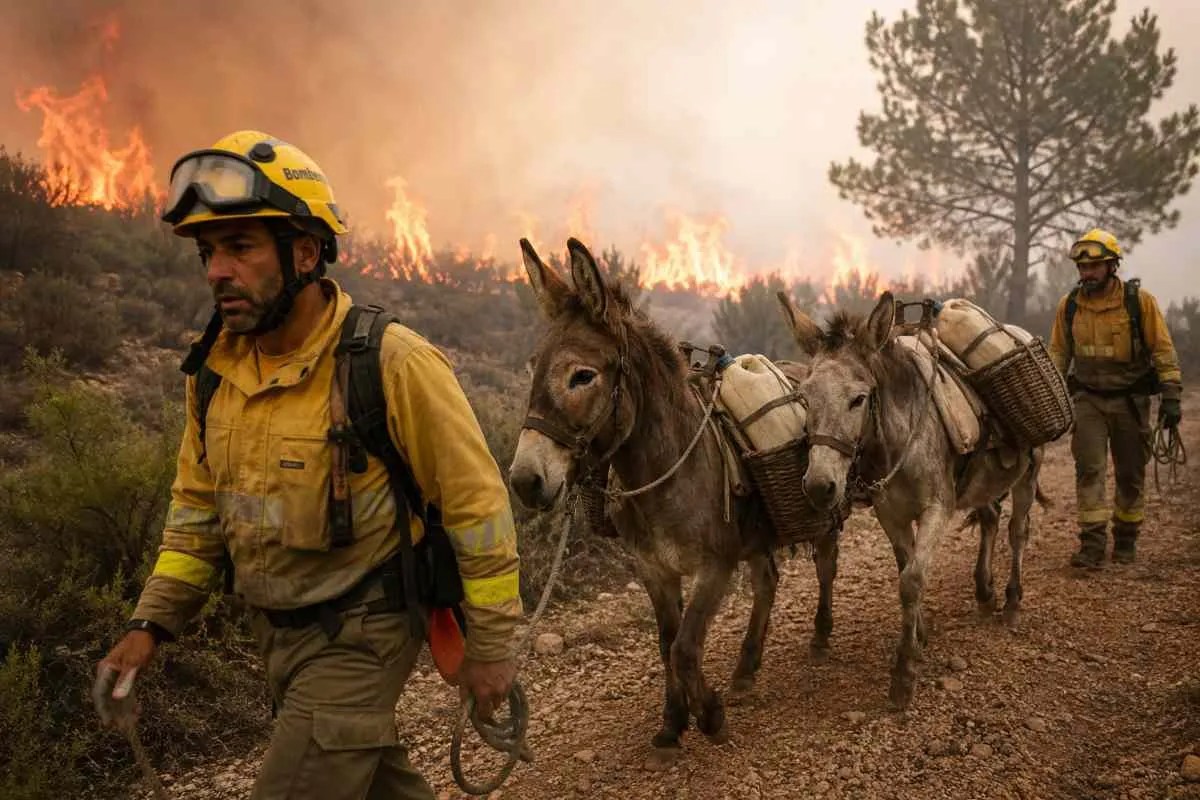
Smoke tastes like old pennies and burnt pine. Anyone who has lived through a summer where the horizon turns the bruised color of a plum knows that taste. It settles on the back of your tongue hours before the flames actually crest the ridge. It stays for days, a greasy reminder that everything you own, everything you built, and everyone you love is separated from ash by sheer, stubborn luck.
We spend billions on the spectacle of modern firefighting. High-flying tankers roar across the sky, dropping red chemical sludge over burning canyons. Heavy machinery cuts raw gashes through ancient forests. Sirens shriek through valleys. Yet, some of the most effective defense against runaway infernos does not roar. It brays.
Step back from the roaring firelines for a moment. Look not at the catastrophe, but at the prevention.
Long before a spark catches dry brush, the battle is won or lost in the quiet margins of the land. It is won in the spaces where vegetation is managed, where fuel loads are trimmed down to the bone. For generations, traditional land managers understood a fundamental truth: you do not fight fire with water alone. You fight it with hunger. If there is nothing to burn, the fire stops. Simple. Brutal. Effective.
Enter the humble donkey.
To modern eyes, conditioned to expect high-tech solutions for high-tech disasters, employing donkeys as fire prevention agents sounds like a joke. A punchline from a folk tale. But ask anyone who manages rugged, inaccessible terrain in parts of Europe and Asia where traditional pastoralism still breathes, and they will tell you a very different story. These animals are living, breathing ecological firebreaks.
Consider what happens next: A wildfire needs a continuous carpet of dry grass, low scrub, and fallen timber to race up a hillside. Break that carpet, and the monster starves.
Goats are famous for their voracious appetites, but goats are fickle. They prefer tender leaves, high shoots, woody browse. Donkeys operate differently. They are biological lawnmowers with a singular, relentless focus. They eat the coarse, dry, highly flammable grasses and weeds that other livestock snub. They strip down the very fine fuels—the kindling layer—that ignite from a single stray spark and carry a wall of fire across miles in minutes.
(Note: While this reads like a novel strategy to urban centers, in many rural agricultural communities, grazing livestock as a wildfire mitigation tool is a time-tested, ancient practice experiencing a necessary modern revival.)
There is a quiet dignity to a donkey standing on a dry ridge at dawn. Dust kicks up from under heavy hooves. Ears twitch against the morning flies. They do not care about the politics of climate change or municipal budgets. They only care about the next patch of dry yellow grass. And so they eat. Methodically. Day after day.
By the time the high heat of midsummer arrives, the landscape has changed. Where there was once a continuous ocean of tinder, there are patches of bare earth and cropped stubble. A wall of flames racing up a canyon hits this managed zone and loses its momentum. It stumbles. It chokes on the lack of fuel.
We forget that nature often provides the answers to the problems we engineer for ourselves. We try to pave, spray, and bulldoze our way out of ecological crises, only to find that nature fights back with interest. Fire is not an invader. It is a natural process made monstrous by our suppression of the small, manageable burns and our neglect of the land's floor.
When you watch a donkey navigate a sheer, rocky cliffside where no tractor could ever climb, you realize the genius of the arrangement. They go where machines cannot. They consume what chemical weed killers leave behind as toxic residue. They fertilize the soil as they work, keeping the ecosystem alive rather than sterilizing it.
The heat rises again. The wind shifts. Somewhere out there, deep in the tinder-dry brush, a dry branch snaps under its own weight. A spark catches. The ancient war begins anew.
On a quiet hill miles away, a grey donkey lifts its head, smells the distant shift in the air, and calmly takes another bite.